Showing posts with label mitigation. Show all posts

Sunday, February 19, 2023

Tree Planting Project at the Hardy Veritree Carbon Plantation (2022)

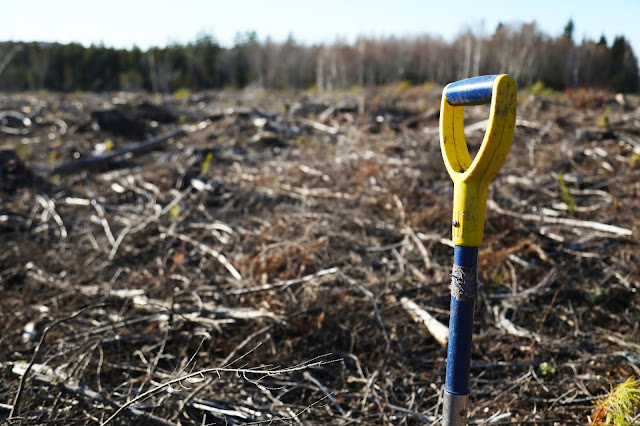
Here's a post to share some info about another carbon sequestration project that we completed on behalf of one of our Sponsor Partners.  The tree planting work on this site in southeastern New Brunswick was done in the Fall of 2022.  The work was done at a large site just west of Hardy, which is on Route 16.  The planting on this site was entirely sponsored by Veritree.


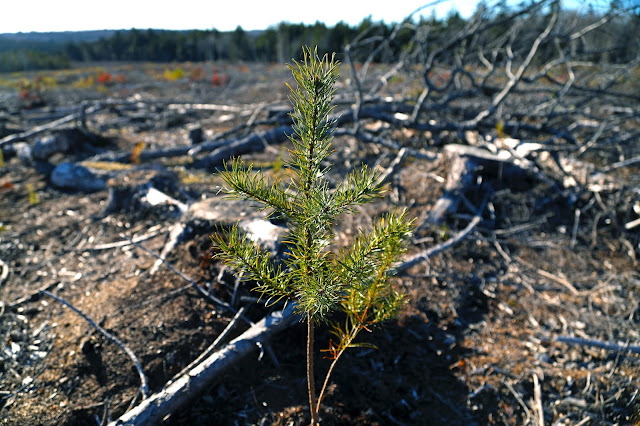
This site was harvested relatively recently, by a third party, and our goal was to rebuild a new forest there.  The site is large, and this might be a great site for a public park in the future.  Here's a link showing the approximate location of this project:


Note that this site is NOT the same Timber River Demonstration Forest site that we have already been managing for approximately fifteen years, although it's very close to that site.  The GPS coordinates at the south end of this year's site are:  46.071211, -64.042194


The primary purpose of this project was to support climate stability through carbon sequestration.  As a side benefit, this site will support biodiversity and wildlife habitat.

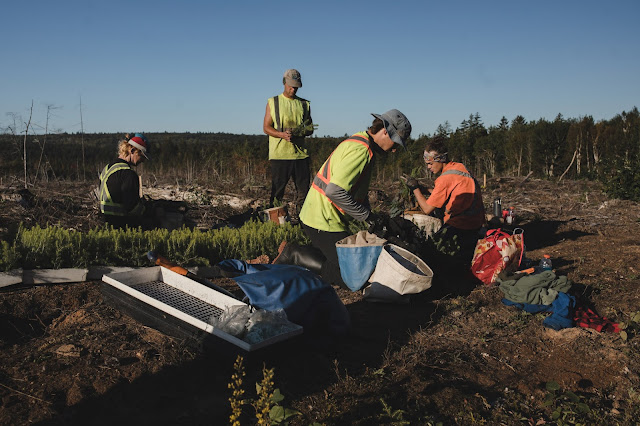
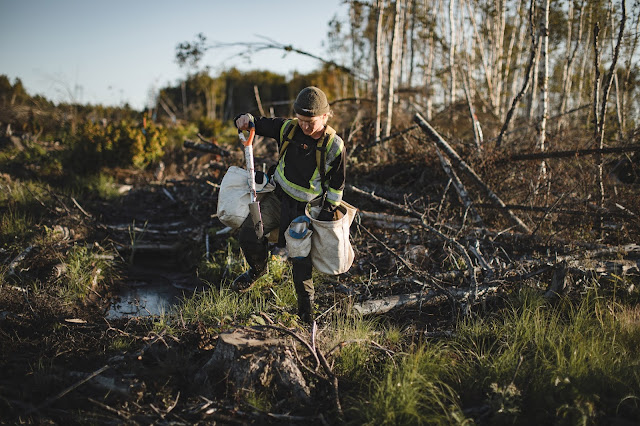
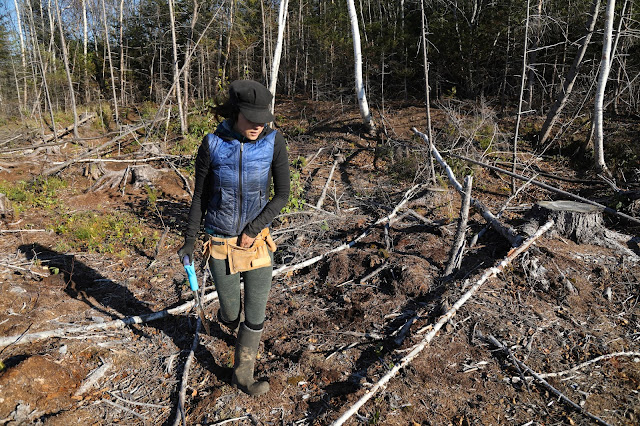
In total, the planting team added 208,225 coniferous seedlings on this site (which covers 252.1 acres, with seven distinct open areas).  The site also shows significant evidence of natural regeneration of white birch, red maple, yellow birch, and other hardwoods and soft deciduous.  Diverse forests are healthy forests.

Here are a few more photos taken during the planting of this project, which took place in September and October of 2022:


We look forward to studying this site in the coming years.  We will be doing periodic surveys to assess the carbon capture progress of the new forest.

Again, a huge thanks to Veritree, the sponsors and lead on this major project.

You can see several dozen additional photos of the work on this planting site by visiting our public 2022 Planting Photos folder on Dropbox (go into the "Hardy Veritree Carbon Plantation" sub-folder).


Thanks for reading!

- Jonathan Clark


Replant.ca Environmental is a Canadian company that plants trees for carbon capture and builds community forests.  We also plant trees in national, provincial, and municipal public parks to mitigate damage from wildfires, storms, insects, and forest diseases.  We operate thanks to numerous small contributions from the general public, in addition to larger project sponsorships from businesses and corporations around the world.  If you'd like to learn how to show your support, visit our donations page.  Even if you aren't able to make a contribution, we very much appreciate when people are able to share our posts or our website link on social media, to help spread the word about the work that we're doing!

To learn more about the various species that we plant, visit the conifers page or the deciduous (hardwoods) page on our website.  Thanks so much for your interest!

Incidentally, our organization is often seeking additional land for our carbon capture projects.  Please visit this link if you might know of a recently-harvested property that we could rebuild into a permanent legacy forest.


Saturday, February 18, 2023

Tree Planting Project at the Cormier Road Carbon Plantation (2022)

Here's a post to share some info about another carbon sequestration project.  The tree planting work on this site in southeastern New Brunswick was done in the fall of 2022.  The work was done at a site in Botsford Portage, to the east of Cormier Village.  This site is also very close to Route 15.  This project was designed and implemented under the direction of the Sustainable Resource Corporation.


This site was formerly owned privately by a third party, and that landowner harvested the wood a few years ago.  We were able to acquire the property after it was harvested, on behalf of our Client (SRC), then we designed a plan to turn it into a carbon capture plantation to help mitigate climate change.  SRC will never allow it to be harvested again.  Here's a map showing where the property is located, adjacent to Chemin Cormier (Cormier Road):


The GPS coordinates at the entrance to this site are:  46.18821, -64.25338


The primary purpose of this project was to support climate stability through carbon sequestration.  As a side benefit, this site will support biodiversity and wildlife habitat.

In total, the planting team added 32,086 coniferous seedlings on this site (three species).  In addition to our planted trees, this site already shows evidence of some natural regeneration of white birch, red maple, yellow birch, sugar maple, and balsam fir.  Diverse forests are healthy forests.

Here are a few more photos taken during the planting of this project, which took place in September and October of 2022.  As the site had been harvested almost three years ago, quite a lot of low-value brush was present, so this was a particularly challenging site for the planting team:


We look forward to studying this site in the coming years.  We will be doing periodic surveys to assess the carbon capture progress of the new forest.

We were very pleased to act as a supply partner to SRC on this project, doing the boots-on-the-ground tree planting work while they approved the project design and provided the financial support.

You can see several dozen additional photos of the work on this planting site by visiting our public 2022 Planting Photos folder on Dropbox (go into the "Cormier Road Carbon Plantation" sub-folder).


Thanks for reading!

- Jonathan Clark


Replant.ca Environmental is a Canadian company that plants trees for carbon capture and builds community forests.  We also plant trees in national, provincial, and municipal public parks to mitigate damage from wildfires, storms, insects, and forest diseases.  We operate thanks to numerous small contributions from the general public, in addition to larger project sponsorships from businesses and corporations around the world.  If you'd like to learn how to show your support, visit our donations page.  Even if you aren't able to make a contribution, we very much appreciate when people are able to share our posts or our website link on social media, to help spread the word about the work that we're doing!

To learn more about the various species that we plant, visit the conifers page or the deciduous (hardwoods) page on our website.  Thanks so much for your interest!

Incidentally, our organization is often seeking additional land for our carbon capture projects.  Please visit this link if you might know of a recently-harvested property that we could rebuild into a permanent legacy forest.


Tree Planting Project at the Shemogue Carbon Plantation (2022)

Here's a post to share some info about another of our carbon sequestration projects.  The tree planting work on this site in southeastern New Brunswick was done in the spring of 2022.  The work was done at a site slightly to the south of Route 15, a few kilometers from the village of Shemogue.  From this site, the Shemogue wind turbine is quite visible just to the northwest.


This site was formerly owned privately by a third party, and that landowner harvested the wood recently.  We were able to acquire the property after it was harvested, then designed a plan to turn it into an environmental project to help mitigate climate change (we will never allow it to be harvested again).  Based on the site characteristics, we decided that this particular property should be part of our group of carbon capture plantations.


The GPS coordinates at the center of this site are:  46.16685, -64.22996


The primary purpose of this project was to support climate stability through carbon sequestration.  As a side benefit, this site will support biodiversity and wildlife habitat.

In total, the planting team added 74,800 coniferous seedlings on this site.  Although the site already shows some evidence of natural regeneration of white birch, red maple, yellow birch, and other hardwoods, we plan to enhance the mix of deciduous species on this site in the near future, as availability permits.  Diverse forests are healthy forests.

Here are a few more photos taken during the planting of this project, which took place in April and May 2022:


We look forward to studying this site in the coming years.  We will be doing periodic surveys to assess the carbon capture progress of the new forest.

You can see several dozen additional photos of the work on this planting site by visiting our public 2022 Planting Photos folder on Dropbox (go into the "Shemogue Carbon Plantation" sub-folder).


Thanks for reading!

- Jonathan Clark


Replant.ca Environmental is a Canadian company that plants trees for carbon capture and builds community forests.  We also plant trees in national, provincial, and municipal public parks to mitigate damage from wildfires, storms, insects, and forest diseases.  We operate thanks to numerous small contributions from the general public, in addition to larger project sponsorships from businesses and corporations around the world.  If you'd like to learn how to show your support, visit our donations page.  Even if you aren't able to make a contribution, we very much appreciate when people are able to share our posts or our website link on social media, to help spread the word about the work that we're doing!

To learn more about the various species that we plant, visit the conifers page or the deciduous (hardwoods) page on our website.  Thanks so much for your interest!

Incidentally, our organization is often seeking additional land for our carbon capture projects.  Please visit this link if you might know of a recently-harvested property that we could rebuild into a permanent legacy forest.


Monday, November 15, 2021

Carbon Capture Project for Tentree, 2021

Our organization did some tree planting work in southeastern New Brunswick this past September (2021).  This was one of the carbon capture plantation projects that we designed for Tentree International.


You've probably heard of Tentree Clothing.  If not, here's a link to their story:

www.businessinsider.com/tentree-sustainable-clothing-review


This particular site was a mid-sized project, where we planted slightly over 60,000 trees.  On this particular site, we planted sixteen distinct species.  That mix included conifers, oaks, birches, sugar maples, butter nut, and more.

One nice characteristic about this site is that it's really easy to find, if you'd like to explore one of Tentree's projects.  Tens of thousands of people drive within a hundred feet of this site every day, as they travel on the TransCanada highway through southeastern New Brunswick.  If you're on the TCH travelling from Moncton to Nova Scotia, you'll see this site on the right/south side of the highway, approximately four kilometers before the exit onto Walker Road (exit 500) close to Sackville.  The border between New Brunswick and Nova Scotia is just a ten minute drive down the highway.  Here's a more detailed map, courtesy of Google Earth:


The work that Tentree has been doing has been exhaustive.  To date, they've helped to fund the planting of more than sixty-six million trees in a number of countries around the world.  And they have a very inspiring goal ... to plant ONE BILLION trees by 2030.  That will be an tremendous achievement.  Replant.ca Environmental is incredibly excited to be a small part of that massive plan.

Tentree is very scientific about their approach to all of this planting.  They're diligent about ensuring that the planting projects are audited and verifiable.  Some of their technology is cutting edge, such as drone mapping software that provides photographic documentation of the sites.  They work with a block-chain based project called Veritree, which was designed to verify the legitimacy of global reforestation projects.  Anyone who is interested in blockchain or auditing or GIS work should check out the Veritree website:

www.veritree.com


Here are a few photos of our crew at work on this site in September.  Special thanks to Kalen Emsley and Tom Miller from Tentree for coming to visit this site to map out and verify the planting, and for doing the photography work that they shared with us.


As a side note, we returned to this site six weeks after this project was finished so we couldo plant a large number of acorns and chestnuts.  Seeds/nuts are not trees, and these were not counted in the tree totals!  This was just an experiment to see if we could have an additional impact upon a portion of the site by doing some late fall planting of some nuts that we had gathered, since we've been experimenting for the past couple years with growing various hardwood seedlings of our own.  Here's a photo of Dee, planting some of the acorns and chestnuts:


Our goal for this exercise was academic.  We do not want to stop planting young trees in the future.  Rather, we're interested in learning more about germination rates for these species in various types of soils in real-world conditions.

The impact that Tentree is having on our global community is profound.  We're very proud to be one of their many global reforestation partners.


You can see more photos of our 2021 tree planting work in our public 2021 Planting Photos folder on Dropbox.


Thanks for reading!

- Jonathan Clark


Replant.ca Environmental is a Canadian company that plants trees for carbon capture and builds community forests.  We also plant trees in national, provincial, and municipal public parks to mitigate damage from wildfires, storms, insects, and forest diseases.  We operate thanks to numerous small contributions from the general public, in addition to larger project sponsorships from businesses and corporations around the world.  If you'd like to learn how to show your support, visit our donations page.  Even if you aren't able to make a contribution, we very much appreciate when people are able to share our posts or our website link on social media, to help spread the word about the work that we're doing!

To learn more about the various species that we plant, visit the conifers page or the deciduous (hardwoods) page on our website.  Thanks so much for your interest!

Incidentally, our organization is often seeking additional land for our carbon capture projects.  Please visit this link if you might know of a recently-harvested property that we could rebuild into a permanent legacy forest.


Friday, February 28, 2020

The Norway Spruce tree (Picea abies)

The Norway spruce is also known as the European spruce.  The Latin name for this tree is Picea abies.  You may wonder why I'm talking about this species despite the fact that it is not originally native to North America.  I'll explain that shortly.

First, let's cover a few basics.  Norway spruce is typically native to northern, central, and eastern Europe.  It doesn't like warm temperatures, so it's not common in southern Europe (although pockets do exist).  It is very closely related to the Siberian spruce, which is found commonly east of the Urals.

Norway spruce has become a relatively common tree in North America, despite not being a native species.  Globally, this species is one of the most widely planted of all trees, both inside and outside its native range.  Norway spruce is planted frequently within the cooler northern parts of the United States, and through eastern Canada.  It is so prevalent that there are now naturalized populations from the Great Lakes to parts of the northeastern seaboard.  It fits quite well into parts of Canada's temperate forest, and even grows well in parts of the southeastern boreal forest (at least where the climate is suitable).

Norway spruce is a very large conifer, often growing to heights of more than 40 meters, and diameters of more than a meter.  More importantly, it is very fast-growing compared to most other spruce species, especially for the first twenty-five years.  Typically, when you see mixed species plantations, you'll notice that pine trees grow very quickly (because they love sunlight) and spruce trees lag behind quite significantly, but the spruce trees slowly start to catch up after a few decades.  Norway spruce narrows that gap significantly.  Here's a photo of a semi-mature tree:


You'll notice that this particular urban tree looks quite symmetrical and full.  It has a nice shape to it.  Norway spruce has high commercial value, and not just for pulp and lumber.  It's also a very popular tree for the cultivation of Christmas trees, and used for this purpose all over the world.  Oslo (the capital of Norway) donates a large Norway spruce Christmas tree to the cities of London, Edinborough, and Washington DC each year, as thanks for the aid that the US and UK gave to Norway during World War II.  Norway spruce are also commonly used as ornamental trees in parks and gardens in many parts of the world (as long as the climate is suitable).

The needles of the Norway spruce are four-sided (quadrangular).  This means that if you take a needle and try to "roll" it between your thumb and finger, it rolls quite easily.  In contract, the needles for some species don't do this.  Balsam fir, as an example, is a three-sided needle but it's a very shallow profile (almost two-sided), so balsam fir needles won't roll easily between your fingers.  The needles of the Norway spruce have quite blunt tips.  Here's a photo of some lush foilage.


The seed cones of the Norway spruce are record-setting among the various spruce species for having the longest length.  Some full-sized cones can be almost twenty centimeters (eight inches) long.  These cones start out being either reddish or greenish in colour, but about half a year after they are pollinated, they mature to a rich brown colour.


Here are a few fun facts about the Norway spruce:

1.  This species is so fast-growing that in some areas, it grows to reach the appropriate size for Christmas trees in as little as four years.

2.  This is another species which is especially suitable for making beer (the brew is made from young branches with the richest needles).

3.  There is a Norway spruce tree in Sweden which has been nicknamed Old Tjikko.  This tree, which grew as a clone from a root system, has been dated as being 9,550 years old.  It is the oldest known individual living tree of any species (some trembling aspen clusters are much older).


Thanks for reading ...

- Jonathan Clark
www.replant-environmental.ca


Replant.ca Environmental is a Canadian company that plants trees for carbon capture and builds community forests.  We also plant trees in national, provincial, and municipal public parks to mitigate damage from wildfires, storms, insects, and forest diseases.  We operate thanks to numerous small contributions from the general public, in addition to larger project sponsorships from businesses and corporations around the world.  If you'd like to learn how to show your support, visit our donations page.  Even if you aren't able to make a contribution, we very much appreciate when people are able to share our posts or our website link on social media, to help spread the word about the work that we're doing!

Teachers are welcome to use content from this post for their classes.  If you know a teacher who might like to use this information, please share it with them!  The more that people learn about trees, the better our world will be.

To learn more about the various species that we plant, visit the conifers page or the deciduous (hardwoods) page on our website.  Thanks so much for your interest!


Incidentally, our organization is often seeking additional land for our carbon capture projects.  Please visit this link if you might know of a recently-harvested property that we could rebuild into a permanent legacy forest.

Saturday, January 11, 2020

The Red Spruce tree (Picea rubens)

For this week's look at various trees that we plant at Replant.ca Environmental, I'm going to focus on the red spruce.  As is common with many different tree species, this one is known by many names.  The other names that I'm most accustomed to hearing are eastern spruce, Maritime spruce, and yellow spruce.  The Latin name is Picea rubens.

Red spruce is an extremely common and valuable tree in eastern Canadian forestry.  Due to its versatility and economic value, it is the most commonly planted tree in the Maritime provinces.  Although it isn't the fastest-growing conifer, it is considered to be a late succession tree.  This means that it "catches up and wins," like the tortoise in the fable of "the tortoise and the hare."  The red spruce can often live to be 250-400 years old.


When the red spruce is young, it prefers to grow in moist soils.  It helps if the groundwater moisture is aerated.  Well-drained soils, or soils that are moistened by flowing water, are ideal.  However, red spruce is quite versatile, and will still thrive in many other types of ground conditions.  Red spruce is quite biologically similar to black spruce (a species which does really well in swampy areas with more stagnant water).  Red spruce is also extremely shade-tolerant when it is young.  This is important, because spruce trees generally grow more slowly than other conifers (such as pine) for the first decade or two.  Due to this slower start, spruce usually fail to get above competing grass and vegetation for several years.  However, they don't usually get choked out by plant competition due to their shade tolerance.

When a red spruce matures, it can be twenty to twenty-five meters in height (seventy to eighty feet).  A mature tree will often achieve a DBH (diameter at breast height) of 50cm to 60cm (up to two feet).  Red spruce often grows straighter than conifers such as red pine and white pine.  Although the red spruce doesn't grow as large as an eastern white pine, it's a beautiful and long-lived species in its own right.  Perhaps this is why the red spruce is the provincial tree of Nova Scotia.

Red spruce is mostly an eastern Canadian and northeast US seaboard species.  Here's a range map, courtesy of Wikipedia:


Spruce needles and balsam fir needles often look very similar to someone who doesn't spend a lot of time in the woods.  However, there's a neat trick that you can do to distinguish between them.  Spruce needles are four-sided.  When you put a needle between two fingers and try to "roll" it, it rolls easily.  Balsam fir needles are three-sided but their shape is like a very flattened triangle.  Due to this shape, balsam fir needles don't roll easily between your fingers.  This trick can still be a bit confusing.  If you use a lot of pressure, it's still possible to "roll" the needles of a balsam fir.  And if the spruce needles are sticky or if your fingers are rough, they don't necessarily roll perfectly.  However, if you are out in the woods and see two trees that look slightly different, and you think one is a spruce and one is a fir, try the needle-roll test.  Also, try grabbing a branch and squeezing.  Be careful though!  Spruce needles are much more pointy at the ends, so they'll feel a lot more prickly than fir needles.

If you're looking at the trunk of a juvenile tree, the appearance of spruce and fir are quite different.  Spruce trees will look scaly, and usually have a yellowish-brown or reddish-brown colour.  They will also have more needles on the trunk.  Conversely, a juvenile balsam fir tree will usually have grey bark, and it's usually quite smooth with almost no needles, except maybe some spare needles on the top foot or so of the tree.  The bark of each of these trees becomes much more rough as the trees passes the juvenile stage.  Both types of trees will develop vertical furrows on the bark, although the furrows will be more pronounced on spruce trees.

Take a close look at the underside of this red spruce branch.  What obvious colour patterns do you see?


When you look at a red spruce branch on a young tree, the new growth has a yellowish tinge, and the older growth has a brownish tinge.

Here are four interesting facts about the red spruce:

1.  This tree is monoecious.  This means that individual flowers (cones) are either male or female, but both sexes can be found on the same tree.  The cones are cross-pollinated by wind.

2.  Red spruce trees do not do well in areas with high atmospheric pollution, or "acid rain" (rain contaminated by industrial smoke and chemicals).  This is one more reason to keep our earth clean.  There's a slogan that says, "The solution to pollution is dilution."  I think a better solution is to avoid polluting in the first place.

3.  Red spruce is the most sought-after wood for making most musical instruments.

4.  Spruce twigs can be boiled with sugar, and the resulting liquid can be used to make spruce beer.  I think a lot of people would prefer spruce beer to hemlock tea.


As I mentioned, the red spruce is the most economically valuable species in the Maritime provinces, and is planted very frequently in post-logging operations.  Unfortunately, in that type of work, the logging companies generally plant it as a monoculture.  At Replant.ca Environmental, we endorse biodiversity.  Red spruce is definitely an important species within our planting mixes, but we never plant it by itself.  Here's a photo of some of our red spruce seedlings:


Thanks for reading ...

- Jonathan Clark
www.replant-environmental.ca


Replant.ca Environmental is a Canadian company that plants trees for carbon capture and builds community forests.  We also plant trees in national, provincial, and municipal public parks to mitigate damage from wildfires, storms, insects, and forest diseases.  We operate thanks to numerous small contributions from the general public, in addition to larger project sponsorships from businesses and corporations around the world.  If you'd like to learn how to show your support, visit our donations page.  Even if you aren't able to make a contribution, we very much appreciate when people are able to share our posts or our website link on social media, to help spread the word about the work that we're doing!

Teachers are welcome to use content from this post for their classes.  If you know a teacher who might like to use this information, please share it with them!  The more that people learn about trees, the better our world will be.

To learn more about the various species that we plant, visit the conifers page or the deciduous (hardwoods) page on our website.  Thanks so much for your interest!


Incidentally, our organization is often seeking additional land for our carbon capture projects.  Please visit this link if you might know of a recently-harvested property that we could rebuild into a permanent legacy forest.


Monday, October 21, 2019

Understanding Greenhouse Gases (GHG's)

Many people have heard of global warming, now more commonly referred to as climate change (even though technically, they are two different things).  However, not many people understand why global warming happens.  I'm writing this post to give our readers a general overview of the situation.  This post will be moderately scientific, but I'm going to try to stick to the basics.

Greenhouse gases are called such because they trap heat that might otherwise dissipate through various processes.  Just five greenhouse gases account for probably more than 95% of climate change effects.  These five gases, from worst to least problematic, are:

     1.  Water
     2.  Carbon Dioxide
     3.  Methane
     4.  Nitrous Oxide
     5.  Ozone

For the most part, this post will talk about the top three offenders.


Water

Many people will be surprised to see "water" at the top of the list, but I'm not referring to liquid water.  I'm referring to water in its gaseous form (known as water vapour).  Most of the water vapour in our atmosphere is essentially invisible, unless there is a large quantity present.  When water vapour becomes concentrated enough to become visible, you will perceive it as "haze," or see it even more obviously as clouds or steam.  Some people assume that fog and mist are also made of water vapour.  They're not.  Fog and mist are comprised of small liquid water droplets suspended in the atmosphere, rather than water in its gaseous form.

The chemical formula for water, regardless of whether it is in liquid or vapor form, is H20.  Ice (water in solid form) also has the same chemical formula.  The only difference between the three states is the amount of energy that is contained in the molecules, which is represented by the temperature.

Climate change scientists disagree about many specific observations, although there is overwhelming consensus that climate change is real.  Depending on the source, you may read that water vapor is responsible for less than half of global warming, or as much as three quarters of global warming.  Regardless of which of those choices is closer to the truth, it's a large amount.

When explaining greenhouse gases (GHG's) to someone who is interested in the science, the first major intellectual frustration usually happens when people suddenly realize that water vapour in the air is responsible for the majority of greenhouse gas effects (and therefore, and therefore, water vapour is the biggest problem when it comes to climate change).  People protest that we can't do anything about the amount of water vapor in the atmosphere.  And you're right!  Mostly right.  There's not much we can do.

The amount of water vapour in the air varies significantly depending on where you are taking a sample.  In deserts, the amount of water vapour is almost negligible.  In rain forests, the atmosphere is heavily laden with water vapour.  For this reason, we must consider global averages when we talk about the contribution of water vapour to global warming.

It is natural to have water vapour in our atmosphere.  Water vapour is essential to life, for many reasons.  For now, let me just say that the Earth's global ecosystem has been in a sort of historical equilibrium for the past several centuries whereby our planet had a "good" amount of water vapour in the atmosphere, but it was in balance.  There was not so much water vapour that it caused problems with global warming.  The real problems with global warming started to happen when we started increasing the amounts of GHG's #2 through #5 on our list.

Let's move on from water for now, although I'll have a few more comments about it at the end.  For now, if you want to memorize one key talking point, focus on this:  Water vapour is controlled by the Earth's temperature, rather than water vapour controlling the Earth's temperature.


Carbon Dioxide

We often refer to carbon dioxide by its chemical formula, CO2.  Carbon dioxide is the gas that the public most commonly associates with climate change.  That's a good thing.  Carbon dioxide is the GHG that the general public should focus on when trying to mitigate the effects of climate change.

Carbon dioxide is composed of two substances (carbon and oxygen molecules) and the ratio is one molecule of carbon for every two molecules of oxygen.  If this gas were broken apart into carbon versus "conventional" oxygen (in its diatomic homonuclear form, O2), the oxygen doesn't pose a problem.  We could break carbon dioxide up into carbon and diatomic oxygen, and then hide the carbon away from the atmosphere (or just hide the CO2 itself from the atmosphere) and we'd have less problems with global warming.


We Interrupt This Bulletin to talk about the Atmosphere

No, the atmosphere wasn't on our list of greenhouse gases.  Understanding the atmosphere is important, because it contains GHG's.  Our atmosphere also contains lots of other gases.  It also contains small amounts of liquids such as rain, and small amounts of solids such as smoke particles and dust.

A lot of us learned in high school that our atmosphere is composed of about 78% nitrogen gas (chemical formula N2), 21% oxygen (O2 form, not the single unbonded oxygen atom), a bit of argon, and trace amounts of several other gases including carbon dioxide.  Nitrogen and oxygen in the atmosphere are called non-greenhouse gases.  These non-greenhouse gases have special properties that mean they don't absorb infrared radiation, and therefore don't contribute to the greenhouse effect.  Carbon dioxide DOES absorb infrared radiation, which is a problem.

Water vapour is not considered to be "part" of our atmosphere when scientists list the relative amounts of each constituent gas.  Although this is confusing, we need to acknowledge that water vapour is IN the atmosphere, but it's not a defined part of it.  When scientists talk about the makeup of the atmosphere, they assume that we're talking about dry air.  If we had to give different atmospheric compositions depending on where we stood on Earth, our results would vary widely.  Even a single point on the Earth would vary from day to day, depending on whether it was cloudy and raining, or clear and sunny.

When we talk about about water in the atmosphere, we have to consider both water vapour (gaseous form) and liquid water (rain, snow, mist, fog).  Sometimes one turns into the other.  Some water droplets evaporate.  Gaseous water vapour often condenses to form water droplets.  When trying to understand that water can be in the atmosphere but not part of it, you have to realized that the distinction is subtle.  Think of baking a batch of chocolate chip cookies.  If you think of nitrogen and oxygen and other gases as mixing up homogeneously, they are analogous to batter in the cookies before you add the chocolate chips.  You can no longer identify individual ingredients such as sugar, flour, or eggs in the batter.  The batter (like the atmosphere) is so well mixed that individual ingredients are no longer discernable.  But water in liquid form (tiny droplets or fat raindrops) is akin to chocolate chips that you might add to the cookie batter.  Even after mixing, you can readily identify the chocolate chips as being contained within the batter mix, even though you can't tell individual parts of the batter apart.  There is a strong analogy between the chocolate chips and the water droplets.

Maybe that was too much of a tangent.  Let's get back to our GHG's.


Methane

The chemical formula of methane is CH4.  Methane is bad.  Well, it's not bad in and of itself.  It's a chemical.  It's used beneficially for humans, for things such as heating and lighting and in the manufacture of useful other chemicals and products.  It's only when methane escapes into the atmosphere that it starts causing a problem.  This is where certain industries need to pay special attention.

How does methane escape?  If escaped methane is the problem, can't we just be more careful with how we handle it?  Well, no.  A lot of the methane on earth occurs naturally.  Methane is the natural by-product of decay in many swamps.  We can't just fill in all the swamps around the world.  Methane is also produced indirectly through human-made activities, in sewers, septic systems, and landfills.  Methane is produced by living creatures.  All those cows around the world release methane into the atmosphere every time they burp.  And methane is also produced in the extraction and transportation of fossil fuels.

The biggest problem with methane is that even though there is much less methane in the atmosphere than carbon dioxide, it is many times more potent than carbon dioxide.  Depending on whom you ask, methane is probably twenty to one hundred times more problematic than CO2.  Perhaps we should think of methane as the "low hanging fruit" in trying to mitigate climate change, and tackle man-made sources of methane as our highest priority?

Another problem with methane is that it too exhibits a "positive feedback loop" as global temperatures rise.  When the temperature rises, most living organisms tend to increase physiological activities (including the emission of methane).  Swamps aren't the only water sources that naturally emit methane.  Our freshwater lakes and rivers and streams and puddles are also a source, because they usually contain small organisms that emit methane.  As temperatures warm up, methane emissions increase, which then cause further increases in global temperatures.  It's a catch-22 situation.  We need to get ahead of the curve, before it's too late.

The amount of atmospheric methane today (about 1.87 ppm) is approximately 2.5 times the amount that was present in the atmosphere during pre-industrial times. 


Atmospheric Behaviour

Now that we know some of the basic characteristics of water vapour, carbon dioxide, and methane, let's look at how they act (and persist) within the atmosphere.  In this respect, these three GHG's behave very differently.

As I alluded to above, we can't really control water vapour.  Water vapour is controlled by temperature, rather than temperature controlling water vapour.  The globe is essentially in a state of equilibrium when it comes to water vapour.  The only minor exception is that as global temperatures rise, the average overall amount of water vapour in the atmosphere also rises (higher overall saturation of the atmosphere), so there's a small concern due to this positive feedback loop.  But we need to look at the other GHG's to solve the problem.  If we can reduce the effects of the other GHG's, the water vapour equilibrium will take care of itself.

Here's a trivia question for you:  Can you guess how long water vapour remains in the atmosphere?  Scientists believe that it is probably not much more than a week on average.  This means that if a molecule of water "evaporates" from an ocean or lake, chances are that on average, it will return to the surface as rainfall or snowfall in just over a week.  This is why water is so good at maintaining an overall temperature-based equilibrium.  It's in a constant state of flux.

Carbon dioxide, unfortunately, does not return quickly to the Earth's surface.  If it did, we wouldn't have these climate change problems (although we'd probably have a different set of problems).  Carbon dioxide is removed from the atmosphere predominantly by photosynthesis, and also by being mixed into the ocean (carbonated surf?).  But this process takes many years.  Estimates are that even after one hundred years, half of any carbon dioxide that has been emitted into the atmosphere is still present up there, and still contributing to global warming.  Even if we could completely stop emitting CO2 tomorrow, in 2069 the atmosphere would still have half of the carbon dioxide that's already up there (mind you, that would be a "sustainable" level).  If reducing methane emissions is the "low hanging fruit" of climate change mitigation for certain industries, then reducing CO2 emissions could be called the "heavy lifting" (on a global scale), and almost everyone can help tackle the carbon dioxide problem.

Methane, our third significant GHG, is a big problem.  Let's look at the positive side first:  A lot of methane disappears from the Earth's atmosphere in about a decade, which is much faster than carbon dioxide.  However, the negative side is that methane is MUCH worse than carbon dioxide when it comes to trapping heat (by worse, I mean that it traps heat more effectively, which is bad for humans who don't want climate change).  If you compare methane and CO2 side-by-side in the first twenty years after release into the atmosphere, methane is almost ONE HUNDRED times as problematic.  Even on a hundred-year comparison, methane is still the bigger problem.  Now you understand why many people say that we need to reduce the number of cows on the planet.  Or teach them to stop burping and be less flatulent.

Fun fact:  NASA says that cow burps release more methane than cow flatulence, in case you wondered which end was the bigger problem.


Ozone

Again, a tangent.  I said earlier that ozone is one of the top five GHG's, although to be fair it is far less of a problem than the top three.  So if it's a problem, that must mean that "More ozone equals more warming," right?  Yes, that's correct.

But right now, some of you are probably thinking, "Wait, if ozone is a problem, why did we ban CFC aerosol cans?  Can't we just spray a lot of CFC's into the atmosphere and wipe out all the ozone, so the ozone stops contributing to global warming?"  Well, yes, I guess that's an option.  But the reason we banned CFC's was because we need ozone to protect us too.  Even though it contributes to global warming, it protects us from deadly types of radiation.  If we eliminate the ozone, we might be cooler, but we'd also have very high rates of skin cancer, eye cataracts, and damage to our genetic and immune systems.  So please, let's not target ozone.


Summary

I think that I've covered all the basics.  In point form:

- Water vapour is the main greenhouse gas, but since we can't do anything about it, don't think that we need to eliminate it.
- Carbon dioxide is second most common GHG, and since we can change the amount of carbon dioxide in the atmosphere through processes such as carbon capture methods, then it's a great target for climate change reduction.
- Methane is often overlooked because it's less prevalent than the two GHG's listed above, BUT since its effects are so much more significant than carbon dioxide, we should also target methane emissions wherever possible.  This is especially important for certain industries such as oil & gas (ie. flare or capture associated natural gas, which is mostly methane, rather than venting it).


Thanks for reading this far.  In a future post, I think I'll talk about carbon capture technology and ways to target methane emissions.  In the meantime though, remember that trees act as a great filter for our atmosphere, because they help remove carbon dioxide.  And that's why we like to plant trees.  Please visit our website to learn more about our carbon capture and community forest projects.

- Jonathan Clark
www.replant.ca-environmental.ca


Replant.ca Environmental is a Canadian afforestation/reforestation company that plants trees to help mitigate climate change.  Click on the graphic below to learn more about our vision:


Incidentally, our organization is often seeking additional land for our carbon capture projects.  Please visit this link if you might know of a recently-harvested property that we could rebuild into a permanent legacy forest.