Showing posts with label parks. Show all posts

Sunday, February 22, 2026

Tree Planting Project in Gros Morne National Park, Newfoundland (2025)

This past Fall (2025), Replant.ca Environmental was able to assist with more tree planting work in Gros Morne National Park.  Gros Morne is located on the west coast of Newfoundland, near Rocky Harbour.  If you're trying to drive there, it's about an hour north of Corner Brook (or four hours of driving north of the ferry terminal in Port Aux Basques).  This project was organized and sponsored by Parks Canada.


Here's a graphic (courtesy of Google Earth) showing the approximate location of our planting sites:


Gros Morne is characterized predominantly by black spruce trees, with pockets of balsam fir, mountain ash (dogberry), tamarack (eastern larch), mountain maple, white birch, and some other deciduous species.

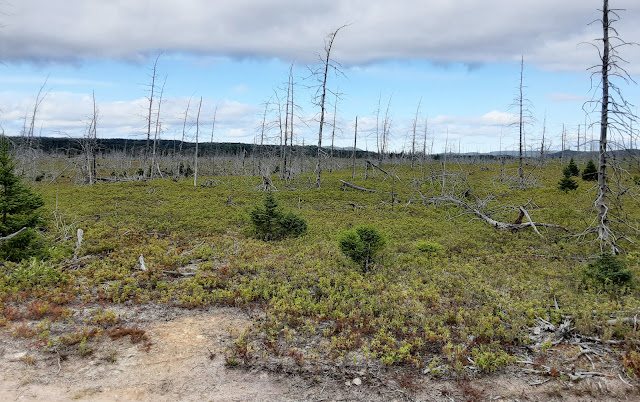
Some of Gros Morne consists of rolling hills covered with forests.  Visitors will also discover exposed rock faces, bogs, ponds, and wetlands.  Gros Morne unfortunately has a number of previously forested areas which were devastated by the spruce budworm several decades ago, which have failed to re-establish.  These significant gaps in the forest canopy become more apparent when flying over the Park at low altitudes.

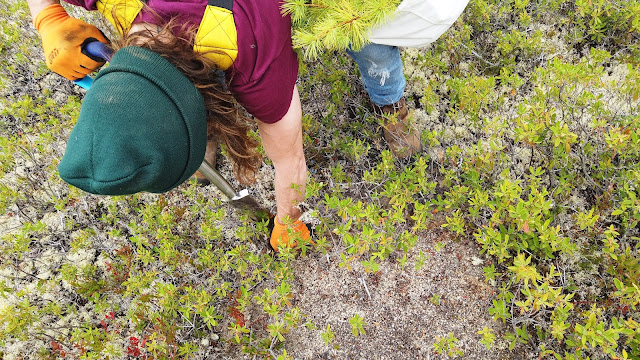
Here are a few photos of our team in action:


The work was quite challenging.  Although the photos above don't show the most challenging ground, there was a lot of brush and vegetation to work through, and there were a lot of fallen tree trunks hidden in the grass and vegetation.  Also, all of the planting sites required helicopters for access, which can frequently lead to significant downtime since helicopters often can't fly in Newfoundland's [frequent] foggy weather.  However, our team loved the experience of getting to visit Newfoundland again.  This wasn't our first time working here, as we did similar projects in 2023 and 2024.  We planted approximately 300,000 trees in Gros Morne in 2025, and are expecting to head back in the Fall of 2026 to plant another 200,000 trees.

All in all, this project was a very rewarding experience!


You can see more photos of our tree planting work at this site by visiting our Planting Photos folder on Dropbox, then going into the "2025 Planting Photos" folder, then into the "Gros Morne National Park" sub-folder.  Start here:

    www.replant-environmental.ca/photos


We'd especially like to thank Darroch Whitaker and the rest of the staff at Gros Morne for their hospitality and logistical support while we were on site.


Jonathan "Scooter" Clark


Replant.ca Environmental is a Canadian company that plants trees for carbon capture and builds community forests.  We also plant trees in national, provincial, and municipal public parks to mitigate damage from wildfires, storms, insects, and forest diseases.  We operate thanks to numerous small contributions from the general public, in addition to larger project sponsorships from NGO's, businesses, and corporations around the world.  If you'd like to learn how to show your support, visit our donations page.  Even if you aren't able to make a contribution, we very much appreciate when people are able to share our posts or our website link on social media, to help spread the word about the work that we're doing!

To learn more about the various species that we plant, visit the conifers page or the deciduous (hardwoods) page on our website.  Thanks so much for your interest!


Thursday, February 23, 2023

The Silver Maple tree (Acer Saccharinum)

Today's post will be about the Silver Maple tree.  The Latin name for this species is Acer saccharinum.  Unfortunately, this tree can also be referred to by a lot of other names, including creek maple, water maple, soft maple, white maple, and silverleaf maple.  We like to stick to just silver maple.  Unfortunately, the Latin name for silver maple is very close to the Latin name for sugar maple (Acer saccharum), which can be very confusing for budding botantists (pardon the pun).

Here's a photo of a very large silver maple in Lincoln Park, Nebraska.  No, not Linkin Park.  


You can see that this tree doesn't necessarily need to grow beside creeks or water.  There's a large silver maple in Mactaquac provincial park that I should have taken a photo of.  There are actually a lot of silver maples in Mactaquac, but I'm thinking of one in particular by the new skating trails.

Within Canada, the range of the silver maple has a moderate overlap with the range of red maple, although red maple grows both further north and further south.  Here's a map for silver maple, courtesy of Wikipedia.  You'll notice that it doesn't extend too far into the Maritimes, but that's changing as the climate warms.  Residents of southern Ontario are quite familiar with this tree though.


Perhaps the most unique thing about the silver maple, in my eyes, is how deep the notches are between the lobes on the leaves (especially the two notches on either side of the central notch).  The leaves are very visually distinct from other maples.


The seeds of the silver maple come in paired samaras, like other maple trees.  However, quite commonly, only one seed of the pair will develop fully.  The shape of the seeds is also slightly different than some other types of maple.  Here's a beautiful photo, which came from a very nice blog post by the Michigan Nature Guy, which you should check out.  Lots of good info there!


Here are a few Fun Facts about silver maples:

1.  Silver maples are one of the first trees to wake up in the spring.  They are also important for bees, because they are one of the first trees to produce pollen in the spring.

2.  Silver maples can be "variably dioecious," which means that the trees can be male or female, or they can also be monoecious, which means that a single tree has both male and female flowers.

3.  Silver maple is a very fast-growing tree, often adding two feet per year.  But if you're planting it near your house, we recommend that you be careful.  It has a very large strong root system that might seek water and compromise your foundation.  Try to keep it at least 15-20 meters away from your house.


Silver maple is a fun tree to plant, when seedlings are available.  We've included silver maples on several of our projects.  It's a great species for restoration projects, especially when moist soils are available.


Thanks for reading!

- Jonathan "Scooter" Clark


Replant.ca Environmental is a Canadian company that plants trees for carbon capture and builds community forests.  We also plant trees in national, provincial, and municipal public parks to mitigate damage from wildfires, storms, insects, and forest diseases.  We operate thanks to numerous small contributions from the general public, in addition to larger project sponsorships from businesses and corporations around the world.  If you'd like to learn how to show your support, visit our donations page.  Even if you aren't able to make a contribution, we very much appreciate when people are able to share our posts or our website link on social media, to help spread the word about the work that we're doing!

Teachers are welcome to use content from this post for their classes.  If you know a teacher who might like to use this information, please share it with them!  The more that people learn about trees, the better our world will be.

To learn more about the various species that we plant, visit the conifers page or the deciduous (hardwoods) page on our website.  Thanks so much for your interest!


Incidentally, our organization is often seeking additional land for our carbon capture projects.  Please visit this link if you might know of a recently-harvested property that we could rebuild into a permanent legacy forest.


Monday, February 20, 2023

Tree Planting Project at Murray Beach Provincial Park, in New Brunswick (2022)

This past Fall (2022), Replant.ca Environmental continued work on a long-term planting project at Murray Beach Provincial Park that we had started in 2021.  This park is located in southeastern New Brunswick.  This work was made possible thanks to a sponsorship from the TreeEra organization.

Murray Beach Provincial Park is only a 45 minute drive from Moncton, on a very scenic route along part of New Brunswick's Acadian coast.  New Brunswick has a 750km drive called the "Acadian Coastal Drive," and Murray Beach Provincial Park is on this trail (Route 955), near the southern end of the trail, in Murray Corner.  The park is near the Little Shemogue River (pronounced Shim-o-Gui), and overlooks the Northumberland Strait.

The waters of the Northumberland Strait (which is part of the southern Gulf of St. Lawrence, between the mainland and PEI) are known for being some of the warmest Atlantic waters north of Virginia, and are very popular with tourists.  You can see the Northumberland Strait in the background of this photo:


Not surprisingly, Murray Beach has a beautiful beach, and the park also has over one hundred camping sites, plus eight cabins.  To make reservations, visit this link.

Here's a graphic (courtesy of Google Earth) showing the location of the park:


The September weather was grey but warm when we were at the park this year.  But there was work to be done, so we couldn't let ourselves get distracted by the beach.

Unfortunately, Murray Beach was hit by Hurricane Dorian in 2019.  Luckily, the damages were not as severe here as in many of the other parks in the region, but there was still a significant loss of mature trees. 


The Replant.ca Environmental team planted 5,189 young seedlings in this park in 2022.  This was the second phase of a multi-year program, and the number of hardwoods will be increased significantly in 2024.  We plan to eventually provide more than seventeen different species (seven conifers and ten deciduous) to the park.

We had done a pre-planting site assessment in August 2022, a few weeks before the planting team arrived, in order to assess the success of the 2021 seedlings.  We were very pleased with the results.  We lost a few hundred of the 2021 trees (probably due to the heat wave in early August) in two exposed patches close to the beach, but the rest of the seedlings looked good, and the areas with slightly more shade looked especially healthy and vibrant.  Considering the challenging temperatures that last year's trees had to deal with during the heat wave, the success rate was excellent.

Our 2022 work continued the efforts made in 2021, with a bit of infilling in areas that were started last year, plus additional trees in various brush patches throughout the park.

Here are a few photos of the team in action at Murray Beach in September 2022:


We will be returning to this site in 2024 to finish the last phase of the work when we add a number of additional hardwood species.  As we wrap up the work on the site, we will also be re-planting the gaps in both edges of the walking corridor that encircles the entire site.  We will be using larger trees for that specific part of the project, which are being grown right now at our central staging area in preparation.

You can see more photos of our 2022 tree planting work on this site by visiting our public 2022 Planting Photos folder on Dropbox, then going into the "Murray Beach" sub-folder.

We'd like to thank Michel (the Park Manager) and his staff for their hospitality and support while we were on site.  We definitely look forward to returning in 2022 to continue the work that Trees For Life is making possible.


Jonathan "Scooter" Clark


Replant.ca Environmental is a Canadian company that plants trees for carbon capture and builds community forests.  We also plant trees in national, provincial, and municipal public parks to mitigate damage from wildfires, storms, insects, and forest diseases.  We operate thanks to numerous small contributions from the general public, in addition to larger project sponsorships from businesses and corporations around the world.  If you'd like to learn how to show your support, visit our donations page.  Even if you aren't able to make a contribution, we very much appreciate when people are able to share our posts or our website link on social media, to help spread the word about the work that we're doing!

To learn more about the various species that we plant, visit the conifers page or the deciduous (hardwoods) page on our website.  Thanks so much for your interest!

Incidentally, our organization is often seeking additional land for our carbon capture projects.  Please visit this link if you might know of a recently-harvested property that we could rebuild into a permanent legacy forest.


Tree Planting Project at Mactaquac Provincial Park, in New Brunswick (2022)

This past Fall (2022), Replant.ca Environmental finished the second phase of our tree planting project at Mactaquac Provincial Park.  We had already started work on this site in the Fall of 2021.  This work was made possible thanks to a sponsorship from the Trees For Life organization, for whom we work as a supply partner.

Mactaquac Provincial Park is only a 30 minute drive from Fredericton, over to the west through either Keswick or French Village.  The park is situated on the St. John River, across from the Mactaquac Dam and power generating station.  This station generates one eighth of the electricity for the entire province of New Brunswick.


Here's a graphic (courtesy of Google Earth) showing the location of the park:


Mactaquac has a golf course, campground, two beaches, hiking trails, and [in the winter] it also has cross-country skiing trails.  The camping options are excellent, with around four hundred camping sites and several rustic cabins.  The washrooms and showers were extremely clean, and the entire project was a wonderful experience.  Here's a link for anyone who wants to make reservations:

www.parcsnbparks.info/en/parks/10/mactaquac-provincial-park


In 2014, the first named hurricane of the season was Hurricane Arthur.  It was a very early hurricane, hitting North America in early July.  It swept up the east coast and over the Maritime provinces.  The winds did a tremendous amount of damage to trees and infrastructure, especially in the Fredericton area.  Mactaquac was hit quite hard, and lost a lot of trees.  Our goal was to start the slow process of replanting some of the areas that had blown down during that storm several years earlier, and also to begin creating new wooded areas in other sections of the park.

The Replant.ca Environmental team planted 32,963 young seedlings within the park in 2022.  As noted, this was the second phase of a multi-year program, and both the species diversity and the number of hardwoods will continue to be increased significantly in 2023 and 2024.  We plan to eventually provide more than sixteen different species (six conifers and ten deciduous) to the park.

The team covered a number of different planting areas within the park.  The next two images show the approximate locations of newly planted seedlings (highlighted):


Most of the planned planting for this site involved planting tree seedlings in fairly open areas, where the Park staff wanted to turn some of the under-utilized fields and openings into future mature stands of trees.  This latter goal is important for carbon sequestration and climate change mitigation, and provides additional habitat for birds and wildlife.  It also allows the Park to better manage their budget for grounds maintenance (controlling the costs related to mowing the grass). There was also a bit of underplanting in some of the thinner sections of woods that are still recovering from the damage created by Hurricane Arthur.

Here are a few photos of the team in action at Mactaquac:


You can see more photos of our 2022 tree planting work on this site by visiting our public 2022 Planting Photos folder on Dropbox, then going into the "Mactaquac Provincial Park" sub-folder.

We'd like to thank Kevin (the Park Manager) and his staff for their hospitality and support while we were on site.  We definitely look forward to returning in 2023 to continue the work that Trees For Life is making possible.


Jonathan "Scooter" Clark


Replant.ca Environmental is a Canadian company that plants trees for carbon capture and builds community forests.  We also plant trees in national, provincial, and municipal public parks to mitigate damage from wildfires, storms, insects, and forest diseases.  We operate thanks to numerous small contributions from the general public, in addition to larger project sponsorships from businesses and corporations around the world.  If you'd like to learn how to show your support, visit our donations page.  Even if you aren't able to make a contribution, we very much appreciate when people are able to share our posts or our website link on social media, to help spread the word about the work that we're doing!

To learn more about the various species that we plant, visit the conifers page or the deciduous (hardwoods) page on our website.  Thanks so much for your interest! 

Incidentally, our organization is often seeking additional land for our carbon capture projects.  Please visit this link if you might know of a recently-harvested property that we could rebuild into a permanent legacy forest. 


Monday, October 25, 2021

Tree Planting Project in Blomidon Provincial Park, Nova Scotia

Our organization did some more tree planting work in Blomidon Provincial Park this past September (2021).  This work was funded by the Trees For Life organization.  You can learn more about them from their website at:  www.treesforlife.ca


This provincial park is located slightly west of central Nova Scotia, in a very picturesque part of the province.  It overlooks the waters of the Minas Basin, which is part of the Bay of Fundy.  The park is located just north of Canning, and just 20km from the town of Wolfville (home to Acadia University).  It overlooks the highest tides in the world.  Here's an overview graphic showing the location of the park:


This project was initiated in 2020 to repair some of the extensive damage done by Hurricane Dorian in 2019.  Dorian hit central Nova Scotia on September 7th, 2019.  Eighty percent of the residents of the province lost power, and in the aftermath, Dorian turned out to be tied for being the strongest hurricane in recorded history to have ever hit Atlantic Canada.  The destruction was widespread.

Damage within Blomidon Park was extensive.  The park staff did an excellent job of cleaning up the mess, but the open spaces that resulted invited some further restoration work.  We discussed our desire to assist with this work, and the park staff were very happy to accommodate.

The park foresters estimated that approximately five acres (two hectares) of the core camping area within the park had been hit the hardest.  In addition, there was another five acre section in front of the camping area that had been cleaned out several years earlier (due to an insect problem) and that area could also use more trees.  Beyond that, there were some other isolated areas that would also benefit from reforestation work.  We decided that this project would be approached in multiple phases.  We would start by planting several thousand seedlings in the fall of 2020, and follow that up with a second larger phase in the fall of 2021.

The first phase of the project was completed successfully in the fall of 2020, thanks to public donations.  However, the project really began to have a major impact in 2021 thanks to the support from the Trees For Life organization.  The support that we received from them this year funded the planting of 8,487 more trees in 2021.  Amazing.


During the planning phase in 2020, we were given some maps outlining the approximate area that the foresters recommended we focus upon.  For context, here is one of those maps:


This photo shows two areas highlighted in red.  The section on the left is the older area that was damaged by insects.  Some trees had been planted in that area several years ago, but the coverage was sporadic and there was certainly room for more.  The section circled in red on the right side of that photo shows the main camping area, prior to the devastation by the hurricane.

To date, our teams have planted a total of eight species in the park.  We've planted five types of conifers so far:  Red spruce, white spruce, eastern larch, white pine, and a handful of black spruce.  We've also planted three species of deciduous hardwoods:  red oak, sugar maple, and yellow birch.  Some of these trees were planted in open ground where the previous mature trees had been completely destroyed and removed.  Other seedlings were planted in partial understory adjacent to camp sites, which again had suffered some wind damage.  These young understory trees will help to ensure the long-term health of the stand surrounding the camp sites.  Incidentally, we'll be adding additional hardwood species to the project in the future.

In addition to prioritizing the camping areas, we've also planted part of the area that was damaged by insects several years ago.  That area has started to regenerate partially.  Some of the trees in that area had been planted, and others are the result of natural regeneration.  The trees and brush in this area were quite patchy.  In some parts, the trees were looking quite healthy and were taller than we were.

Here's a graphic showing all of the areas that we've worked in to date:


Here are a few photos of the team in action in the park:


The second phase of planting on this project went very smoothly.  We're looking forward to returning next fall to wrap up the final phase of the restoration work.  The project is getting close to completion now, and the addition of several more hardwood species will finish this project in 2022.

We'd like to thank the staff at the Nova Scotia Department of Lands and Forestry for helping organize this project, and again to the Trees For Life organization for making this work possible.

You can see more photos of our 2021 tree planting work in our public 2021 Planting Photos folder on Dropbox.


If you'd like to learn more about Blomidon Provincial Park, visit their website:

parks.novascotia.ca/park/blomidon


Thanks for reading!

Jonathan Clark


Replant.ca Environmental is a Canadian company that plants trees for carbon capture and builds community forests.  We also plant trees in national, provincial, and municipal public parks to mitigate damage from wildfires, storms, insects, and forest diseases.  We operate thanks to numerous small contributions from the general public, in addition to larger project sponsorships from businesses and corporations around the world.  If you'd like to learn how to show your support, visit our donations page.  Even if you aren't able to make a contribution, we very much appreciate when people are able to share our posts or our website link on social media, to help spread the word about the work that we're doing!

To learn more about the various species that we plant, visit the conifers page or the deciduous (hardwoods) page on our website.  Thanks so much for your interest!

Incidentally, our organization is often seeking additional land for our carbon capture projects.  Please visit this link if you might know of a recently-harvested property that we could rebuild into a permanent legacy forest.


Sunday, October 17, 2021

Tree Planting Project in Terra Nova National Park (2021)

This summer (2021), Replant.ca Environmental was able to assist with some tree planting work in Terra Nova National Park.  Terra Nova is located on the east coast of Newfoundland, covering several of the inlets along Bonavista Bay.  If you're trying to drive there, it's just over an hour south of Gander International Airport, or slightly over two hours north of St. John's.  Think about the name.  Terra means "land" in Latin, and "Nova" means "new."  So basically, it's very close to being a Latin version of the name of the province.

Newfoundland officially became Canada's tenth province in 1949.  Up to that point, it was usually under colonial rule (with one twenty-six year period as a Dominion).  An interesting bit of trivia is that up until 1947, Newfoundland was still issuing its own coinage, obviously distinct from Canadian coins.  After Newfoundland joined Canada, it was only eight more years before Terra Nova was created, in 1957.  Terra Nova covers almost 400 square kilometers, so it's larger than most of Canada's provincial or municipal parks.

Newfoundland eventually became known as the province of Newfoundland & Labrador, after this name change was added to the Canadian constitution in 1981.

As noted by Wikipedia, Terra Nova protects the Eastern Island Boreal Forest natural region.  This region covers most of the island of Newfoundland (east of Deer Lake), and is characterized predominantly by black spruce trees, with pockets of balsam fir, white pine, mountain ash, tamarack, maple, and some other deciduous species.

Most of Terra Nova consists of rolling hills covered with forests.  Visitors will also discover exposed rock faces, bogs, ponds, and wetlands.  Here's a photo showing part of the park which is in the process of regenerating.  You can see some juvenile spruce among older trunks of dead trees, and a ground layer covered with moss and Labrador tea vegetation:


Here's a graphic (courtesy of Google Earth) showing the location of the park:


Terra Nova has two campgrounds at Newman Sound and Malady Head.  In addition, there are also tons of back-country camping options, accessible by hiking, kayaking, or canoeing.  If you'd like some further information about reserving camping sites, start here:

www.pc.gc.ca/en/pn-np/nl/terranova/activ


Our Regional Director of [Newfoundland] Operations, John Moran, was able to send us a couple photos of the work done in TNNP in 2021:


This year (2021) was the first year that our organization did any work in this beautiful national park.  We hope and expect that we will be able to make further contributions in the future.  We're truly excited about this project, being one of our most unique and beautiful project sites to date!


You can see more photos of our 2021 tree planting work in our public 2021 Planting Photos folder on Dropbox.

We'd especially like to thank John Gosse (the Nature Legacy Ecologist) and his staff for their hospitality and support while we were on site.  We definitely look forward to returning in 2022 to continue any additional work that can be arranged.


Edit:  We were able to continue our work at Terra Nova in 2022.  If you'd like to learn more about that work, visit this link:

replant-environmental.blogspot.com/2023/02/tree-planting-at-terra-nova-national.html


Jonathan "Scooter" Clark


Replant.ca Environmental is a Canadian company that plants trees for carbon capture and builds community forests.  We also plant trees in national, provincial, and municipal public parks to mitigate damage from wildfires, storms, insects, and forest diseases.  We operate thanks to numerous small contributions from the general public, in addition to larger project sponsorships from businesses and corporations around the world.  If you'd like to learn how to show your support, visit our donations page.  Even if you aren't able to make a contribution, we very much appreciate when people are able to share our posts or our website link on social media, to help spread the word about the work that we're doing!

To learn more about the various species that we plant, visit the conifers page or the deciduous (hardwoods) page on our website.  Thanks so much for your interest!

Incidentally, our organization is often seeking additional land for our carbon capture projects.  Please visit this link if you might know of a recently-harvested property that we could rebuild into a permanent legacy forest.


Tree Planting Project at Mactaquac Provincial Park (2021)

This fall, Replant.ca Environmental started a long-term planting project at Mactaquac Provincial Park.  This work was made possible thanks to a sponsorship from the Trees For Life organization.  Learn more about Trees For Life at www.treesforlife.ca

Mactaquac Provincial Park is only a 30 minute drive from Fredericton, over to the west through either Keswick or French Village.  The park is situated on the St. John River, across from the Mactaquac Dam and power generating station.  This station generates one eighth of the electricity for the entire province of New Brunswick.


Here's a graphic (courtesy of Google Earth) showing the location of the park:


Mactaquac has a golf course, campground, two beaches, hiking trails, and [in the winter] it also has cross-country skiing trails.  The camping options are excellent, with around four hundred camping sites and several rustic cabins.  The washrooms and showers were extremely clean, and the entire project was a wonderful experience.  Here's a link for anyone who wants to make reservations:

https://www.parcsnbparks.info/en/parks/10/mactaquac-provincial-park


In 2014, the first named hurricane of the season was Hurricane Arthur.  It was a very early hurricane, hitting North America in early July.  It swept up the east coast and over the Maritime provinces.  The winds did a tremendous amount of damage to trees and infrastructure, especially in the Fredericton area.  Mactaquac was hit quite hard, and lost a lot of trees.  Our goal was to start the slow process of replanting some of the areas that had blown down during that storm several years earlier, and also to begin creating new wooded areas in other sections of the park.

The Replant.ca Environmental team planted 48,564 young seedlings within the park in 2021.  A total of seven species were planted:  Red spruce, white spruce, eastern white pine, eastern larch, eastern white cedar, northern (red) oak, and sugar maple.  This was the first phase of a multi-year program, and both the species diversity and the number of hardwoods will be increased significantly in 2022 and 2023.  We plan to eventually provide more than sixteen different species (six conifers and ten deciduous) to the park.

The team covered a number of different planting areas within the park.  The next three images show the approximate locations of newly planted seedlings (shaded in cyan).  Please note that these two photos are not perfectly oriented with north to the top, as is common in cartography.  However, they fit better in the blog post this way:


Here are a few photos of the team in action at Mactaquac:


You can see more photos of our 2021 tree planting work in our public 2021 Planting Photos folder on Dropbox.

We'd like to thank Kevin (the Park Manager) and his staff for their hospitality and support while we were on site.  We definitely look forward to returning in 2022 to continue the work that Trees For Life is making possible.


Edit:  If you'd like to read about the continuation of our work on this site in 2022, visit this link:

https://replant-environmental.blogspot.com/2023/02/tree-planting-project-at-mactaquac.html


Jonathan "Scooter" Clark


Replant.ca Environmental is a Canadian company that plants trees for carbon capture and builds community forests.  We also plant trees in national, provincial, and municipal public parks to mitigate damage from wildfires, storms, insects, and forest diseases.  We operate thanks to numerous small contributions from the general public, in addition to larger project sponsorships from businesses and corporations around the world.  If you'd like to learn how to show your support, visit our donations page.  Even if you aren't able to make a contribution, we very much appreciate when people are able to share our posts or our website link on social media, to help spread the word about the work that we're doing!

To learn more about the various species that we plant, visit the conifers page or the deciduous (hardwoods) page on our website.  Thanks so much for your interest! 

Incidentally, our organization is often seeking additional land for our carbon capture projects.  Please visit this link if you might know of a recently-harvested property that we could rebuild into a permanent legacy forest.