Replant.ca Environmental is a Canadian organization whose vision is to help our global environment through planting trees. We build demonstration forests that are accessible to the public. We also plant in public parks, and we build carbon capture plantations that help mitigate climate change. Our operations are funded by NGO's, corporations, and numerous small donations from global citizens who know that their individual actions will help make a difference.
Here's a post about another carbon sequestration project that we recently completed on behalf of one of our Sponsor Partners. The tree planting work on this site in southeastern New Brunswick was done in the Spring of 2024. The work was done at a large site on the side of the TransCanada Highway, just west of Sackville. The planting on this site was entirely sponsored by One Tree Planted.
This site was harvested about a decade and a half ago, by a third party, and our goal was to help rebuild a new forest there. The site is large and easily accessible, and might be a great site for a public park in the future. It is fairly close to Sackville's Beech Hill Park, which has some nice recreation trails, and trails on this site could complement those that are already built in the area.
As noted, although we hope to provide future opportunities for public recreation on this site, the primary initial purpose of this project was to support climate stability through carbon sequestration. As a side benefit, this site will support biodiversity and wildlife habitat. There were already some healthy trees growing on this site (mostly balsam fir, white spruce, American beech, trembling aspen, red maple, and white birch) so we were able to plant at fairly low density, adding only 33,750 more trees (mostly eastern white pine seedlings) into open areas on this 121.8 acre site. Diverse forests are healthy forests, and eastern white pine is an especially appealing native tree when considering possible negative future climate change scenarios.
Here are a few more photos taken during the planting of this project, which took place in late April of 2024:
You
can see more photos of our tree planting work at this site by visiting
our Planting Photos folder on Dropbox, then going into the "2024
Planting Photos" folder, then into the "Tantramar Rec Trails" sub-folder. Start
here:
We look forward to studying this site in the coming years. We will be doing periodic surveys to assess the carbon capture progress of the new forest, and hope to start exploring the possibility of building recreational trails in 2027.
Again, a huge thanks to One Tree Planted, the sponsors and lead on this major project.
Replant.ca Environmental is a Canadian company that plants trees for carbon capture and builds community forests. We also plant trees in national, provincial, and municipal public parks to mitigate damage from wildfires, storms, insects, and forest diseases. We operate thanks to numerous small contributions from the general public, in addition to larger project sponsorships from businesses and corporations around the world. If you'd like to learn how to show your support, visit our donations page. Even if you aren't able to make a contribution, we very much appreciate when people are able to share our posts or our website link on social media, to help spread the word about the work that we're doing!
To learn more about the various species that we plant, visit the conifers page or the deciduous (hardwoods) page on our website. Thanks so much for your interest!
Incidentally, our organization is often seeking additional land for our carbon capture projects. Please visit this link if you might know of a recently-harvested property that we could rebuild into a permanent legacy forest.
Today's post will be about the Silver Maple tree. The Latin name for this species is Acer saccharinum. Unfortunately, this tree can also be referred to by a lot of other names, including creek maple, water maple, soft maple, white maple, and silverleaf maple. We like to stick to just silver maple. Unfortunately, the Latin name for silver maple is very close to the Latin name for sugar maple (Acer saccharum), which can be very confusing for budding botantists (pardon the pun).
Here's a photo of a very large silver maple in Lincoln Park, Nebraska. No, not Linkin Park.
You can see that this tree doesn't necessarily need to grow beside creeks or water. There's a large silver maple in Mactaquac provincial park that I should have taken a photo of. There are actually a lot of silver maples in Mactaquac, but I'm thinking of one in particular by the new skating trails.
Within Canada, the range of the silver maple has a moderate overlap with the range of red maple, although red maple grows both further north and further south. Here's a map for silver maple, courtesy of Wikipedia. You'll notice that it doesn't extend too far into the Maritimes, but that's changing as the climate warms. Residents of southern Ontario are quite familiar with this tree though.
Perhaps the most unique thing about the silver maple, in my eyes, is how deep the notches are between the lobes on the leaves (especially the two notches on either side of the central notch). The leaves are very visually distinct from other maples.
The seeds of the silver maple come in paired samaras, like other maple trees. However, quite commonly, only one seed of the pair will develop fully. The shape of the seeds is also slightly different than some other types of maple. Here's a beautiful photo, which came from a very nice blog post by the Michigan Nature Guy, which you should check out. Lots of good info there!
Here are a few Fun Facts about silver maples:
1. Silver maples are one of the first trees to wake up in the spring. They are also important for bees, because they are one of the first trees to produce pollen in the spring.
2. Silver maples can be "variably dioecious," which means that the trees can be male or female, or they can also be monoecious, which means that a single tree has both male and female flowers.
3. Silver maple is a very fast-growing tree, often adding two feet per year. But if you're planting it near your house, we recommend that you be careful. It has a very large strong root system that might seek water and compromise your foundation. Try to keep it at least 15-20 meters away from your house.
Silver maple is a fun tree to plant, when seedlings are available. We've included silver maples on several of our projects. It's a great species for restoration projects, especially when moist soils are available.
Replant.ca Environmental is a Canadian company that plants trees for carbon capture and builds community forests. We also plant trees in national, provincial, and municipal public parks to mitigate damage from wildfires, storms, insects, and forest diseases. We operate thanks to numerous small contributions from the general public, in addition to larger project sponsorships from businesses and corporations around the world. If you'd like to learn how to show your support, visit our donations page. Even if you aren't able to make a contribution, we very much appreciate when people are able to share our posts or our website link on social media, to help spread the word about the work that we're doing!
Teachers are welcome to use content from this post for their classes. If you know a teacher who might like to use this information, please share it with them! The more that people learn about trees, the better our world will be.
To learn more about the various species that we plant, visit the conifers page or the deciduous (hardwoods) page on our website. Thanks so much for your interest!
Incidentally, our organization is often seeking additional land for our carbon capture projects. Please visit this link if you might know of a recently-harvested property that we could rebuild into a permanent legacy forest.
Today I'm going to talk about the Butternut, which is also more formally known as the White Walnut tree. This tree is an endangered species in Canada. It grows fairly widely in the US, where is it also endangered. Even though it is endangered here in Canada, butternut trees grow quite commonly in southern Ontario, southern Quebec, and in parts of New Brunswick (especially the Saint John river valley). The problem is that the population is diminishing, when if anything, it should be expanding in range (due to climate change). Butternut prefers a slightly cooler climate than black walnut, hence why it is more common to find in parts of Canada.
Here's a photo of a very large butternut tree:
Here's a range map for this species, courtesy of Wikipedia:
Butternut grows best on stream banks and in well-drained soils. Like black walnut, the butternut is a pioneer species which needs open sunlight. Butternut trees are quite shade intolerant, so you won't find them deep in a mature forest. It will last for almost a century in mixed forests where it is part of the over-story, but young trees do not want to grow under the canopy.
Like black walnuts, the nuts are edible. They're very tasty, and [not surprisingly] have more of a buttery taste than black walnuts (hence the name). The shells are encased in a soft sticky husk. These shells are hard to crack, but not as difficult as black walnuts. The resulting nut, when you get it out of the shell, is about the same size as a pecan.
Here's a photo showing a cracked shell of a butternut:
The leaf of a butternut is a large one, which typically has 11-17 smaller leaflets on it. Like the black walnut, many people are confused by the individual leaflets and think they're the leaves. On the butternut, the terminal leaflet at the tip of the leaf is usually quite large. This is distinctly helpful to aid in contrasting the leaves with those of black walnut (which are small at the tip of the leaf). Here's a photo of a butternut leaf:
The butternut is especially susceptible to a fungus which is killing trees all over North America. This is why it is currently endangered. The butternut trees in New Brunswick are thought to be slightly more resistant to this fungus, but they're still susceptible. Several organizations and groups in New Brunswick are trying to help save this tree. Here's a CBC article that is relevant:
1. The fattest known butternut is located in Oneida, New York state. The circumference of the trunk at breast height was 24 FEET when measured a few years ago. That's a 7.3 meter circumference. Massive.
2. Butternut wood is prized by furniture-makers, just like black walnut, although the wood is much softer to work with than black walnut.
3. Butternut hybridizes easily with Japanese walnut. This hybrid is called the buartnut and is more resistant to the fungus than a pure butternut. The buartnut may become a commonly known tree in the future.
We'll leave you with a photo of some butternut seedlings, courtesy of Ontario's Silver Creek Nursery:
Replant.ca Environmental is a Canadian company that plants trees for carbon capture and builds community forests. We also plant trees in national, provincial, and municipal public parks to mitigate damage from wildfires, storms, insects, and forest diseases. We operate thanks to numerous small contributions from the general public, in addition to larger project sponsorships from businesses and corporations around the world. If you'd like to learn how to show your support, visit our donations page. Even if you aren't able to make a contribution, we very much appreciate when people are able to share our posts or our website link on social media, to help spread the word about the work that we're doing!
To learn more about the various species that we plant, visit the conifers page or the deciduous (hardwoods) page on our website. Thanks so much for your interest!
Teachers
are welcome to use content from this post for their classes. If you
know a teacher who might like to use this information, please share it
with them! The more that people learn about trees, the better our world
will be.
Incidentally, our organization is often seeking additional land for our carbon capture projects. Please visit this link if you might know of a recently-harvested property that we could rebuild into a permanent legacy forest.
Last week we looked at the yellow birch. This week, we'll look at another birch tree which is more well-known: the paper birch. Unlike the yellow birch, the paper birch grows well almost everywhere in Canada, and due to its white bark, it is something of an iconic tree. The white bark is obviously the reason why this species is perhaps more commonly referred to as white birch. In some areas, it is also called "canoe birch."
Let's start with a photo of a semi-mature tree, so we can get a good look at the bark.
If you go back to our yellow birch post, you'll see that the colour difference is fairly obvious on your computer screen, but you may not find this to be the case in the field. Sometimes, a yellow birch will appear to be a lot more pale in colour, or a "white" birch might appear slightly creamy-coloured, which can really confuse observers. A better way to improve your identification skills is to look carefully at the composition of the bark, and the way that it flakes or peels off the trunk. Strips of paper birch bark are generally thicker than that of yellow birch bark. Even more telling is the outward appearance. While the yellow birch flakes in many small curls, paper birch usually peels off in much larger sections. In some instances, on mature trees, you might almost be able to peel off a piece that is about the size of a piece of photocopy paper. There is almost universal agreement that the paper birch is a very "pretty" tree.
Despite the very white bark on mature and semi-mature trees, the bark of juvenile paper birch trees is actually quite red! This is the case from the time that the tree is just a germinant or whip until the diameter of the truck is thicker than an inch or two. Here's a photo. Take a close look at the tiny white marks all over the red bark, which help clarify that these trees are paper birch:
Unfortunately, the paper birch is not as healthy as the yellow birch. A mature paper birch may only live about half as long as a yellow birch, as most only survive for about a hundred years. Incidentally, paper birch trees that live in colder climates tend to live longer than specimens in the southern part of their range. On a positive note, a single birch tree can release more than a MILLION tiny seeds (samara) in a season, so one mature tree can help generate a huge number of eventual successors.
Paper birch supposedly grows to be slightly smaller than yellow birch at maturity, but we've found that the two species are quite similar. We have a number of mature birch of both species on some of the properties that we manage, and many of the paper birch trees are around twenty meters (seventy feet) high, with a DBH (diameter at breast height) of about 60 cm (two feet). This is similar to the size of mature yellow birch in this region.
Here's a range map of the paper birch, courtesy of Wikipedia:
Fun fact: The paper birch is the provincial tree of Saskatchewan. It's also the state tree of New Hampshire.
Let's get back to examining the paper birch in more detail. Have you ever walked through the woods and found a rotten piece of paper birch on the ground, and discovered that while the bark is still intact, the wood inside has completely rotted away? This happens fairly often. This is because the bark of the paper birch has a very high oil content, and is very waterproof. This helps ensure that it is more resistant to rot than the wood in the core of the tree.
Paper birch trees are "monoecious." This means that an individual tree has both male and female flowers, called catkins. The catkins tend to develop in May or June. Female catkins are greenish, and are smaller than the brownish male catkins. By early fall, the seeds have matured and begin to fall. Seeds continue to fall throughout the winter. Most people wouldn't be able to describe a birch seed when asked, because they are fairly tiny and not at all obvious to someone taking a walk through the woods. However, next time that you're walking through a stand of birch trees with snow on the ground, take a close look at see if you see a lot of small brown specs on the surface of the snow. These may be birch seeds!
To see a good illustration showing how small birch seeds are, check out this short YouTube video from someone who is demonstrating how to grow silver birch:
Ok, it's time for some more fun facts about paper birch!
1. If you're planting both paper birch and black walnut on the same property, don't plant them close to each other! The roots of the black walnut secrete a chemical (juglone) which is very toxic to paper birch trees.
2. Although paper birch bark is a staple food for moose, it is full of lignin which is hard to digest. For this reason, moose need to eat many other types of plants in combination with the birch. Incidentally, deer also love to eat the bark of the paper birch, especially once the snow cover gets deep and ground forage is hard to get to.
3. The leaves of the paper birch often appear in pairs. They have toothed edges which are called margins.
Birch trees are an important part of the mix of hardwoods that we plant
on the properties that we manage. We have to think about carbon
sequestration and longevity, so we tend to plant a greater number of
yellow birch than paper birch. However, paper birch are very
attractive so it would be a failure not to include them. As a
forest reaches a steady state maturity, with old trees being gradually
replaced by young trees, a mix of yellow and white birch is beneficial.
Having said that, paper birch is more of a pioneer species than yellow birch, which means that it thrives better than yellow birch in
openly disturbed forests with lots of exposure to sunlight. In the
long term, we feel that yellow birch (a shade-tolerant successional species) has a bit of an advantage over
paper birch for a mature forest with lots of shade. Here's a photo of some of our white birch seedlings:
Replant.ca Environmental is a Canadian company that plants trees for carbon capture and builds community forests. We also plant trees in national, provincial, and municipal public parks to mitigate damage from wildfires, storms, insects, and forest diseases. We operate thanks to numerous small contributions from the general public, in addition to larger project sponsorships from businesses and corporations around the world. If you'd like to learn how to show your support, visit our donations page. Even if you aren't able to make a contribution, we very much appreciate when people are able to share our posts or our website link on social media, to help spread the word about the work that we're doing!
Teachers are welcome to use content from this post for their classes. If you know a teacher who might like to use this information, please share it with them! The more that people learn about trees, the better our world will be.
To learn more about the various species that we plant, visit the conifers page or the deciduous (hardwoods) page on our website. Thanks so much for your interest!
Incidentally, our organization is often seeking additional land for our carbon capture projects. Please visit this link if you might know of a recently-harvested property that we could rebuild into a permanent legacy forest.
The Eastern white cedar is known by many names, but the most common alternatives are the northern white cedar, the swamp cedar, or the eastern arborvitae. The Latin name for this tree is Thuja occidentalis.
You won't often hear rural dwellers referring to this tree as the arborvitae. That term arborvitae is somewhat confusing. Many horticulturalists use it. However, arborvitae really refers to the entire Thuja s. genus, which includes five different species. The only other arborvitae is the western red cedar, which we plant very frequently in BC's western coastal areas. Incidentally, the word arborvitae comes from two separate words: Arbor, meaning "tree," and vitae, meaning "life." The implication is "tree of life."
When you look at the taxonomic classification of the Thuja genus, they belong to a family known as Cupressaceae, or more commonly known in English as cypress. That's right, the north American cedars are not even true cedars! Sigh. Why is tree classification so confusing? True cedars are only found natively in the Mediterranean and in the Himalayas. Let's get back to our "fake" cedar, the eastern white cedar.
Perhaps the most unique thing about cedar trees is the appearance of the needles. Cedar branches look very different than most other conifers, due to the flattened shape of the needles:
You can see that the needles almost look like scales.
When an eastern white cedar tree develops cones, they are quite small - only about one centimeter long. Each cone contains approximately eight seeds, however, the cones grow in very dense clusters. They start off as a yellowish colour, but then eventually turn to a fairly dark shade of brown. Here's a photo showing some immature cones that are still developing:
This species is not a large one. These trees rarely grow to be more than 15-25 meters in height (about 50-80 feet). However, even though they're usually not nearly as tall as many of the other mature conifer species in eastern Canada, their trunks can still grow fairly thick, sometimes reaching almost a meter in diameter (3 feet) at maturity. These measurements are typical for trees growing in the United States. When they're found in Canada, they're usually slightly smaller.
Cedar trees taste great, at least to deer. And that's a big problem. Deer are especially attracted to these trees. Exploding deer populations are causing all kinds of problems in many parts of Canada. In the town that I grew up in, in central Nova Scotia, the deer can be found everywhere throughout town, and ravage people's gardens and shrubbery. Cedar trees are one of the favorite species for deer to eat, and this is having a negative impact on cedar populations all over eastern North America.
On the west coast, when we plant cedar, we sometimes also install "browse protection devices" over the trees. A browse protector usually looks like a tall thin plastic cone, about three feet tall. We place a four-foot cedar stake beside a freshly planted cedar tree, and pound this stake into the ground with a mallet so it is firmly anchored, then place the cone over both the cedar seedling and the stake. The cone is then tied to the stake so it will remain in place for several years. The cones are translucent, which allows enough sunlight to reach the tree for photosynthesis. The tree grows up inside the cone for approximately 3-5 years, then the crew goes back into the plantation to remove the cones, so they can be re-used on another project. This system seems to work fairly well for letting the cedar seedlings become established until the trees are large enough that the deer start to ignore them (the deer prefer very young seedlings that are closer to the ground). Here's a photo of a browse cone, protecting a freshly planted young cedar:
Cedar trees can live for a very, very long time. Here's an interesting story: There is an old eastern white cedar located on the shore of Lake Superior in Minnesota. The Ojibwa refer to this tree as the Little Cedar Spirit Tree. The first known written reference to this specific tree happened way back in 1731, by a French explorer named Sieur de la Verendrye. The Ojibwa often leave tobacco around the tree as an offering to help protect them on voyages on Lake Superior. Despite this tree being quite famous, that doesn't mean that it's one of the oldest. It could be, but some eastern white cedars can live to be more than a thousand years old! Why would anyone ever want to cut one of these trees down?
Although this species prefers very moist climates, it has managed to carve out a fairly large footprint in eastern Canada by taking advantage of conditions where other larger and faster-growing trees have problems thriving. These cedar trees can survive on rocky cliffs, and in very moist swampy areas. In that sense, this cedar is a good species to mix with black spruce when the ground conditions are appropriately moist. Although eastern white cedar isn't found commonly throughout Nova Scotia or in the eastern half of Prince Edward Island, it has a wide range throughout the rest of eastern and central Canada and the northeastern United States. Here's a range map, courtesy of Wikipedia:
I want to leave you with a few interesting facts about this species:
1. When a branch falls from an eastern white cedar, it can sometimes lay out new roots into the ground and grow into a new tree, if the conditions are just right!
2. The inner bark of this tree is tough enough to make into string or rope.
3. Some people plant this species in their back yards specifically to attract wildlife. Besides deer, rabbits and many types of birds are also attracted to this tree.
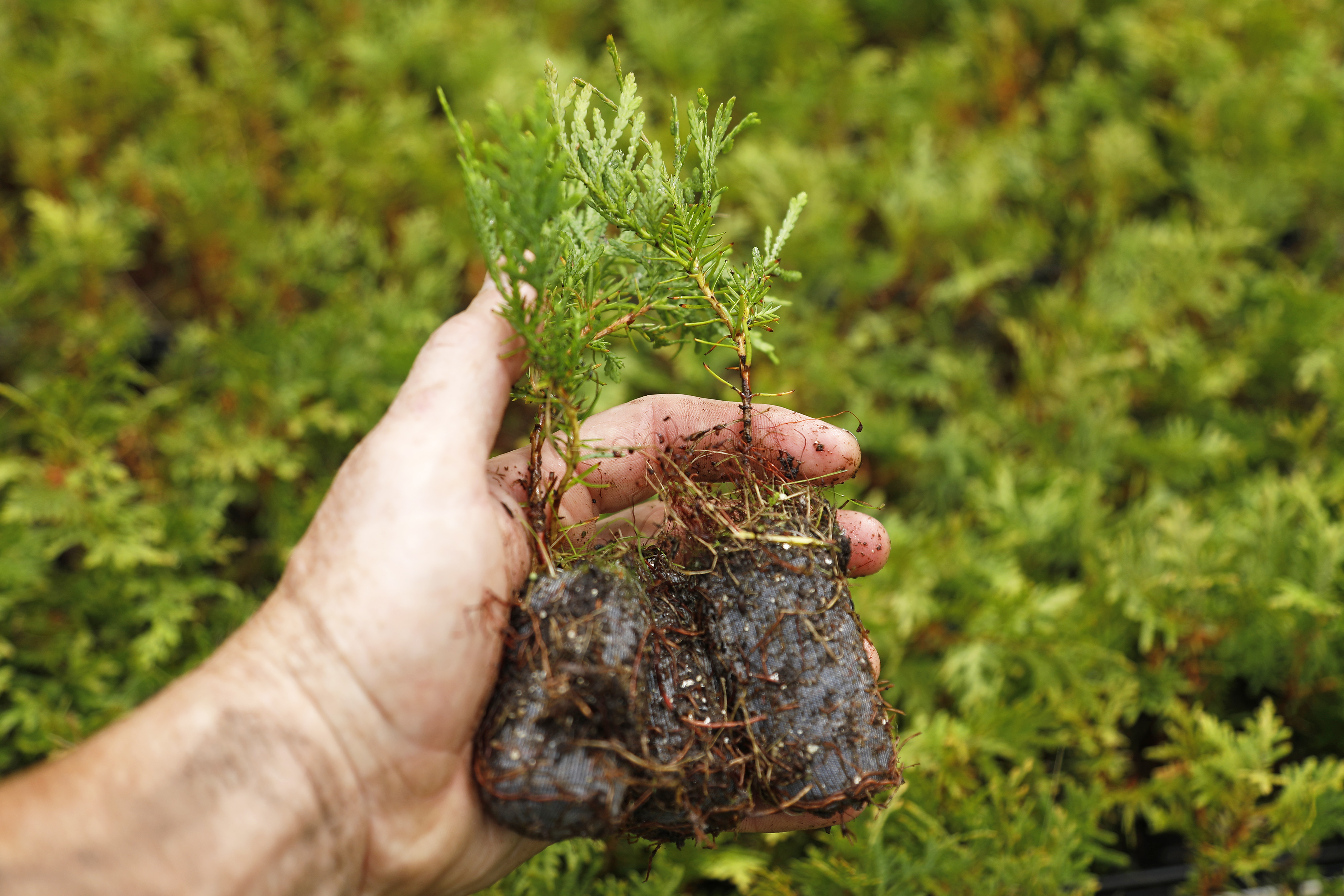
For the 2020 planting season, we included several thousand eastern white cedars in our species mixes at Replant.ca Environmental. We planted these trees in areas with more moisture or shade, including understory areas, near streams, and in swampy areas. Even though they are one of the less voluminous conifers in our mixes, and there is a higher risk of some mortality due to deer browsing, we feel that these are a very beneficial species to add to our mixes. Here's a photo of some of our eastern white cedar seedlings:
Replant.ca Environmental is a Canadian company that plants trees for carbon capture and builds community forests. We also plant trees in national, provincial, and municipal public parks to mitigate damage from wildfires, storms, insects, and forest diseases. We operate thanks to numerous small contributions from the general public, in addition to larger project sponsorships from businesses and corporations around the world. If you'd like to learn how to show your support, visit our donations page. Even if you aren't able to make a contribution, we very much appreciate when people are able to share our posts or our website link on social media, to help spread the word about the work that we're doing!
Teachers are welcome to use content from this post for their classes. If you know a teacher who might like to use this information, please share it with them! The more that people learn about trees, the better our world will be.
To learn more about the various species that we plant, visit the conifers page or the deciduous (hardwoods) page on our website. Thanks so much for your interest!
Incidentally, our organization is often seeking additional land for our carbon capture projects. Please visit this link if you might know of a recently-harvested property that we could rebuild into a permanent legacy forest.
For this week's featured species, we're going to look at the White Spruce. The proper Latin name for this species is Picea glauca. White spruce is sometimes referred to as "Canadian spruce," although that's not an official name of any sort.
Some people refer to Engelmann spruce as white spruce, but that's a different species. Engelmann spruce is found at elevation in southern BC at the western US. Engelmann spruce is often crossed with true white spruce to create a hardy hybrid that is planted all over western Canada.
Here's a photo that I took of a white spruce, which I believe was probably about 30-40 years old:
The white spruce is a very plentiful tree. It's very healthy, and has a broad range. You can find this species all across Canada, except for the very southern reaches of BC and Alberta, and the west coast of BC (where Sitka spruce takes over). Here's a range map from Wikipedia:
Spruce trees, in general, love water. They typically prefer flowing (aerated) water, although black spruce can thrive in some pretty fetid swampy areas. White spruce is certainly quite happy to grow in moisture-laden soils. White spruce, like all other spruce trees, is also a very shade-tolerant tree. However, it is slightly less shade tolerant than red spruce (red spruce is a common tree in New Brunswick and Nova Scotia). Regardless, white spruce will do adequately when planted under a canopy, or in areas with high brush and vegetation competition. However, white spruce seedlings can be susceptible to spring frosts. Having brush or a mature canopy over young seedlings acts to protect them until they're older.
When I was very young, I thought that all cones, regardless of what species of conifer the cone came from, were called pine cones. Of course, that was that naivete of a young child. The cones on spruce trees are called spruce cones. White spruce has two types of cones, male and female. Each tree contains both types. The male cones produce pollen, which floats to the female cones to fertilize the seed. After the cones are fertilized, it takes about three months for them to mature and open. When the cones open, the seed is dispersed fairly far from the tree, due to small wings on each seed. It is common for seed to spread more than 100m from the parent tree, thanks to winds. Although the number of seeds per cone varies, there are usually at least a few dozen seeds in a cone, and sometimes more than a hundred.
A mature white spruce will often live to be more than 200 years old. Some trees live to be many times older than that. After the first century, as long as the site and growing conditions are adequate, a white spruce will often reach 30m (100 feet) in height, and can have a diameter of more than a meter (3 feet) at the base. This species can capture very large amounts of carbon. Our Walker Road property has some beautiful mature white spruce that are starting to approach this size.
Although we don't harvest any of our trees at Replant.ca Environmental, white spruce is often used in the manufacture of acoustic guitars.
One way to distinguish white spruce from red spruce is by the colour of the needles. The white spruce needles are a bluish-green shade, in contrast to the more yellow-green shade of red spruce needles.
This year, we've planted many thousands of white spruce seedlings at Replant.ca Environmental. Here's a photo of some of them:
Replant.ca Environmental is a Canadian company that plants trees for carbon capture and builds community forests. We also plant trees in national, provincial, and municipal public parks to mitigate damage from wildfires, storms, insects, and forest diseases. We operate thanks to numerous small contributions from the general public, in addition to larger project sponsorships from businesses and corporations around the world. If you'd like to learn how to show your support, visit our donations page. Even if you aren't able to make a contribution, we very much appreciate when people are able to share our posts or our website link on social media, to help spread the word about the work that we're doing!
Teachers are welcome to use content from this post for their classes. If you know a teacher who might like to use this information, please share it with them! The more that people learn about trees, the better our world will be.
To learn more about the various species that we plant, visit the conifers page or the deciduous (hardwoods) page on our website. Thanks so much for your interest!
Incidentally, our organization is often seeking additional land for our carbon capture projects. Please visit this link if you might know of a recently-harvested property that we could rebuild into a permanent legacy forest.
This post will talk about one of our favorite tree species of the east coast, the Eastern white pine. The Latin name for this species is Pinus strobus. Here's a famous photo of a giant Eastern white pine tree in Virginia:
Eastern white pine (which is also referred to by some people in the Unites States as the northern white pine), is a beautiful species. It grows all over eastern Canada and around the Great Lakes, and also throughout the northeastern seaboard of the United States. Ironically, even though it is sometimes called the northern white, it doesn't really grow well north of New Brunswick, central Newfoundland, or southern Ontario. Here's a map showing the typical range, thanks to Wikipedia:
Eastern white pine is a powerful species. In mature forests, it is typically the largest tree that might be found, and often towers well above other species around it. This tree can very easily grow to be more than forty meters tall (130 feet), and some historical specimens were reported to exceed sixty meters. Even forty meters is very tall for the east coast! There are a number of old eastern whites on our Charles Clark Forest Reserve property in Nova Scotia, and I'm going to try to get an accurate measurement of their height soon. Thanks to the use of drone technology, it will be very quick and easy to get a measurement that should be accurate to within one meter. A few of these old giants were blown down several years ago by Hurricane Juan, but a number of them survived and still thrive today. Thankfully, they recently survived the impact of Hurricane Dorian too.
Although height is everyone's favorite metric when it comes to talking about big trees, let's not forget about DBH, which stands for "diameter at breast height." A mature eastern white can measure between 1.0 and 1.5 meters across (that's about three to five feet, for our American followers). Stand beside one, or try to wrap your arms around it, and you'll be humbled. What's even more impressive about this species is its lifespan. Mature trees often live 200-250 years, and can sometimes live for more than four centuries. Some native Americans referred to this type of tree as the "Tree of Peace," and Henry David Thoreau remarked, "There is no finer tree."
There's a great historical story about eastern white pines. In the 1700's, these trees were often used as masts for ships. Government representatives (early day timber cruisers) would search for the best specimens in the forests and etch a special mark (a broad arrow) into the bark of the tree. These trees were then designated as property of the crown, and anyone who cut one down (and got caught doing so) was ostensibly given a fine for "stealing" the tree. This lead to a backlash in the American colonies that was arguably even more significant than the tea tax or the Stamp Act, and eventually led to the Pine Tree Riot of 1772. This incident was significant in the lead-up to the American Revolution. You can learn more about the Pine Tree Riot at this wiki link: https://en.wikipedia.org/wiki/Pine_Tree_Riot
The eastern white pine is the provincial tree of Ontario. Despite its majesty, it doesn't always grow symmetrically. If growing in an area exposed to heavy winds, the tree will often have very short branches on the side exposed most chronically to the wind, and large drooping branches on the leeward side of the trunk. This happens to other species too, but eastern white is probably more noted for it because these trees tower above other species, so this characteristic is more common in eastern whites. Many of you probably know of Tom Thomson's famous painting, called "The Jack Pine." You may not know that his first famous Canadian outdoor painting, entitled, "Byng Inlet, Georgian Bay," features three eastern white pine trees. I won't post the image here due to potential copyright issues, but you can find it easily with a google search.
When young eastern white pines are growing, they can survive in any kind of soil, although they generally prefer sandy soils. However, they're versatile, and can still survive in moist receiving zones. They grow best when exposed to significant amounts of sunlight, but they're also very shade tolerant when young. This lets seedlings become established as juvenile trees in understory plantations. For this reason, eastern white pine seedlings do best when planted in open ground or in mature canopies with some open space (two extremes), but generally don't do well when planted in dense young stands with thick juvenile brush.
Different pine species tend to have different numbers of needles in their clusters, consistent to each species. Some pines are two-needle, some are three-needle, and some are five-needle. The eastern white, like most other white pines around the world, is a five-needle pine. These needles grow to be as long as fifteen centimeters on mature trees, and stay on the tree for between one and four years before they fall off and are replaced with new growth.
For those of you who are more intimately familiar with forestry and arboriculture, two of the main diseases that hit eastern whites are Amillaria root rot and white pine blister rust. The biggest insect pest that causes problems for this species is the white pine weevil. The white pine weevil attacks eastern white pine in eastern North America, but tends to target spruce trees in western North America.
Here's a photo of one of the large eastern white pines on our Charles Clark Forest Reserve project in Nova Scotia. It towers above the surrounding canopy! Thankfully, Hurricane Dorian didn't blow it over.
Now you know a lot about one of our favorite tree species. We'll leave you with this photo of some of the thousands of eastern white pine seedlings that we planted in 2019! They're a very important part of our species mix when we're building our community forests and creating forest reserves for carbon capture. You can learn more by going to our website and looking at our progress report page.
Replant.ca Environmental is a Canadian company that plants trees for carbon capture and builds community forests. We also plant trees in national, provincial, and municipal public parks to mitigate damage from wildfires, storms, insects, and forest diseases. We operate thanks to numerous small contributions from the general public, in addition to larger project sponsorships from businesses and corporations around the world. If you'd like to learn how to show your support, visit our donations page. Even if you aren't able to make a contribution, we very much appreciate when people are able to share our posts or our website link on social media, to help spread the word about the work that we're doing!
Teachers are welcome to use content from this post for their classes. If you know a teacher who might like to use this information, please share it with them! The more that people learn about trees, the better our world will be.
To learn more about the various species that we plant, visit the conifers page or the deciduous (hardwoods) page on our website. Thanks so much for your interest!
Incidentally, our organization is often seeking additional land for our carbon capture projects. Please visit this link if you might know of a recently-harvested property that we could rebuild into a permanent legacy forest.