Showing posts with label five. Show all posts

Tuesday, October 26, 2021

Tree Planting Project at Five Islands Provincial Park, Nova Scotia

Our organization did some more tree planting work at the Five Islands Provincial Park this past September (of 2021).  This work was funded by the Trees For Life organization.  You can learn more about them from their website:  www.treeforlife.ca


This provincial park is located in north central Nova Scotia, on the north side of the Minas Basin.  This is on the south side of the arm that connects most of mainland Nova Scotia with New Brunswick.  The town of Truro is about an hour to the east.  Here's an overview graphic of eastern Canada, courtesy of Google Earth, which shows the location of this park:


This project was put together to initiate afforestation on some open areas, and to repair some of the extensive damage done by Hurricane Dorian in 2019.  This storm battered central Nova Scotia quite strongly, and was the costliest storm in history when it came to damages to the provincial power grid.

Damages within the park were not as bad as in some of Nova Scotia's other provincial parks.  However, since there were open areas in the park from previous insect damage, this park was a prime candidate for the planting of some new seedlings.  When we offered to assist with this work, the park staff were very happy to accommodate.

The park foresters estimated that a series of openings along the sides of Camping Area B would be amenable to the addition of seedlings.  We decided that this project would be approached in multiple phases.  We would start by planting several thousand trees in the fall of 2020, and follow that up with a larger phase of planting in the fall of 2021.


Our first phase of work in 2020 got off to a great start, and was initially funded by public donations.  However, the project really began to have a major impact in 2021 with the support of the Trees For Life organization.  The support that we received from them funded the planting of 12,490 more trees in 2021!

The following graphic shows approximately where new seedlings have been added so far.  Some of the seedlings were planted in open areas where trees were lost to the hurricane, and others were scattered as an underplant under various sections of existing partial canopy:


To date, our species mix for this project has included a total of seven species.  We had five types of conifers (mostly red spruce, eastern white pine, and eastern hemlock, plus a handful of eastern larch and black spruce).  We also had four species of deciduous hardwoods (sugar maple, red oak, mountain ash, and yellow birch).

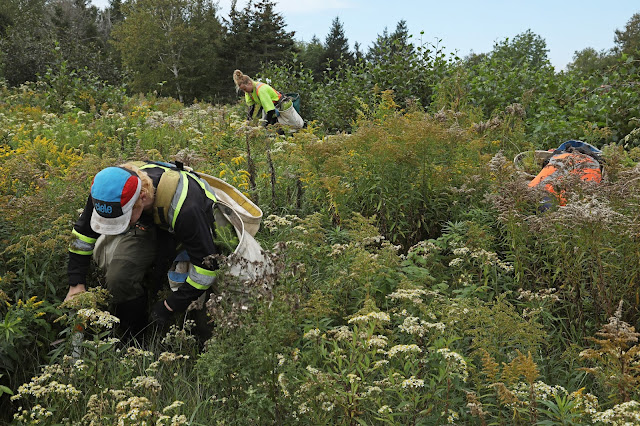
Here are a few photos of our team in action in 2021:


The second phase of planting on this project went very smoothly.  We're looking forward to returning next year to wrap up the final phase of the restoration work.  This project is getting very close to completion now, and the addition of a few more hardwood seedlings will finish this project in 2022.

We'd like to thank the staff at the Nova Scotia Department of Lands and Forestry for helping organize this project, and again to the Trees For Life organization for making this work possible.

You can see more photos of our 2021 tree planting work in our public 2021 Planting Photos folder on Dropbox.


If you'd like to learn more about the Five Island Provincial Park, visit their web page:

parks.novascotia.ca/park/five-islands


Thanks for reading!

- Jonathan Clark


Replant.ca Environmental is a Canadian company that plants trees for carbon capture and builds community forests.  We also plant trees in national, provincial, and municipal public parks to mitigate damage from wildfires, storms, insects, and forest diseases.  We operate thanks to numerous small contributions from the general public, in addition to larger project sponsorships from businesses and corporations around the world.  If you'd like to learn how to show your support, visit our donations page.  Even if you aren't able to make a contribution, we very much appreciate when people are able to share our posts or our website link on social media, to help spread the word about the work that we're doing!

To learn more about the various species that we plant, visit the conifers page or the deciduous (hardwoods) page on our website.  Thanks so much for your interest!

Incidentally, our organization is often seeking additional land for our carbon capture projects.  Please visit this link if you might know of a recently-harvested property that we could rebuild into a permanent legacy forest.


Monday, January 18, 2021

Five Islands Provincial Park, Environmental Tree Planting Project

Our work at Five Islands Provincial Park has been a multi-year project.  This blog post was written as a review of our initial efforts in 2020.  We have an updated post about our 2021 work at this link.  However, if you're curious about the work that we did in 2020, please read on ...


Our organization did some tree planting work at the Five Islands Provincial Park this past September (2020).


This provincial park is located in north central Nova Scotia, on the north side of the Minas Basin.  This is on the south side of the arm that connects most of mainland Nova Scotia with New Brunswick.  The town of Truro is about an hour to the east.  Here's an overview graphic of eastern Canada, showing the location of this park:


This project was put together to initiate afforestation on some open areas, and to repair some of the extensive damage done by Hurricane Dorian in 2019.  This storm battered central Nova Scotia quite strongly, and was the costliest storm in history when it came to damages to the provincial power grid.

Damages within the park were not as bad as in some of Nova Scotia's other provincial parks.  However, since there were open areas in the park from previous insect damage, this park was a prime candidate for the planting of some new seedlings.  When we offered to assist with this work, the park staff were very happy to accommodate.

The park foresters estimated that a series of openings along the upper sides of Camping Area B would be amenable to the addition of seedlings.  We decided that this project would be approached in two phases.  We would plant several thousand trees in the fall of 2020, and follow that up with a second phase of planting in the fall of 2021 to complete the project.

Before our team arrived on site, we were given some maps outlining the approximate area that the foresters recommended we focus on.  For context, here is one of those maps:


The first day that we arrived on site was cool and somewhat overcast, with high humidity in the air.  We were given a tour of the area, and we spent some time with the local forester doing a final review of the areas which would be covered.  This project was completed over a three-day span.  The second day of planting was sunny with cloudy periods.  The final day was rainy.  While some people don't like to work in the rain, we always like to see our new seedlings getting watered right away.

The ground covered was generally a shallow slope, with a full cover of vegetation and a few existing juvenile conifers.  Here are two representative photos:


Our species mix for this project included a total of seven species.  We had three conifers (red spruce, eastern white pine, and eastern hemlock), and four species of deciduous hardwoods (sugar maple, red oak, mountain ash, and yellow birch).  We planted almost nine thousand trees in this park in 2020, and will double that number in 2021.

Here's a photo of Chris (the head forester at the park), examining some of our red oak stock:


Here's a photo of some of the sugar maple seedlings that we planted:


Here are a few more photos taken while working on this project, including the welcome sign at the front entrance, a photo of myself (Jonathan) getting ready to plant some trees, a tree with a large burl, and three photos taken down near the beach:


The first phase of planting on this project went very smoothly.  We're looking forward to returning during the fall of 2021 to finish the work!  A post about that work will be linked here in late 2021.

If you'd like to learn more about the Five Island Provincial Park, visit their web page:

parks.novascotia.ca/park/five-islands


Thanks for reading!

- Jonathan Clark


Replant.ca Environmental is a Canadian company that plants trees for carbon capture and builds community forests.  We also plant trees in national, provincial, and municipal public parks to mitigate damage from wildfires, storms, insects, and forest diseases.  We operate thanks to numerous small contributions from the general public, in addition to larger project sponsorships from businesses and corporations around the world.  If you'd like to learn how to show your support, visit our donations page.  Even if you aren't able to make a contribution, we very much appreciate when people are able to share our posts or our website link on social media, to help spread the word about the work that we're doing!

To learn more about the various species that we plant, visit the conifers page or the deciduous (hardwoods) page on our website.  Thanks so much for your interest!

Incidentally, our organization is often seeking additional land for our carbon capture projects.  Please visit this link if you might know of a recently-harvested property that we could rebuild into a permanent legacy forest.

Monday, October 14, 2019

The Eastern White Pine tree (Pinus strobus)

This post will talk about one of our favorite tree species of the east coast, the Eastern white pine.  The Latin name for this species is Pinus strobus.  Here's a famous photo of a giant Eastern white pine tree in Virginia:


Eastern white pine (which is also referred to by some people in the Unites States as the northern white pine), is a beautiful species.  It grows all over eastern Canada and around the Great Lakes, and also throughout the northeastern seaboard of the United States.  Ironically, even though it is sometimes called the northern white, it doesn't really grow well north of New Brunswick, central Newfoundland, or southern Ontario.  Here's a map showing the typical range, thanks to Wikipedia:


Eastern white pine is a powerful species.  In mature forests, it is typically the largest tree that might be found, and often towers well above other species around it.  This tree can very easily grow to be more than forty meters tall (130 feet), and some historical specimens were reported to exceed sixty meters.  Even forty meters is very tall for the east coast!  There are a number of old eastern whites on our Charles Clark Forest Reserve property in Nova Scotia, and I'm going to try to get an accurate measurement of their height soon.  Thanks to the use of drone technology, it will be very quick and easy to get a measurement that should be accurate to within one meter.  A few of these old giants were blown down several years ago by Hurricane Juan, but a number of them survived and still thrive today.  Thankfully, they recently survived the impact of Hurricane Dorian too.

Although height is everyone's favorite metric when it comes to talking about big trees, let's not forget about DBH, which stands for "diameter at breast height."  A mature eastern white can measure between 1.0 and 1.5 meters across (that's about three to five feet, for our American followers).  Stand beside one, or try to wrap your arms around it, and you'll be humbled. What's even more impressive about this species is its lifespan.  Mature trees often live 200-250 years, and can sometimes live for more than four centuries.  Some native Americans referred to this type of tree as the "Tree of Peace," and Henry David Thoreau remarked, "There is no finer tree."

There's a great historical story about eastern white pines.  In the 1700's, these trees were often used as masts for ships.  Government representatives (early day timber cruisers) would search for the best specimens in the forests and etch a special mark (a broad arrow) into the bark of the tree.  These trees were then designated as property of the crown, and anyone who cut one down (and got caught doing so) was ostensibly given a fine for "stealing" the tree.  This lead to a backlash in the American colonies that was arguably even more significant than the tea tax or the Stamp Act, and eventually led to the Pine Tree Riot of 1772.  This incident was significant in the lead-up to the American Revolution.  You can learn more about the Pine Tree Riot at this wiki link:
  https://en.wikipedia.org/wiki/Pine_Tree_Riot

The eastern white pine is the provincial tree of Ontario.  Despite its majesty, it doesn't always grow symmetrically.  If growing in an area exposed to heavy winds, the tree will often have very short branches on the side exposed most chronically to the wind, and large drooping branches on the leeward side of the trunk.  This happens to other species too, but eastern white is probably more noted for it because these trees tower above other species, so this characteristic is more common in eastern whites.  Many of you probably know of Tom Thomson's famous painting, called "The Jack Pine."  You may not know that his first famous Canadian outdoor painting, entitled, "Byng Inlet, Georgian Bay," features three eastern white pine trees.  I won't post the image here due to potential copyright issues, but you can find it easily with a google search.

When young eastern white pines are growing, they can survive in any kind of soil, although they generally prefer sandy soils.  However, they're versatile, and can still survive in moist receiving zones.  They grow best when exposed to significant amounts of sunlight, but they're also very shade tolerant when young.  This lets seedlings become established as juvenile trees in understory plantations.  For this reason, eastern white pine seedlings do best when planted in open ground or in mature canopies with some open space (two extremes), but generally don't do well when planted in dense young stands with thick juvenile brush.

Different pine species tend to have different numbers of needles in their clusters, consistent to each species.  Some pines are two-needle, some are three-needle, and some are five-needle.  The eastern white, like most other white pines around the world, is a five-needle pine.  These needles grow to be as long as fifteen centimeters on mature trees, and stay on the tree for between one and four years before they fall off and are replaced with new growth.

For those of you who are more intimately familiar with forestry and arboriculture, two of the main diseases that hit eastern whites are Amillaria root rot and white pine blister rust.  The biggest insect pest that causes problems for this species is the white pine weevil.  The white pine weevil attacks eastern white pine in eastern North America, but tends to target spruce trees in western North America.

Here's a photo of one of the large eastern white pines on our Charles Clark Forest Reserve project in Nova Scotia.  It towers above the surrounding canopy!  Thankfully, Hurricane Dorian didn't blow it over.


Now you know a lot about one of our favorite tree species.  We'll leave you with this photo of some of the thousands of eastern white pine seedlings that we planted in 2019!  They're a very important part of our species mix when we're building our community forests and creating forest reserves for carbon capture.  You can learn more by going to our website and looking at our progress report page.


Thanks for reading!

- Jonathan Clark
www.replant-environmental.ca


Replant.ca Environmental is a Canadian company that plants trees for carbon capture and builds community forests.  We also plant trees in national, provincial, and municipal public parks to mitigate damage from wildfires, storms, insects, and forest diseases.  We operate thanks to numerous small contributions from the general public, in addition to larger project sponsorships from businesses and corporations around the world.  If you'd like to learn how to show your support, visit our donations page.  Even if you aren't able to make a contribution, we very much appreciate when people are able to share our posts or our website link on social media, to help spread the word about the work that we're doing!

Teachers are welcome to use content from this post for their classes.  If you know a teacher who might like to use this information, please share it with them!  The more that people learn about trees, the better our world will be.

To learn more about the various species that we plant, visit the conifers page or the deciduous (hardwoods) page on our website.  Thanks so much for your interest!

Incidentally, our organization is often seeking additional land for our carbon capture projects.  Please visit this link if you might know of a recently-harvested property that we could rebuild into a permanent legacy forest.