You won't often hear rural dwellers referring to this tree as the arborvitae. That term arborvitae is somewhat confusing. Many horticulturalists use it. However, arborvitae really refers to the entire Thuja s. genus, which includes five different species. The only other arborvitae is the western red cedar, which we plant very frequently in BC's western coastal areas. Incidentally, the word arborvitae comes from two separate words: Arbor, meaning "tree," and vitae, meaning "life." The implication is "tree of life."
When you look at the taxonomic classification of the Thuja genus, they belong to a family known as Cupressaceae, or more commonly known in English as cypress. That's right, the north American cedars are not even true cedars! Sigh. Why is tree classification so confusing? True cedars are only found natively in the Mediterranean and in the Himalayas. Let's get back to our "fake" cedar, the eastern white cedar.
Perhaps the most unique thing about cedar trees is the appearance of the needles. Cedar branches look very different than most other conifers, due to the flattened shape of the needles:

You can see that the needles almost look like scales.
When an eastern white cedar tree develops cones, they are quite small - only about one centimeter long. Each cone contains approximately eight seeds, however, the cones grow in very dense clusters. They start off as a yellowish colour, but then eventually turn to a fairly dark shade of brown. Here's a photo showing some immature cones that are still developing:

This species is not a large one. These trees rarely grow to be more than 15-25 meters in height (about 50-80 feet). However, even though they're usually not nearly as tall as many of the other mature conifer species in eastern Canada, their trunks can still grow fairly thick, sometimes reaching almost a meter in diameter (3 feet) at maturity. These measurements are typical for trees growing in the United States. When they're found in Canada, they're usually slightly smaller.
Cedar trees taste great, at least to deer. And that's a big problem. Deer are especially attracted to these trees. Exploding deer populations are causing all kinds of problems in many parts of Canada. In the town that I grew up in, in central Nova Scotia, the deer can be found everywhere throughout town, and ravage people's gardens and shrubbery. Cedar trees are one of the favorite species for deer to eat, and this is having a negative impact on cedar populations all over eastern North America.
On the west coast, when we plant cedar, we sometimes also install "browse protection devices" over the trees. A browse protector usually looks like a tall thin plastic cone, about three feet tall. We place a four-foot cedar stake beside a freshly planted cedar tree, and pound this stake into the ground with a mallet so it is firmly anchored, then place the cone over both the cedar seedling and the stake. The cone is then tied to the stake so it will remain in place for several years. The cones are translucent, which allows enough sunlight to reach the tree for photosynthesis. The tree grows up inside the cone for approximately 3-5 years, then the crew goes back into the plantation to remove the cones, so they can be re-used on another project. This system seems to work fairly well for letting the cedar seedlings become established until the trees are large enough that the deer start to ignore them (the deer prefer very young seedlings that are closer to the ground). Here's a photo of a browse cone, protecting a freshly planted young cedar:

Cedar trees can live for a very, very long time. Here's an interesting story: There is an old eastern white cedar located on the shore of Lake Superior in Minnesota. The Ojibwa refer to this tree as the Little Cedar Spirit Tree. The first known written reference to this specific tree happened way back in 1731, by a French explorer named Sieur de la Verendrye. The Ojibwa often leave tobacco around the tree as an offering to help protect them on voyages on Lake Superior. Despite this tree being quite famous, that doesn't mean that it's one of the oldest. It could be, but some eastern white cedars can live to be more than a thousand years old! Why would anyone ever want to cut one of these trees down?
Although this species prefers very moist climates, it has managed to carve out a fairly large footprint in eastern Canada by taking advantage of conditions where other larger and faster-growing trees have problems thriving. These cedar trees can survive on rocky cliffs, and in very moist swampy areas. In that sense, this cedar is a good species to mix with black spruce when the ground conditions are appropriately moist. Although eastern white cedar isn't found commonly throughout Nova Scotia or in the eastern half of Prince Edward Island, it has a wide range throughout the rest of eastern and central Canada and the northeastern United States. Here's a range map, courtesy of Wikipedia:

I want to leave you with a few interesting facts about this species:
1. When a branch falls from an eastern white cedar, it can sometimes lay out new roots into the ground and grow into a new tree, if the conditions are just right!
2. The inner bark of this tree is tough enough to make into string or rope.
3. Some people plant this species in their back yards specifically to attract wildlife. Besides deer, rabbits and many types of birds are also attracted to this tree.
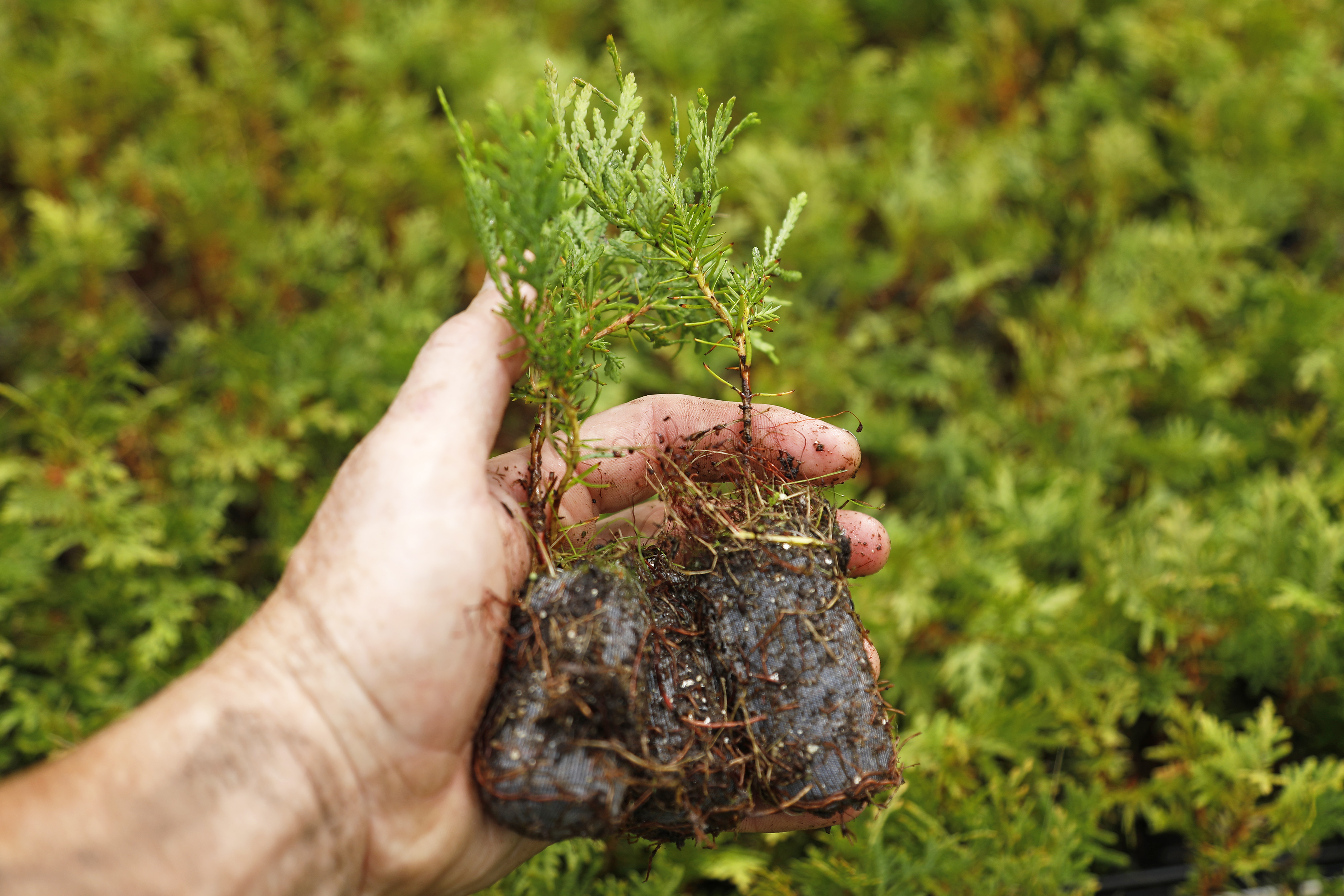
For the 2020 planting season, we included several thousand eastern white cedars in our species mixes at Replant.ca Environmental. We planted these trees in areas with more moisture or shade, including understory areas, near streams, and in swampy areas. Even though they are one of the less voluminous conifers in our mixes, and there is a higher risk of some mortality due to deer browsing, we feel that these are a very beneficial species to add to our mixes. Here's a photo of some of our eastern white cedar seedlings:
Thanks for reading ...
- Jonathan Clark
www.replant-environmental.ca
Replant.ca Environmental is a Canadian company that plants trees for carbon capture and builds community forests. We also plant trees in national, provincial, and municipal public parks to mitigate damage from wildfires, storms, insects, and forest diseases. We operate thanks to numerous small contributions from the general public, in addition to larger project sponsorships from businesses and corporations around the world. If you'd like to learn how to show your support, visit our donations page. Even if you aren't able to make a contribution, we very much appreciate when people are able to share our posts or our website link on social media, to help spread the word about the work that we're doing!
Teachers are welcome to use content from this post for their classes. If you know a teacher who might like to use this information, please share it with them! The more that people learn about trees, the better our world will be.
To learn more about the various species that we plant, visit the conifers page or the deciduous (hardwoods) page on our website. Thanks so much for your interest!
Incidentally, our organization is often seeking additional land for our carbon capture projects. Please visit this link if you might know of a recently-harvested property that we could rebuild into a permanent legacy forest.

