Showing posts with label scooter. Show all posts

Wednesday, November 27, 2019

The Jack Pine tree (Pinus banksiana)

Let's take a look at another pine tree that we plant, the Jack Pine.  This tree is also referred to as the scrub pine, the grey pine, the Hudson Bay pine, or the Banksian pine.  The latter name is due to its Latin name, Pinus banksiana.  The term "scrub pine" seems somewhat dismissive.  Where is the love?

To be fair, the Jack pine is not the most impressive species out there.  We mix some Jack pine into our species mixes sometimes, but that's more for diversity than because it's a major contributor to carbon capture.  We also plant two other types of pine (Norway and Eastern White) in larger quantities.  Still, diversity is important.  What happens if global warming raises average temperatures by several degrees over the next few decades?  This could have a seriously negative effect upon many of the species currently growing in Canada, and we think that Jack pine is the conifer that is least likely to be affected if temperatures do get that high (eastern white pine being the second least vulnerable).

Here's a photo of some Jack pine trees, courtesy of Wikipedia.  I'll try to replace this photo with one of my own at some point:


The range of the Jack pine is quite broad.  There are a lot of different species of pine trees in the world (about 120, depending on whom you ask).  In western Canada, you can find about twenty different pine species, four of which I've planted while working in commercial operations.  In eastern Canada, you can find about thirteen species, three of which we plant at Replant.ca Environmental.  As far as I'm aware, Jack pine has the largest geographic distribution range within Canada (of the pines).  Here's a graphic from Wikipedia to illustrate that:


Despite its broad range and hardiness, the reason that Jack pine is often omitted from "favorite tree" lists is because it doesn't grow as large as some other types (such as Eastern white pine), and the trunk doesn't often grow as straight or majestically.  Due to this, many foresters and carpenters don't get as excited by Jack pine as they do by other types of pine, although to be honest, this probably has saved more than a few individual trees from the axe.  Under good growing conditions, Jack pine usually only reaches a height of 15-20 meters at maturity (50-65 feet), and the trunk doesn't often exceed a diameter of about 50 centimeters (one and a half feet).  As mentioned, the trunks can often be twisted or knotty, so when it is used commercially, it is often more likely to be used for pulpwood than for lumber.

Jack pines can be affected by quite a few diseases.  There are weevils and sawflies and budworms that attack the trees.  Jack pine can also be affected by a disease called sweet fern blister rust.  When this happens, Jack pine is an inadvertent victim.  Normally, sweet fern blister rust affects sweet ferns, but the spores can drift onto Jack pine and attack the trees too.

Jack pine is somewhat similar to lodgepole pine, which we plant very frequently on commercial projects all over the west coast.  Like lodgepole pine, the cones of Jack pine tend to open during periods of extreme heat (including wildfires).  Remember that occasional mild wildfires can be beneficial to the overall forest ecosystem.  However, Jack pine don't regrow in densities as thick as lodgepole does after a fire.  Also, on a mature tree, the Jack pine cones look quite different because they usually point forward along the branches.

When trying to identify a pine tree, it's always important to see how many needles come in each cluster.  Each pine species is quite distinct, usually having either two, three, or five needles per cluster.  Jack pine is a two-needle pine.

When I talked about eastern white pine, I mentioned one of Tom Thomson's famous paintings, "Byng Inlet, Georgian Bay."  The Jack pine is featured in an even more well-known painting by Tom Thomson, entitled "The Jack Pine."  That painting is currently held by the National Galley of Canada.  Here's an image of that very recognizable painting, courtesy of the NGC:


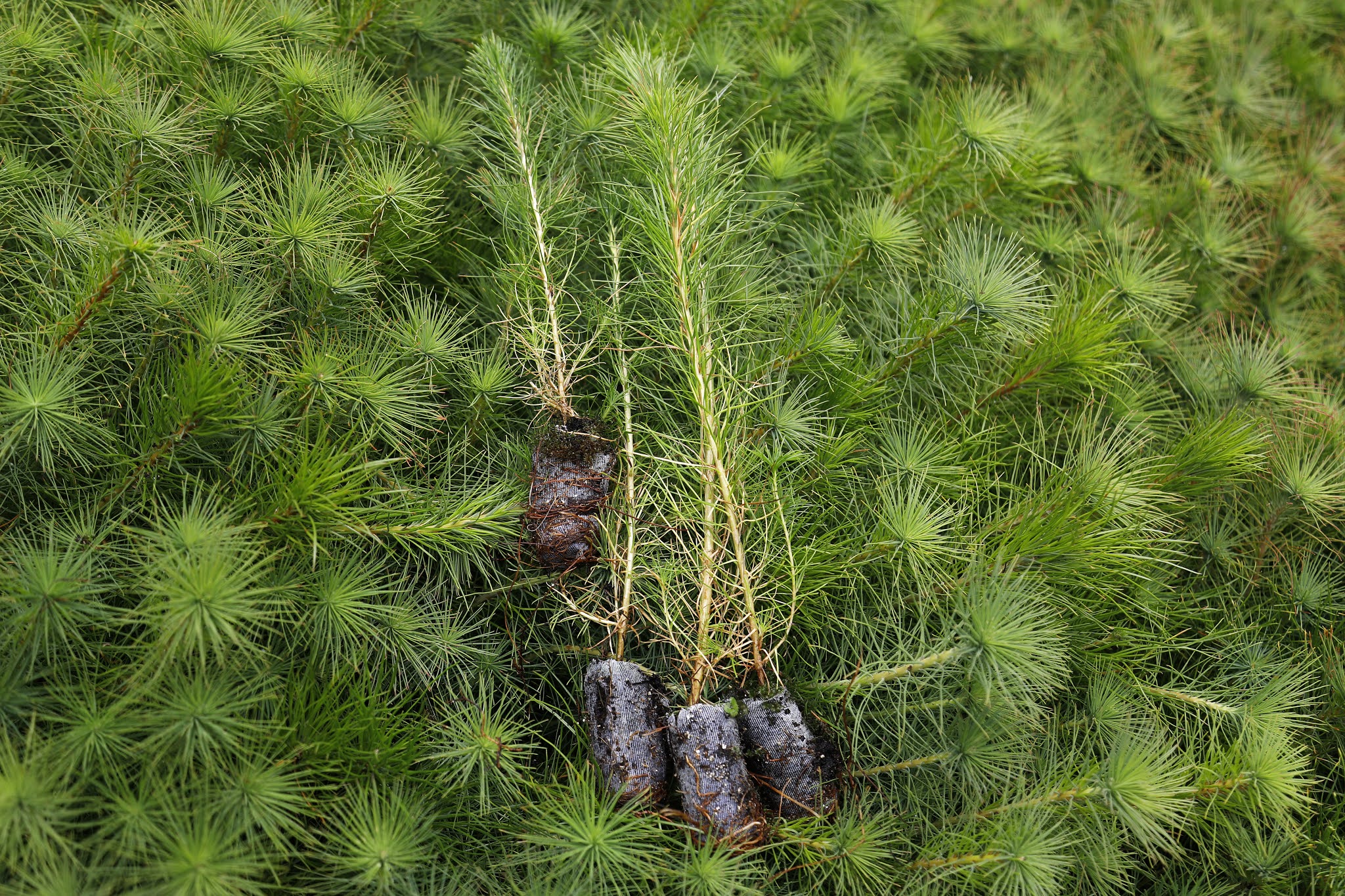
Although the Jack pine will probably never feature heavily in our mixes, we have to give it credit for being sturdy and hardy, which is why this species is the most common tree found throughout Canada!  I'll leave you with a photo of some of our Jack pine seedlings:


Thanks for reading ...

- Jonathan Clark
www.replant-environmental.ca


Replant.ca Environmental is a Canadian company that plants trees for carbon capture and builds community forests.  We also plant trees in national, provincial, and municipal public parks to mitigate damage from wildfires, storms, insects, and forest diseases.  We operate thanks to numerous small contributions from the general public, in addition to larger project sponsorships from businesses and corporations around the world.  If you'd like to learn how to show your support, visit our donations page.  Even if you aren't able to make a contribution, we very much appreciate when people are able to share our posts or our website link on social media, to help spread the word about the work that we're doing!

Teachers are welcome to use content from this post for their classes.  If you know a teacher who might like to use this information, please share it with them!  The more that people learn about trees, the better our world will be.

To learn more about the various species that we plant, visit the conifers page or the deciduous (hardwoods) page on our website.  Thanks so much for your interest!


Incidentally, our organization is often seeking additional land for our carbon capture projects.  Please visit this link if you might know of a recently-harvested property that we could rebuild into a permanent legacy forest.

Monday, November 11, 2019

Calling on Artists for a Music Compilation of Tree Planting Songs

There are a lot of great songs about tree planting, written by various talented Canadian planters.  I'd like to see some of those shared to a wider audience, therefore, I'm going to use Replant.ca Environmental to sponsor the production of a compilation of songs about tree planting, by tree planters.


Edit:  This compilation is now complete.  It was very well received, and we'll be publishing another volume in 2024.  Please contact us if you're interested in participating, but in the meantime, here's a link to the 2020 compilation:

The Flagging Tapes, Vol. 1

Back to the original post ...


I'm aware of two previous planting music compilations:  "Planters' Punch" and "Hi & Ho, We Plant Trees."  You can find both of these by going to my public Dropbox folder at replant.ca/dropbox and then going into the "Canadian Reforestation" sub-folder, then into the "Planting Music" sub-folder.  All of the songs from these compilations have been shared publicly with permission of the organizers of the CD's (Michael & Peter).

Planters' Punch was compiled by Michael Mloszewski.  Click on his name to learn more background about Michael.  This compilation was put together in the late 1990's, if my information is correct.  Although all the songs were written or performed by planters, some don't actually have planting as the theme to the lyrics.

Hi & Ho, We Plant Trees was organized and compiled by Peter Krahn, who is still a very active member of our planting community.  I believe that this double album may have been released around 2005?  All of the songs on this album have planting as the central theme.  I've heard many of these songs when getting into crew trucks at various companies.

Anyway, it's time for a new album.  I've already been contacted by more than half a dozen planters who want to contribute songs to the album.  Artists will have to agree to have their songs published (internet) for free downloading.  None of the music will be sold, and no physical CD's will be produced.  There will be an independent panel of judges who review all submissions, to ensure that they meet a certain minimal level of quality.  Artists will be encouraged to register their songs with SOCAN in order to qualify for any potential public broadcast royalties.

This compilation will be made available at no cost to the planting community.

---------------------
 
Edit, February 2020:  This album is now available as a free download!  Visit:


---------------------


Artists who are in the central Maritime provinces can have their tracks recorded for this compilation at my own studio (no cost), if they'd like.  I'll be located in Sackville, New Brunswick.  I'll be able to do recording sessions between mid-December and mid-January.  For anyone who is located too far away for this, you'll have to find a way to get a professional-sounding recording done on your own, at your own expense.  Home studio recordings are fine, as long as they sound good.  Once the songs are collected, I'll get the collection mastered properly.  That process will start around January 20th, 2020, so ideally all tracks need to be submitted by about January 15th.

If anyone else is interested in contributing to this project, please email me at jonathan.scooter.clark@gmail.com and give me a bit of information about your music.  Ideally, I'd like to be able to release this compilation by mid-February at the latest, before my spring coastal season starts.

Thanks for your interest, and please share this with other planter-musicians.

- Scooter
www.replant-environmental.ca


Incidentally, our organization is often seeking additional land for our carbon capture projects.  Please visit this link if you might know of a recently-harvested property that we could rebuild into a permanent legacy forest.

Friday, November 1, 2019

How Many Trees are Planted in Canada Each Year?

I've been curious to know approximately how many trees are planted in Canada each year.  Apparently, I'm not the only one, since several other people have asked me this same question over the past month.  I'm going to try to come up with a very rough guess here, based upon what little information I can find, coupled with some semi-educated assumptions.  If anyone has any access to official data for any of the provinces, please let me know so I can update this post!  I originally wrote this post for my commercial tree planting blog, but it's good information for anyone thinking about our national capacity for tree planting for carbon capture purposes.

British Columbia
This one is easiest, since the Western Forestry Contractors' Association pays close attention to these numbers, and publishes charts frequently.  Their best guess for 2020 planting in BC is approximately 308 million trees.  They base their information upon a survey of sowing requests at various forest nurseries.
Source:  https://wfca.ca/2019/09/western-forestry-contractors-association-rumour-mill-roundupdate-volume-19-issue-13/

Alberta
I have 2016 data for Alberta.  That year, the province planted 57,605 Ha of the 83,786 Ha harvested (the rest was left for natural regeneration).  Assuming an average planting density of 1500 stems/Ha, which is purely a guess, I estimate approximately 86 million trees.

Saskatchewan
I have 2016 data for Saskatchewan.  That year, the province harvested 17,701 Ha.  Let's assume that they planted half of that amount, and that the average planting density was 1500 stems/Ha.  Those assumptions may be quite inaccurate, but the number of trees in Saskatchewan doesn't significantly affect the national total.  I estimate approximately 13 million trees.  Lots of room for growth in the northern boreal.

Manitoba
I have 2016 data for Manitoba, which is very similar to Saskatchewan in limitation.  Manitoba harvested 10,686 Ha in 2016, so if we again estimate that half of that area was replanted, at a density of 1500 stems/Ha, we have another 8 million trees.

Ontario
In 2016, Ontario planted 67,369 Ha of land (57% of the 117,230 Ha harvested).  If we estimate a planting density of 1500 stems/Ha, that works out to approximately 101 million trees.  Incidentally, Ontario is the only province that also seeds significant areas.  In 2016, about eleven thousand hectares were seeded throughout the province (this figure is not included in the planting totals).

Quebec
I have 2016 data for Quebec.  Quebec harvested 205,859 Ha and planted 36% of that (73,344 ha).  Incidentally, Quebec is the only province that harvests a greater land base annually than BC.  Let's again assume an average planting density of 1800 stems/Ha (this number based upon feedback from several long-time Quebec tree planters).  That gives us about 132 million trees planted annually in Quebec.

The Atlantic Provinces
There's a surprising amount of planting in New Brunswick and Nova Scotia.  Not as much in Newfoundland, and practically none in Prince Edward Island.  It's hard to tell how much planting actually takes place, because a very large percentage of blocks in the Atlantic provinces are left for natural regen.  Despite this, I know that several hundred planters work in the very fragmented industry each year.  Perhaps the best indicator would be to get a census on total sowing at all the forest nurseries in those provinces.  I'm going to have to guess for now, in lieu of any sort of reasonable data, and say that 40 million trees are planted each year in these four provinces combined.  I did find that New Brunswick planted 17,625 Ha in 2016, Nova Scotia planted 5,024 Ha in 2016, PEI planted 317 Ha, and Newfoundland planted 3,721 Ha, for a four-province total of 22,167 hectares.
Source:  https://cfs.nrcan.gc.ca/statsprofile


Totals:
308m  British Columbia
  86m  Alberta
  13m  Saskatchewan
    8m  Manitoba
101m  Ontario
132m  Quebec
  40m  Atlantic Provinces
688m  Canada-Wide


Well there you have it.  There are probably several inaccurate numbers in there, but hopefully the mistakes balance each other out to some extent so that the overall total is reasonably close.

Incidentally, I found data from Natural Resources Canada which states that 410,221 Ha were planted in 2016, Canada-wide.  Too bad that they didn't give the number of trees.  Anyway, if our estimate of 688 million trees is correct, then that would suggest that the average planting density across the country is approximately 1677 stems/Ha.  This seems reasonable based upon personal experience.


- Jonathan Clark
www.replant-environmental.ca


Our organization is often seeking additional land for our carbon capture projects.  Please visit this link if you might know of a recently-harvested property that we could rebuild into a permanent legacy forest.