Showing posts with label new brunswick. Show all posts

Sunday, February 22, 2026

Tree Planting Project in Fundy Trail Provincial Park, New Brunswick (2025)

Our organization did some more tree planting work in the Fundy Trail Provincial Park this past September (2025).  This work was funded entirely by the Forests Canada organization as the Project Sponsor.


Within this provincial park, the Fundy Trail Parkway is a 30 kilometer long drive , hugging the coastal cliffs along southern New Brunswick.  It has stunning views of the Bay of Fundy, and the area encompasses two separate UNESCO designated sites (the Fundy Biosphere Reserve and the Stanhammer Global GeoPark).  The area is also home to the start of the "Fundy Footpath" hiking path, which is rated as one of the top fifty hiking trails in the world!  Fundy National Park is very close.

The Parkway started off as a not-for-profit and charitable park (not part of Fundy National Park) which was run by a skills-based board of directors, who were appointed for three-year terms by New Brunswick's Minister of Tourism, Culture, and Heritage.  The Parkway has recently been designated as one of New Brunswick's provincial parks.

Here's a graphic showing the approximate region where we were working:


The approximate GPS coordinates at the Info Centre (close to where our team started) are:  45.490804, -65.308758


The Parkway was built very recently.  Sections of it opened in 2020, and the remaining connector from Alma opened in June of 2022.  A number of gravel and borrow pits were needed during the construction phase, and our past work involved the remediation of several of these areas, adding trees so the pits (which have been filled in) will be eventually be covered with forest again.  In addition to the visual value of obscuring the landscape scars, there are also the obvious benefits of increasing carbon sequestration and providing additional habitat for birds and other animals.  Basically, several goals aligned with the work that we carried out. 

For our 2025 project, the majority of our work focused upon planting trees in a recent addition to the park's land base, a hundred-acre property in Cradle Brook that a previous private owner had logged, which the province managed to acquire to become part of the park.  These new trees will now be protected and allowed to grow in perpetuity.

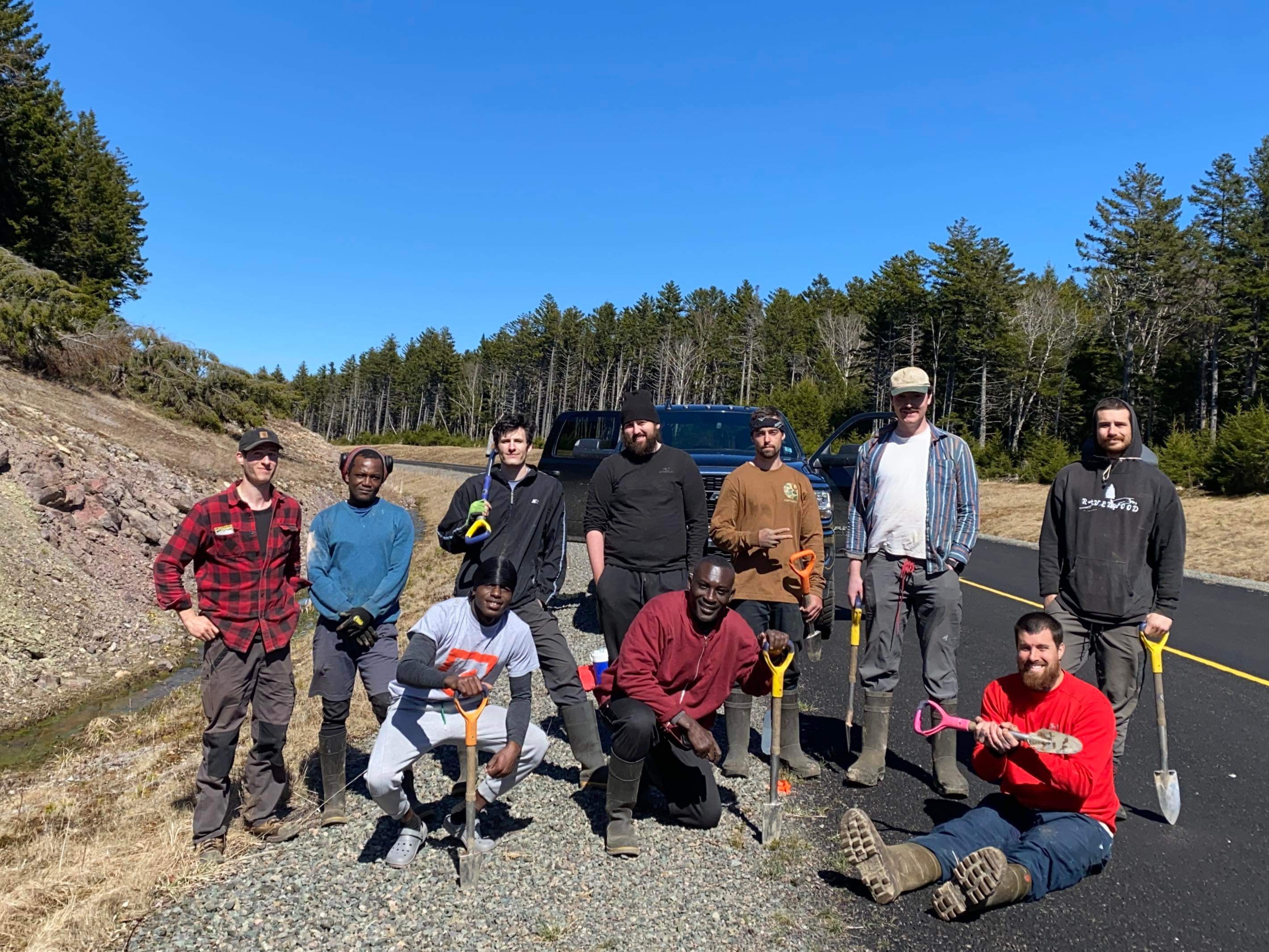
We planted 90,445 more trees in Fundy Trail Provincial Park during the 2025 phase of our multi-year project to help improve the park! 

Here are a few photos of the planting team in action:


This project went very smoothly.  We expect to return in 2026 to add some additional seedlings in areas which are not yet complete.  Naturally, we will also be making regular visits back to monitor the long-term growth and health of the planted trees.

We'd like to thank the staff at NB Parks (especially Josh & Osman) for helping make this project work, and again want to thank the Forests Canada organization for being the sponsor that made this work possible.


You can see more photos of our tree planting work at this site by visiting our Planting Photos folder on Dropbox, then going into the "2025 Planting Photos" folder, then into the "Fundy Trail Parkway" sub-folder.  Start here:

    www.replant-environmental.ca/photos


If you'd like to learn more about the Fundy Trail Provincial Park, visit their web page:

www.nbparks.ca/en/parks/35/fundy-trail-provincial-park


Thanks for reading!

- Jonathan Clark


Replant.ca Environmental is a Canadian company that plants trees for carbon capture and builds community forests.  We also plant trees in national, provincial, and municipal public parks to mitigate damage from wildfires, storms, insects, and forest diseases.  We operate thanks to numerous small contributions from the general public, in addition to larger project sponsorships from businesses and corporations around the world.  If you'd like to learn how to show your support, visit our donations page.  Even if you aren't able to make a contribution, we very much appreciate when people are able to share our posts or our website link on social media, to help spread the word about the work that we're doing!


To learn more about the various species that we plant, visit the conifers page or the deciduous (hardwoods) page on our website.  Thanks so much for your interest!

Incidentally, our organization is often seeking additional land for our carbon capture projects.  Please visit this link if you might know of a recently-harvested property that we could rebuild into a permanent legacy forest.


Saturday, November 23, 2024

Tree Planting Project at Herring Cove Provincial Park, New Brunswick (2024)

Our organization did some tree planting work at Herring Cove Provincial Park this past September.  This work was funded entirely by the Forests Canada organization through their Forest Recovery Canada initiative as the Project Sponsor.


This provincial park is located in the very southwest corner of New Brunswick, on Campobello Island (which is northeast of Grand Manan Island).  From the United States, Herring Cove is only a six minute drive from the border bridge at Lubec Narrows.  From our home base in Canada, the route is slightly more complicated, involving two ferry crossings in each direction, first to Deer Island and then on to Campobello Island.  Here's an overview graphic, courtesy of Google Earth:


The approximate GPS coordinates at the park visitor centre are:  44.87716, -66.93423


Most of the planting for this particular project involved planting tree seedlings where the Park staff wanted to improve visual buffers between camping sites (with existing sporadic mature trees).  We also planted a few trees in some open areas that should be returned to forest land, and in parts of the understory where the canopy could use eventual thickening and diversity.  The afforestation and the underplanting with both be important for carbon sequestration and climate change mitigation, and will provide additional habitat for birds and wildlife.  Basically, several goals aligned with the work that we carried out.  The following graphic shows the approximate locations for the new seedlings:


In total, our planting team added 13,443 trees to the Park this year!

Here are a few photos of the planting team in action:


This project went very smoothly.  We were able to complete the planned planting on all of the current-year targeted areas within this park.  We expect to return at some point in the near future to add more seedlings to additional areas.  Naturally, we will also be making regular visits back to monitor the long-term growth and health of the planted trees.

We'd like to thank the staff at NB Parks for helping with the logistical planning that ensured this project came together, and we again want to thank the Forests Canada organization for being the sponsor that made this work possible.

You can see more photos of our tree planting work at this site by visiting our Planting Photos folder on Dropbox, then going into the "2024 Planting Photos" folder, then into the "Herring Cove Provincial Park" sub-folder.  Start here:

    www.replant-environmental.ca/photos


If you'd like to learn more about Herring Cove Provincial Park, visit their web page:

www.parcsnbparks.info/en/parks/6/herring-cove-provincial-park


Thanks for reading!

- Jonathan Clark


Replant.ca Environmental is a Canadian company that plants trees for carbon capture and builds community forests.  We also plant trees in national, provincial, and municipal public parks to mitigate damage from wildfires, storms, insects, and forest diseases.  We operate thanks to numerous small contributions from the general public, in addition to larger project sponsorships from businesses and corporations around the world.  If you'd like to learn how to show your support, visit our donations page.  Even if you aren't able to make a contribution, we very much appreciate when people are able to share our posts or our website link on social media, to help spread the word about the work that we're doing!


To learn more about the various species that we plant, visit the conifers page or the deciduous (hardwoods) page on our website.  Thanks so much for your interest!

Incidentally, our organization is often seeking additional land for our carbon capture projects.  Please visit this link if you might know of a recently-harvested property that we could rebuild into a permanent legacy forest.


Tree Planting Project in Tantramar, New Brunswick (2024)

Here's a post about another carbon sequestration project that we recently completed on behalf of one of our Sponsor Partners.  The tree planting work on this site in southeastern New Brunswick was done in the Spring of 2024.  The work was done at a large site on the side of the TransCanada Highway, just west of Sackville.  The planting on this site was entirely sponsored by One Tree Planted.


This site was harvested about a decade and a half ago, by a third party, and our goal was to help rebuild a new forest there.  The site is large and easily accessible, and might be a great site for a public park in the future.  It is fairly close to Sackville's Beech Hill Park, which has some nice recreation trails, and trails on this site could complement those that are already built in the area.

As noted, although we hope to provide future opportunities for public recreation on this site, the primary initial purpose of this project was to support climate stability through carbon sequestration.  As a side benefit, this site will support biodiversity and wildlife habitat.  There were already some healthy trees growing on this site (mostly balsam fir, white spruce, American beech, trembling aspen, red maple, and white birch) so we were able to plant at fairly low density, adding only 33,750 more trees (mostly eastern white pine seedlings) into open areas on this 121.8 acre site.  Diverse forests are healthy forests, and eastern white pine is an especially appealing native tree when considering possible negative future climate change scenarios.

Here are a few more photos taken during the planting of this project, which took place in late April of 2024:


You can see more photos of our tree planting work at this site by visiting our Planting Photos folder on Dropbox, then going into the "2024 Planting Photos" folder, then into the "Tantramar Rec Trails" sub-folder.  Start here:

    www.replant-environmental.ca/photos


We look forward to studying this site in the coming years.  We will be doing periodic surveys to assess the carbon capture progress of the new forest, and hope to start exploring the possibility of building recreational trails in 2027.

Again, a huge thanks to One Tree Planted, the sponsors and lead on this major project.


Thanks for reading!

- Jonathan Clark


Replant.ca Environmental is a Canadian company that plants trees for carbon capture and builds community forests.  We also plant trees in national, provincial, and municipal public parks to mitigate damage from wildfires, storms, insects, and forest diseases.  We operate thanks to numerous small contributions from the general public, in addition to larger project sponsorships from businesses and corporations around the world.  If you'd like to learn how to show your support, visit our donations page.  Even if you aren't able to make a contribution, we very much appreciate when people are able to share our posts or our website link on social media, to help spread the word about the work that we're doing!

To learn more about the various species that we plant, visit the conifers page or the deciduous (hardwoods) page on our website.  Thanks so much for your interest!

Incidentally, our organization is often seeking additional land for our carbon capture projects.  Please visit this link if you might know of a recently-harvested property that we could rebuild into a permanent legacy forest.


Tree Planting in Mactaquac Provincial Park, New Brunswick (2024)

This past Fall (2024), Replant.ca Environmental finished the third phase of our long-term tree planting project at Mactaquac Provincial Park.  The work that we did in 2024 was made possible by support from Forests Canada (formerly known as Forests Ontario), and their ongoing Forest Recovery Canada program.

Mactaquac Provincial Park is only a 30 minute drive from Fredericton, over to the west through either Keswick or French Village.  The park is situated on the St. John River, across from the Mactaquac Dam and power generating station.  This station generates one eighth of the electricity for the entire province of New Brunswick.


Here's a graphic (courtesy of Google Earth) showing the location of the park:


Mactaquac has a golf course, campground, two beaches, hiking trails, and [in the winter] it also has cross-country skiing trails.  The camping options are excellent, with around four hundred camping sites and several rustic cabins.  The washrooms and showers were extremely clean, and the entire project was a wonderful experience.  Here's a link for anyone who wants to make reservations:

www.parcsnbparks.info/en/parks/10/mactaquac-provincial-park


In 2014, the first named hurricane of the season was Hurricane Arthur.  It was a very early hurricane, hitting North America in early July.  It swept up the east coast and over the Maritime provinces.  The winds did a tremendous amount of damage to trees and infrastructure, especially in the Fredericton area.  Mactaquac was hit quite hard, and lost a lot of trees.  Our goal was to start the slow process of replanting some of the areas that had blown down during that storm several years earlier, and also to begin creating new wooded areas in other sections of the park.

We had already done work in this park in both 2021 and 2022. The green areas that can be seen in the image below are from those earlier phases.  This year, we were able to complete five more sections in May (outlined in red) and one more section in the September (outlined in blue), as can be seen here:


Most of the planting for this site involves planting tree seedlings in fairly open areas, where the Parks team is turning some of the under-utilized fields and openings into future mature stands of trees.  This latter goal is important for carbon sequestration and climate change mitigation, and provides additional habitat for birds and wildlife.  It also allows the Park to better manage their budget for grounds maintenance (controlling the costs related to mowing the grass). There is also some underplanting at lower densities in some of the thinner sections of woods that are still recovering from the damage created by Hurricane Arthur.

Here are a few photos of the team in action at Mactaquac:


You can see more photos of our tree planting work at this site by visiting our Planting Photos folder on Dropbox, then going into the "2024 Planting Photos" folder, then into the "Mactaquac Provincial Park" sub-folder.  Start here:

    www.replant-environmental.ca/photos


We'd like to thank Kevin (the Park Manager) and Rob and their staff for their hospitality and support while we were on site.  We definitely look forward to returning in 2023 to continue the work that Forests Canada is making possible.


Jonathan "Scooter" Clark


Replant.ca Environmental is a Canadian company that plants trees for carbon capture and builds community forests.  We also plant trees in national, provincial, and municipal public parks to mitigate damage from wildfires, storms, insects, and forest diseases.  We operate thanks to numerous small contributions from the general public, in addition to larger project sponsorships from businesses and corporations around the world.  If you'd like to learn how to show your support, visit our donations page.  Even if you aren't able to make a contribution, we very much appreciate when people are able to share our posts or our website link on social media, to help spread the word about the work that we're doing!

To learn more about the various species that we plant, visit the conifers page or the deciduous (hardwoods) page on our website.  Thanks so much for your interest! 

Incidentally, our organization is often seeking additional land for our carbon capture projects.  Please visit this link if you might know of a recently-harvested property that we could rebuild into a permanent legacy forest. 


Tree Planting at the Fundy Trail Provincial Park, New Brunswick (2024)

Our organization did some more tree planting work in the Fundy Trail Provincial Park this past April and September.  This work was funded entirely by the Beam Suntory organization as the Project Sponsor.  Among other brands within their Canadian portfolio, Beam Suntory are the distillers of Alberta Pure Vodka.


Within this provincial park, the Fundy Trail Parkway is a 30 kilometer long drive , hugging the coastal cliffs along southern New Brunswick.  It has stunning views of the Bay of Fundy, and the area encompasses two separate UNESCO designated sites (the Fundy Biosphere Reserve and the Stanhammer Global GeoPark).  The area is also home to the start of the "Fundy Footpath" hiking path, which is rated as one of the top fifty hiking trails in the world!  Fundy National Park is very close.

The Parkway started off as a not-for-profit and charitable park (not part of Fundy National Park) which was run by a skills-based board of directors, who were appointed for three-year terms by New Brunswick's Minister of Tourism, Culture, and Heritage.  The Parkway has recently been designated as one of New Brunswick's provincial parks.

Here's a graphic showing the approximate region where we were working:


The approximate GPS coordinates at the Info Centre (close to where our team started) are:  45.490804, -65.308758


The Parkway was built very recently.  Sections of it opened in 2020, and the remaining connector from Alma opened in June of 2022.  A number of gravel and borrow pits were needed during the construction phase, and our work involved the remediation of several of these areas, adding trees so the pits (which have been filled in) will be eventually be covered with forest again.  In addition to the visual value of obscuring the landscape scars, there are also the obvious benefits of increasing carbon sequestration and providing additional habitat for birds and other animals.  Basically, several goals aligned with the work that we carried out. 

We had planted some of the gravel pits in 2022, and we continued work in other areas for this project in 2024.  Altogether, our planting team added 31,446 more trees to the Parkway with the 2024 phase of the project!  

Here are a few photos of the planting team in action:


This project went very smoothly.  We expect to return in 2025 to add some additional seedlings in areas which are not yet complete.  Naturally, we will also be making regular visits back to monitor the long-term growth and health of the planted trees.

We'd like to thank the staff at NB Parks (especially Josh & Osman) for helping make this project work, and again want to thank the Beam Suntory organization for being the sponsor that made this work possible.


You can see more photos of our tree planting work at this site by visiting our Planting Photos folder on Dropbox, then going into the "2024 Planting Photos" folder, then into the "Fundy Trail Parkway" sub-folder.  Start here:

    www.replant-environmental.ca/photos


If you'd like to learn more about the Fundy Trail Provincial Park, visit their web page:

www.fundytrailparkway.com


Thanks for reading!

- Jonathan Clark


Replant.ca Environmental is a Canadian company that plants trees for carbon capture and builds community forests.  We also plant trees in national, provincial, and municipal public parks to mitigate damage from wildfires, storms, insects, and forest diseases.  We operate thanks to numerous small contributions from the general public, in addition to larger project sponsorships from businesses and corporations around the world.  If you'd like to learn how to show your support, visit our donations page.  Even if you aren't able to make a contribution, we very much appreciate when people are able to share our posts or our website link on social media, to help spread the word about the work that we're doing!


To learn more about the various species that we plant, visit the conifers page or the deciduous (hardwoods) page on our website.  Thanks so much for your interest!

Incidentally, our organization is often seeking additional land for our carbon capture projects.  Please visit this link if you might know of a recently-harvested property that we could rebuild into a permanent legacy forest.


Tuesday, February 21, 2023

The Butternut Tree (Juglans cinerea)

Today I'm going to talk about the Butternut, which is also more formally known as the White Walnut tree.  This tree is an endangered species in Canada.  It grows fairly widely in the US, where is it also endangered.  Even though it is endangered here in Canada, butternut trees grow quite commonly in southern Ontario, southern Quebec, and in parts of New Brunswick (especially the Saint John river valley).  The problem is that the population is diminishing, when if anything, it should be expanding in range (due to climate change).  Butternut prefers a slightly cooler climate than black walnut, hence why it is more common to find in parts of Canada.

Here's a photo of a very large butternut tree:


Here's a range map for this species, courtesy of Wikipedia:


Butternut grows best on stream banks and in well-drained soils.  Like black walnut, the butternut is a pioneer species which needs open sunlight.  Butternut trees are quite shade intolerant, so you won't find them deep in a mature forest.  It will last for almost a century in mixed forests where it is part of the over-story, but young trees do not want to grow under the canopy.

Like black walnuts, the nuts are edible.  They're very tasty, and [not surprisingly] have more of a buttery taste than black walnuts (hence the name).  The shells are encased in a soft sticky husk.  These shells are hard to crack, but not as difficult as black walnuts.  The resulting nut, when you get it out of the shell, is about the same size as a pecan.

Here's a photo showing a cracked shell of a butternut:


The leaf of a butternut is a large one, which typically has 11-17 smaller leaflets on it.  Like the black walnut, many people are confused by the individual leaflets and think they're the leaves.  On the butternut, the terminal leaflet at the tip of the leaf is usually quite large.  This is distinctly helpful to aid in contrasting the leaves with those of black walnut (which are small at the tip of the leaf).  Here's a photo of a butternut leaf:


The butternut is especially susceptible to a fungus which is killing trees all over North America.  This is why it is currently endangered.  The butternut trees in New Brunswick are thought to be slightly more resistant to this fungus, but they're still susceptible.  Several organizations and groups in New Brunswick are trying to help save this tree.  Here's a CBC article that is relevant:

www.cbc.ca/news/canada/new-brunswick/butternut-tree-miramichi-vikings-extinct-research-scientist-new-brunswick-1.4143430


Here are some Fun Facts about the butternut:

1.  The fattest known butternut is located in Oneida, New York state.  The circumference of the trunk at breast height was 24 FEET when measured a few years ago.  That's a 7.3 meter circumference.  Massive.

2.  Butternut wood is prized by furniture-makers, just like black walnut, although the wood is much softer to work with than black walnut.

3.  Butternut hybridizes easily with Japanese walnut.  This hybrid is called the buartnut and is more resistant to the fungus than a pure butternut.  The buartnut may become a commonly known tree in the future.


We'll leave you with a photo of some butternut seedlings, courtesy of Ontario's Silver Creek Nursery:


Thanks for reading!

- Jonathan Clark


Replant.ca Environmental is a Canadian company that plants trees for carbon capture and builds community forests.  We also plant trees in national, provincial, and municipal public parks to mitigate damage from wildfires, storms, insects, and forest diseases.  We operate thanks to numerous small contributions from the general public, in addition to larger project sponsorships from businesses and corporations around the world.  If you'd like to learn how to show your support, visit our donations page.  Even if you aren't able to make a contribution, we very much appreciate when people are able to share our posts or our website link on social media, to help spread the word about the work that we're doing!

To learn more about the various species that we plant, visit the conifers page or the deciduous (hardwoods) page on our website.  Thanks so much for your interest!

Teachers are welcome to use content from this post for their classes.  If you know a teacher who might like to use this information, please share it with them!  The more that people learn about trees, the better our world will be.

Incidentally, our organization is often seeking additional land for our carbon capture projects.  Please visit this link if you might know of a recently-harvested property that we could rebuild into a permanent legacy forest.