Showing posts with label species. Show all posts

Tuesday, February 21, 2023

The Butternut Tree (Juglans cinerea)

Today I'm going to talk about the Butternut, which is also more formally known as the White Walnut tree.  This tree is an endangered species in Canada.  It grows fairly widely in the US, where is it also endangered.  Even though it is endangered here in Canada, butternut trees grow quite commonly in southern Ontario, southern Quebec, and in parts of New Brunswick (especially the Saint John river valley).  The problem is that the population is diminishing, when if anything, it should be expanding in range (due to climate change).  Butternut prefers a slightly cooler climate than black walnut, hence why it is more common to find in parts of Canada.

Here's a photo of a very large butternut tree:


Here's a range map for this species, courtesy of Wikipedia:


Butternut grows best on stream banks and in well-drained soils.  Like black walnut, the butternut is a pioneer species which needs open sunlight.  Butternut trees are quite shade intolerant, so you won't find them deep in a mature forest.  It will last for almost a century in mixed forests where it is part of the over-story, but young trees do not want to grow under the canopy.

Like black walnuts, the nuts are edible.  They're very tasty, and [not surprisingly] have more of a buttery taste than black walnuts (hence the name).  The shells are encased in a soft sticky husk.  These shells are hard to crack, but not as difficult as black walnuts.  The resulting nut, when you get it out of the shell, is about the same size as a pecan.

Here's a photo showing a cracked shell of a butternut:


The leaf of a butternut is a large one, which typically has 11-17 smaller leaflets on it.  Like the black walnut, many people are confused by the individual leaflets and think they're the leaves.  On the butternut, the terminal leaflet at the tip of the leaf is usually quite large.  This is distinctly helpful to aid in contrasting the leaves with those of black walnut (which are small at the tip of the leaf).  Here's a photo of a butternut leaf:


The butternut is especially susceptible to a fungus which is killing trees all over North America.  This is why it is currently endangered.  The butternut trees in New Brunswick are thought to be slightly more resistant to this fungus, but they're still susceptible.  Several organizations and groups in New Brunswick are trying to help save this tree.  Here's a CBC article that is relevant:

www.cbc.ca/news/canada/new-brunswick/butternut-tree-miramichi-vikings-extinct-research-scientist-new-brunswick-1.4143430


Here are some Fun Facts about the butternut:

1.  The fattest known butternut is located in Oneida, New York state.  The circumference of the trunk at breast height was 24 FEET when measured a few years ago.  That's a 7.3 meter circumference.  Massive.

2.  Butternut wood is prized by furniture-makers, just like black walnut, although the wood is much softer to work with than black walnut.

3.  Butternut hybridizes easily with Japanese walnut.  This hybrid is called the buartnut and is more resistant to the fungus than a pure butternut.  The buartnut may become a commonly known tree in the future.


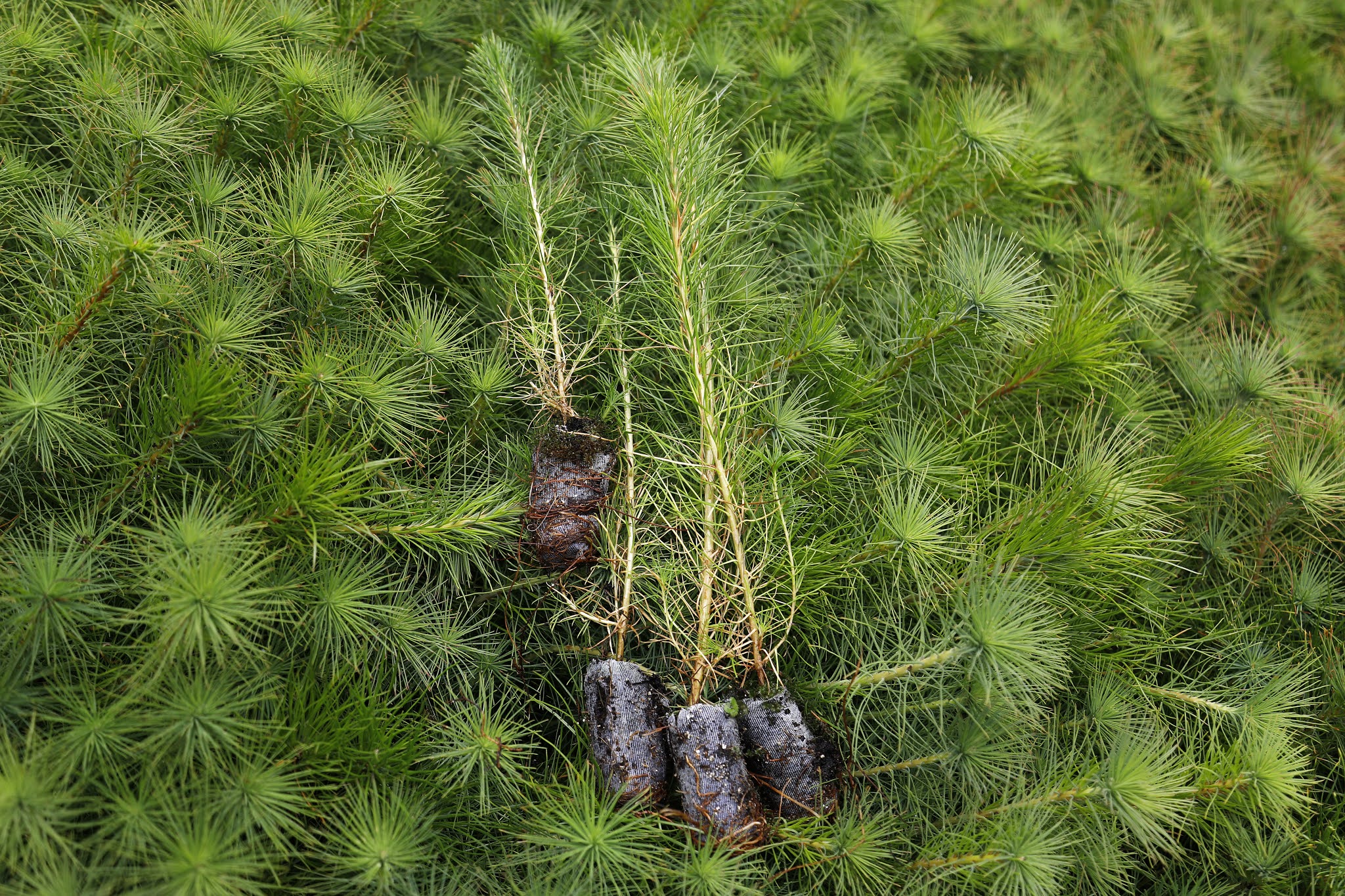
We'll leave you with a photo of some butternut seedlings, courtesy of Ontario's Silver Creek Nursery:


Thanks for reading!

- Jonathan Clark


Replant.ca Environmental is a Canadian company that plants trees for carbon capture and builds community forests.  We also plant trees in national, provincial, and municipal public parks to mitigate damage from wildfires, storms, insects, and forest diseases.  We operate thanks to numerous small contributions from the general public, in addition to larger project sponsorships from businesses and corporations around the world.  If you'd like to learn how to show your support, visit our donations page.  Even if you aren't able to make a contribution, we very much appreciate when people are able to share our posts or our website link on social media, to help spread the word about the work that we're doing!

To learn more about the various species that we plant, visit the conifers page or the deciduous (hardwoods) page on our website.  Thanks so much for your interest!

Teachers are welcome to use content from this post for their classes.  If you know a teacher who might like to use this information, please share it with them!  The more that people learn about trees, the better our world will be.

Incidentally, our organization is often seeking additional land for our carbon capture projects.  Please visit this link if you might know of a recently-harvested property that we could rebuild into a permanent legacy forest.


Monday, February 24, 2020

The Black Spruce tree (Picea mariana)

Today's post is about a species which rarely gets any love.  It's the swamp-loving black spruce (Latin name Picea mariana).  Here's a typical photo, which I took from a helicopter in northern Alberta (the majority of these trees are black spruce):


Oddly enough, the black spruce doesn't have any other common names (except in French), regardless of where you find it across Canada.  And you WILL find black spruce all across Canada.  Its geographic range is much more diverse than even the Jack pine.  Black spruce can be found in all ten provinces and all three Arctic territories.  Here's a range map, courtesy of Wikipedia:


It's quite easy to find specimens of black spruce.  Just look for a swamp.  Black spruce thrives in wet areas, even when the water is quite stagnant.  Remember that all spruce trees love water, but most varieties prefer flowing, oxygenated water.

Black spruce has roots that are especially shallow and wide-spreading.  This allows it to thrive in areas which are too wet for competing species.  Trees, like many other creatures, can drown.  Shallow roots help ensure that the black spruce does well in swamps.  Trees need water, but they also need oxygen.  Flood their root systems, and they will eventually die.  Some trees can only tolerate root submersion for as little a week or so before they start to die.  The black spruce can survive for more than a month.  Regardless, their shallow roots make it less likely that they won't have any access to oxygen for extended periods.  Unfortunately, it also makes this species susceptible to blowdown in windstorms.

If you take a close look at black spruce trees near bogs and swamps, you'll see that the closer you get to water, the less vigorous the growth.


Spruce trees rarely grow to be large trees.  It is quite common for mature black spruce trees to be no more than 15m in height, although they can occasionally grow to 25m in really good conditions.  However, you're more likely to see them in the 10m to 15m range.  The trunk rarely grows to more than 50cm in diameter (a foot and a half) for a large tree.  On a positive note, black spruce usually have very straight trunks, without a significant taper until the very top of the tree.

The top of the black spruce is interesting.  The crown is narrow and pointed, and the small branches all droop, yet the tips are turned upward.  Unlike the tips, the cones hang downward.  Here's an excellent photo from Wikimedia Commons:


One of the more interesting things that many people learn about the black spruce is their long-term fire ecology behaviour.  Black spruce trees often live in peat bogs, as well as swamps.  Despite the moist ground, black spruce stands are especially susceptible to wildfires.  If you're puzzled about this, it's important to know that monocultures (especially conifers) are often especially susceptible to wildfires, while mixed-wood forests with lots of species such as aspen will be less susceptible.  Since black spruce is so much more tolerant of swampy/boggy conditions than most other trees (except for larch/tamarack), it tends to grow frequently in pure stands.  These pure stands are susceptible to fire, despite the wet ground.

Black spruce stands tend to burn frequently, but they also regenerate quickly immediately after a fire (just like lodgepole pine).  Therefore, a lot of black spruce stands tend to be very even-aged.  Over time (centuries), swampy areas with black spruce will often slowly become filled in by organics, and the surface of the ground will become elevated and drier.  As this happens, there will be ingress from moderately moisture-tolerant species such as tamarack, white cedar, white spruce, balsam fir, and eventually balsam poplar and trembling aspen.  Don't judge black spruce as an ugly swamp tree with no significant value.  In the long term, it's an important precursor to more diverse mature mixed-wood forests.


I'll leave you with three random facts about the black spruce:
- This is the provincial tree of Newfoundland and Labrador.
- Like red spruce, it is good for making spruce beer.
- Disposable chopsticks are often made of black spruce (or trembling aspen).

That's all for now.  I hope you enjoyed reading this, and it made you appreciate this species a bit more.  We don't plant very much black spruce at Replant.ca Environmental, simply because it's not great for long-term carbon capture, but it does occupy a small percentage of our annual seedling mixes due to its suitability (along with cedar and tamarack) in swampy ground.  Here's a photo of some of our black spruce seedlings:


Thanks for reading ...

- Jonathan Clark
www.replant-environmental.ca


Replant.ca Environmental is a Canadian company that plants trees for carbon capture and builds community forests.  We also plant trees in national, provincial, and municipal public parks to mitigate damage from wildfires, storms, insects, and forest diseases.  We operate thanks to numerous small contributions from the general public, in addition to larger project sponsorships from businesses and corporations around the world.  If you'd like to learn how to show your support, visit our donations page.  Even if you aren't able to make a contribution, we very much appreciate when people are able to share our posts or our website link on social media, to help spread the word about the work that we're doing!

Teachers are welcome to use content from this post for their classes.  If you know a teacher who might like to use this information, please share it with them!  The more that people learn about trees, the better our world will be.

To learn more about the various species that we plant, visit the conifers page or the deciduous (hardwoods) page on our website.  Thanks so much for your interest!


Incidentally, our organization is often seeking additional land for our carbon capture projects.  Please visit this link if you might know of a recently-harvested property that we could rebuild into a permanent legacy forest.


Wednesday, November 27, 2019

The Jack Pine tree (Pinus banksiana)

Let's take a look at another pine tree that we plant, the Jack Pine.  This tree is also referred to as the scrub pine, the grey pine, the Hudson Bay pine, or the Banksian pine.  The latter name is due to its Latin name, Pinus banksiana.  The term "scrub pine" seems somewhat dismissive.  Where is the love?

To be fair, the Jack pine is not the most impressive species out there.  We mix some Jack pine into our species mixes sometimes, but that's more for diversity than because it's a major contributor to carbon capture.  We also plant two other types of pine (Norway and Eastern White) in larger quantities.  Still, diversity is important.  What happens if global warming raises average temperatures by several degrees over the next few decades?  This could have a seriously negative effect upon many of the species currently growing in Canada, and we think that Jack pine is the conifer that is least likely to be affected if temperatures do get that high (eastern white pine being the second least vulnerable).

Here's a photo of some Jack pine trees, courtesy of Wikipedia.  I'll try to replace this photo with one of my own at some point:


The range of the Jack pine is quite broad.  There are a lot of different species of pine trees in the world (about 120, depending on whom you ask).  In western Canada, you can find about twenty different pine species, four of which I've planted while working in commercial operations.  In eastern Canada, you can find about thirteen species, three of which we plant at Replant.ca Environmental.  As far as I'm aware, Jack pine has the largest geographic distribution range within Canada (of the pines).  Here's a graphic from Wikipedia to illustrate that:


Despite its broad range and hardiness, the reason that Jack pine is often omitted from "favorite tree" lists is because it doesn't grow as large as some other types (such as Eastern white pine), and the trunk doesn't often grow as straight or majestically.  Due to this, many foresters and carpenters don't get as excited by Jack pine as they do by other types of pine, although to be honest, this probably has saved more than a few individual trees from the axe.  Under good growing conditions, Jack pine usually only reaches a height of 15-20 meters at maturity (50-65 feet), and the trunk doesn't often exceed a diameter of about 50 centimeters (one and a half feet).  As mentioned, the trunks can often be twisted or knotty, so when it is used commercially, it is often more likely to be used for pulpwood than for lumber.

Jack pines can be affected by quite a few diseases.  There are weevils and sawflies and budworms that attack the trees.  Jack pine can also be affected by a disease called sweet fern blister rust.  When this happens, Jack pine is an inadvertent victim.  Normally, sweet fern blister rust affects sweet ferns, but the spores can drift onto Jack pine and attack the trees too.

Jack pine is somewhat similar to lodgepole pine, which we plant very frequently on commercial projects all over the west coast.  Like lodgepole pine, the cones of Jack pine tend to open during periods of extreme heat (including wildfires).  Remember that occasional mild wildfires can be beneficial to the overall forest ecosystem.  However, Jack pine don't regrow in densities as thick as lodgepole does after a fire.  Also, on a mature tree, the Jack pine cones look quite different because they usually point forward along the branches.

When trying to identify a pine tree, it's always important to see how many needles come in each cluster.  Each pine species is quite distinct, usually having either two, three, or five needles per cluster.  Jack pine is a two-needle pine.

When I talked about eastern white pine, I mentioned one of Tom Thomson's famous paintings, "Byng Inlet, Georgian Bay."  The Jack pine is featured in an even more well-known painting by Tom Thomson, entitled "The Jack Pine."  That painting is currently held by the National Galley of Canada.  Here's an image of that very recognizable painting, courtesy of the NGC:


Although the Jack pine will probably never feature heavily in our mixes, we have to give it credit for being sturdy and hardy, which is why this species is the most common tree found throughout Canada!  I'll leave you with a photo of some of our Jack pine seedlings:


Thanks for reading ...

- Jonathan Clark
www.replant-environmental.ca


Replant.ca Environmental is a Canadian company that plants trees for carbon capture and builds community forests.  We also plant trees in national, provincial, and municipal public parks to mitigate damage from wildfires, storms, insects, and forest diseases.  We operate thanks to numerous small contributions from the general public, in addition to larger project sponsorships from businesses and corporations around the world.  If you'd like to learn how to show your support, visit our donations page.  Even if you aren't able to make a contribution, we very much appreciate when people are able to share our posts or our website link on social media, to help spread the word about the work that we're doing!

Teachers are welcome to use content from this post for their classes.  If you know a teacher who might like to use this information, please share it with them!  The more that people learn about trees, the better our world will be.

To learn more about the various species that we plant, visit the conifers page or the deciduous (hardwoods) page on our website.  Thanks so much for your interest!


Incidentally, our organization is often seeking additional land for our carbon capture projects.  Please visit this link if you might know of a recently-harvested property that we could rebuild into a permanent legacy forest.

Saturday, November 23, 2019

The Eastern Hemlock tree (Tsuga canadensis)

Today I'm going to talk about one of the longest-lived of the trees on Canada's east coast, the Eastern hemlock.  Some of you also might know it as Canadian hemlock, or even as eastern hemlock-spruce.  I'm not a fan of that last name, because it confuses people.  Eastern hemlock is not a spruce conifer!  But speaking of names, this species has a Latin name which I find easiest to remember of all Latin names:  Tsuga canadensis.  I guess that's because I'm a proud Canadian.

Before I get into too much detail about this species, let's start with a photo.  This is a good close-up photo showing just a handful of the several thousand eastern hemlock seedlings that we planted this year (2019).


There are three types of hemlocks in Canada, although they all have very narrow distributions.  Western hemlock and mountain hemlock are only found in BC, and mostly in coastal parts of that province.  I've planted large numbers of both of these species while doing commercial reforestation work on Vancouver Island.  So despite the fact that eastern hemlock is not widely distributed throughout most of Canada, it is still the most well-known hemlock.  It can be found throughout all three of the maritime provinces, and also in southern parts of Ontario and Quebec.  Here's a range map, courtesy of Wikipedia:


It's interesting that eastern hemlock does so well throughout southeastern Canada and the northeast seaboard of the US, considering that most hemlocks thrive in temperate rainforests.  The two west coast hemlocks definitely thrive in the moist areas of the coast, and with the exception of the Ancient Rainforest area east of Prince George, almost all west coast hemlocks grow within a hundred kilometers of the Pacific ocean.

The hemlock family got its name from a perceived similarity between the smell of crushed hemlock (conifer) needles and the crushed hemlock plant, even though the plant is completely unrelated to the conifer tree family.  You may be aware that hemlock is well known as a poisonous plant, but hemlock trees thankfully are not toxic! Incidentally, let me take a complete tangent from this post, in case you're trying to remember where you heard about hemlock plants being poison.  Back in ancient Greece, the famous philosopher Socrates went on trial for corrupting the youth of Athens (encouraging anti-democratic uprisings).  He was tried by an assembly of 500 citizens, the majority of whom decided that he was guilty, and was subsequently sentenced to death by poisoning.  At the execution, he calmly agreed to drink the poison down, and that was the end of him.  Plato and Aristotle, two other historical figures that you might be acquainted with if you've studied philosophy (or are a Monty Python fan), were two of his most famous students at the time.  And incidentally, the poisonous hemlock plant is found in twelve US states.  But I digress.  Let's get back to the conifer.

I mentioned earlier that eastern hemlock trees are quite long lived.  Indeed!  They would make any octagenarian jealous.  It is very common for mature trees to live for 250-400 years, if they aren't knocked down in a bad windstorm.  There is one eastern hemlock in Pennsylvania that is going to hit it's 600th birthday in a few decades.  That's pretty impressive.

On Canada's east coast, mature trees often reach a height of about 30m (100 feet) and the trunk of these trees can often approach 1.5m in diamater (almost five feet).  Our Charles Clark forest reserve property in north central Nova Scotia has a belt through the center of the property with almost twenty acres that hasn't been cut in about a century, and it is full of beautiful mature hemlocks.  This part of the property almost feels like a rainforest when you visit it.  In many parts of the US, hemlock trees are only found at elevations of 600 meters and above (cooler climate), but our Charles Clark property is only about 40m above sea level.

Unfortunately, the eastern hemlock is susceptible to two major pests right now.  The first is an "adelgid" (similar to an aphid) known as the woolly hemlock adelgid.  This insect was introduced to north American accidentally from Asia, and eastern hemlock is not resistant to it.  Canadian hemlocks haven't been hit too hard yet, but the adelgid is really doing a lot of damage to stands east of the Appalachians.  The other problem insect is the hemlock looper, which is a type of moth that eats hemlock (and several other common Canadian trees).  Eastern hemlock is also susceptible to a couple varieties of the Armillaria fungus, which is a widely distributed forest parasite (a small mushroom) that attacks many different species.  However, Armillaria (also known colloquially as honey mushrooms) are generally only a problem for mature hemlock.

Another problem that eastern hemlock have to cope with when they're young is being used as a snack by deer.  Deer populations in urban areas of Nova Scotia have exploded over the past decade.  I don't know if the same holds true for rural deer, but in town, we see them on our front lawns everywhere, and they've caused an enormous amount of damage to cedar shrubs and several dozen other types of small plants and flowers.  Anyway, deer love to browse on tender plants.  They tend to avoid plants with needles (except for cedar, which they love) and they also tend to avoid plants with strong odors or bitter tastes.  Although hemlock is not their preferred diet, they will sometimes snack on young hemlock trees.  Hemlock tea tastes quite bitter, but yet the deer don't seem to mind if they're quite hungry.  Hemlock tea is bitter enough that most tea drinkers would definitely turn their nose up, although it apparently has a lot of vitamin C.

If you're ever looking to plant conifers on the east coast, and the property already has some existing brush or tree cover, consider the eastern hemlock as one of the species to potentially include in your mix.  The eastern hemlock is very shade tolerant - one of the most shade tolerant conifers in Canada.

I'll leave you with a photo of some of our eastern hemlock seedlings:


Thanks for reading!

- Jonathan Clark
www.replant-environmental.ca


Replant.ca Environmental is a Canadian company that plants trees for carbon capture and builds community forests.  We also plant trees in national, provincial, and municipal public parks to mitigate damage from wildfires, storms, insects, and forest diseases.  We operate thanks to numerous small contributions from the general public, in addition to larger project sponsorships from businesses and corporations around the world.  If you'd like to learn how to show your support, visit our donations page.  Even if you aren't able to make a contribution, we very much appreciate when people are able to share our posts or our website link on social media, to help spread the word about the work that we're doing!

Teachers are welcome to use content from this post for their classes.  If you know a teacher who might like to use this information, please share it with them!  The more that people learn about trees, the better our world will be.

To learn more about the various species that we plant, visit the conifers page or the deciduous (hardwoods) page on our website.  Thanks so much for your interest!

Incidentally, our organization is often seeking additional land for our carbon capture projects.  Please visit this link if you might know of a recently-harvested property that we could rebuild into a permanent legacy forest.