Showing posts with label swamp. Show all posts

Friday, January 8, 2021

The Red Maple tree (Acer rubrum)

Today we'll talk about the red maple tree, which many people think of as "Canada's tree."  After all, a red-coloured generic maple leaf is featured on Canada's national flag.  The Latin name for the red maple is the Acer rubrum.  Some people also refer to this species as the water maple, the swamp maple, or the soft maple.

Red maple gets its name due to the brilliant red colour of the leaves before they drop in the fall.  Here's a photo of a red maple, which stands out brilliantly in the early fall when surrounded by other species with leaves that stay green.

Even though many Canadians think of the red maple as "our" tree, it only grows throughout parts of Canada.  Its range in the US is much larger!  In Canada, red maple can be found very commonly throughout southern Ontario, southern Quebec, and the Maritime provinces.  However, in the US, the range extends through all of the northeastern and southeastern parts of the country, right down to the southern tip of Florida and west into Texas.  That's great, because if global warming raises our average temperatures in Canada in the next few decades, the red maple (and many other hardwoods) will thrive.  Here's a range map, courtesy of Wikipedia:

This species can grow to be a fairly large tree.  It is common for mature trees to be as much as thirty meters in height (100 feet) and to have a diameter at breast height that is a full meter thick (three feet).  Of course, a tree grown in the open can have an even thicker trunk than one grown in a forest, which is the case with most species.

Red maple has a fairly thin bark.  It is easy for this bark to become damaged by animals or other reasons, in which case fungi may be able to get into the tree, eventually leading to heart rot of the core of the tree.  Although this maple can grow to be fairly large, it is not an extremely long lasting tree like many conifers.  A mature red maple will often live for more than a century when left alone, but this is still not as long as species such as red spruce or eastern white pine.

Red maple has an ability to thrive in many types of ecosystems.  It's a pioneer species, coming in rapidly after a forest has been disturbed.  Thanks to its versatility, it can grow in direct sunlight or shade, in elevations from sea level to almost a thousand meters (3000 feet), in a wide pH range for soil acidity, and in everything from dry ground to poorly drained swamps.  In fact, its ability to thrive in swampy areas is why it is often referred to as water maple or swamp maple.

As a forest matures, it is common for the red maples to eventually die out and be replaced by shade-tolerant succession species.  However, due to widespread die-off of American elms and American chestnuts during the last couple of centuries, red maple is slowly becoming a more important component of mature forests throughout the eastern United States.

The leaves of the red maple are a very distinct feature of the species, as we've already mentioned.  Here's a photo of some leaves before they start to turn colour in the fall:

And of course, you can compare their shape as being somewhat similar to that of the Canadian flag:


I should note that the maple leaf on the Canadian flag is NOT actually the red maple.  It's a generic or stylized maple design, sort of a blend between red and sugar and a few other maples.  There are about ten types of maple trees in Canada.

Red maple leaves have a very distinct shape.  They also have slightly serrated edges, which helps distinguish them from the leaves of other maples.  In the fall, as they are getting ready to die and fall from the tree, they lose their green colour and turn yellow/orange and sometimes to a bright red.  Trees with male flowers are more likely to turn a brilliant red than trees with female flowers.  Also, trees in colder areas (further north, higher elevation) are also more likely to be be a bright red instead of a more subdued orange.

One drawback with red maples:  If you have horses, don't plant red maples in their paddocks or pastures.  The leaves are toxic to horses.

Here are a few fun facts about red maple trees:

1.  The red maple is the state tree of Rhode Island.  Rhode Islanders love their reds, it seems.  Their state bird is the red hen, and even the name Rhode Island comes from a Dutch reference to "reddish."  That could refer to the reddish clay, or it may refer to the reddish colour of the maples.

2.  Wood ducks often like to nest inside the cavities of swamp maples.

3.  Red maples grow quite quickly, and can start producing seed when they are just four or five years old.

4.  Red maple seeds are called samara, which is a seed type that means "dried fruit with wing."  The seeds grow on the tree in pairs.  As they fall, they separate and rotate slowly to the ground.  This means that the wind is able to carry the seeds a fair distance away from the tree, to help propagate the species more widely.  These seeds are fairly large (about an inch long) and are quite easy to spot.  Here's a photo of a connected pair:


At Replant.ca Environmental, we sometimes plant red maple seedlings.  There's no need to plant them in harvested or damaged areas that held red maple previously, because they regenerate quite well naturally.  However, it can be helpful to plant this type of tree as part of a broader species mix in some afforestation projects where natural regen is unlikely, such as when turning unused pastureland back to forest.  Here's a photo of some of the red maple seedlings that we were planting on several of our projects this past fall:


Thanks for reading!

- Jonathan Clark


Replant.ca Environmental is a Canadian company that plants trees for carbon capture and builds community forests.  We also plant trees in national, provincial, and municipal public parks to mitigate damage from wildfires, storms, insects, and forest diseases.  We operate thanks to numerous small contributions from the general public, in addition to larger project sponsorships from businesses and corporations around the world.  If you'd like to learn how to show your support, visit our donations page.  Even if you aren't able to make a contribution, we very much appreciate when people are able to share our posts or our website link on social media, to help spread the word about the work that we're doing!

Teachers are welcome to use content from this post for their classes.  If you know a teacher who might like to use this information, please share it with them!  The more that people learn about trees, the better our world will be. 

To learn more about the various species that we plant, visit the conifers page or the deciduous (hardwoods) page on our website.  Thanks so much for your interest! 


Incidentally, our organization is often seeking additional land for our carbon capture projects.  Please visit this link if you might know of a recently-harvested property that we could rebuild into a permanent legacy forest.

Monday, February 24, 2020

The Black Spruce tree (Picea mariana)

Today's post is about a species which rarely gets any love.  It's the swamp-loving black spruce (Latin name Picea mariana).  Here's a typical photo, which I took from a helicopter in northern Alberta (the majority of these trees are black spruce):


Oddly enough, the black spruce doesn't have any other common names (except in French), regardless of where you find it across Canada.  And you WILL find black spruce all across Canada.  Its geographic range is much more diverse than even the Jack pine.  Black spruce can be found in all ten provinces and all three Arctic territories.  Here's a range map, courtesy of Wikipedia:


It's quite easy to find specimens of black spruce.  Just look for a swamp.  Black spruce thrives in wet areas, even when the water is quite stagnant.  Remember that all spruce trees love water, but most varieties prefer flowing, oxygenated water.

Black spruce has roots that are especially shallow and wide-spreading.  This allows it to thrive in areas which are too wet for competing species.  Trees, like many other creatures, can drown.  Shallow roots help ensure that the black spruce does well in swamps.  Trees need water, but they also need oxygen.  Flood their root systems, and they will eventually die.  Some trees can only tolerate root submersion for as little a week or so before they start to die.  The black spruce can survive for more than a month.  Regardless, their shallow roots make it less likely that they won't have any access to oxygen for extended periods.  Unfortunately, it also makes this species susceptible to blowdown in windstorms.

If you take a close look at black spruce trees near bogs and swamps, you'll see that the closer you get to water, the less vigorous the growth.


Spruce trees rarely grow to be large trees.  It is quite common for mature black spruce trees to be no more than 15m in height, although they can occasionally grow to 25m in really good conditions.  However, you're more likely to see them in the 10m to 15m range.  The trunk rarely grows to more than 50cm in diameter (a foot and a half) for a large tree.  On a positive note, black spruce usually have very straight trunks, without a significant taper until the very top of the tree.

The top of the black spruce is interesting.  The crown is narrow and pointed, and the small branches all droop, yet the tips are turned upward.  Unlike the tips, the cones hang downward.  Here's an excellent photo from Wikimedia Commons:


One of the more interesting things that many people learn about the black spruce is their long-term fire ecology behaviour.  Black spruce trees often live in peat bogs, as well as swamps.  Despite the moist ground, black spruce stands are especially susceptible to wildfires.  If you're puzzled about this, it's important to know that monocultures (especially conifers) are often especially susceptible to wildfires, while mixed-wood forests with lots of species such as aspen will be less susceptible.  Since black spruce is so much more tolerant of swampy/boggy conditions than most other trees (except for larch/tamarack), it tends to grow frequently in pure stands.  These pure stands are susceptible to fire, despite the wet ground.

Black spruce stands tend to burn frequently, but they also regenerate quickly immediately after a fire (just like lodgepole pine).  Therefore, a lot of black spruce stands tend to be very even-aged.  Over time (centuries), swampy areas with black spruce will often slowly become filled in by organics, and the surface of the ground will become elevated and drier.  As this happens, there will be ingress from moderately moisture-tolerant species such as tamarack, white cedar, white spruce, balsam fir, and eventually balsam poplar and trembling aspen.  Don't judge black spruce as an ugly swamp tree with no significant value.  In the long term, it's an important precursor to more diverse mature mixed-wood forests.


I'll leave you with three random facts about the black spruce:
- This is the provincial tree of Newfoundland and Labrador.
- Like red spruce, it is good for making spruce beer.
- Disposable chopsticks are often made of black spruce (or trembling aspen).

That's all for now.  I hope you enjoyed reading this, and it made you appreciate this species a bit more.  We don't plant very much black spruce at Replant.ca Environmental, simply because it's not great for long-term carbon capture, but it does occupy a small percentage of our annual seedling mixes due to its suitability (along with cedar and tamarack) in swampy ground.  Here's a photo of some of our black spruce seedlings:


Thanks for reading ...

- Jonathan Clark
www.replant-environmental.ca


Replant.ca Environmental is a Canadian company that plants trees for carbon capture and builds community forests.  We also plant trees in national, provincial, and municipal public parks to mitigate damage from wildfires, storms, insects, and forest diseases.  We operate thanks to numerous small contributions from the general public, in addition to larger project sponsorships from businesses and corporations around the world.  If you'd like to learn how to show your support, visit our donations page.  Even if you aren't able to make a contribution, we very much appreciate when people are able to share our posts or our website link on social media, to help spread the word about the work that we're doing!

Teachers are welcome to use content from this post for their classes.  If you know a teacher who might like to use this information, please share it with them!  The more that people learn about trees, the better our world will be.

To learn more about the various species that we plant, visit the conifers page or the deciduous (hardwoods) page on our website.  Thanks so much for your interest!


Incidentally, our organization is often seeking additional land for our carbon capture projects.  Please visit this link if you might know of a recently-harvested property that we could rebuild into a permanent legacy forest.


Sunday, December 1, 2019

The Eastern White Cedar tree (Thuja occidentalis)

The Eastern white cedar is known by many names, but the most common alternatives are the northern white cedar, the swamp cedar, or the eastern arborvitae.  The Latin name for this tree is Thuja occidentalis.

You won't often hear rural dwellers referring to this tree as the arborvitae.  That term arborvitae is somewhat confusing.  Many horticulturalists use it.  However, arborvitae really refers to the entire Thuja s. genus, which includes five different species.  The only other arborvitae is the western red cedar, which we plant very frequently in BC's western coastal areas.  Incidentally, the word arborvitae comes from two separate words:  Arbor, meaning "tree," and vitae, meaning "life."  The implication is "tree of life."

When you look at the taxonomic classification of the Thuja genus, they belong to a family known as Cupressaceae, or more commonly known in English as cypress.  That's right, the north American cedars are not even true cedars!  Sigh.  Why is tree classification so confusing?  True cedars are only found natively in the Mediterranean and in the Himalayas.  Let's get back to our "fake" cedar, the eastern white cedar.

Perhaps the most unique thing about cedar trees is the appearance of the needles.  Cedar branches look very different than most other conifers, due to the flattened shape of the needles:


You can see that the needles almost look like scales.

When an eastern white cedar tree develops cones, they are quite small - only about one centimeter long.  Each cone contains approximately eight seeds, however, the cones grow in very dense clusters.  They start off as a yellowish colour, but then eventually turn to a fairly dark shade of brown.  Here's a photo showing some immature cones that are still developing:


This species is not a large one.  These trees rarely grow to be more than 15-25 meters in height (about 50-80 feet).  However, even though they're usually not nearly as tall as many of the other mature conifer species in eastern Canada, their trunks can still grow fairly thick, sometimes reaching almost a meter in diameter (3 feet) at maturity.  These measurements are typical for trees growing in the United States.  When they're found in Canada, they're usually slightly smaller.

Cedar trees taste great, at least to deer.  And that's a big problem.  Deer are especially attracted to these trees.  Exploding deer populations are causing all kinds of problems in many parts of Canada.  In the town that I grew up in, in central Nova Scotia, the deer can be found everywhere throughout town, and ravage people's gardens and shrubbery.  Cedar trees are one of the favorite species for deer to eat, and this is having a negative impact on cedar populations all over eastern North America.

On the west coast, when we plant cedar, we sometimes also install "browse protection devices" over the trees.  A browse protector usually looks like a tall thin plastic cone, about three feet tall.  We place a four-foot cedar stake beside a freshly planted cedar tree, and pound this stake into the ground with a mallet so it is firmly anchored, then place the cone over both the cedar seedling and the stake.  The cone is then tied to the stake so it will remain in place for several years.  The cones are translucent, which allows enough sunlight to reach the tree for photosynthesis.  The tree grows up inside the cone for approximately 3-5 years, then the crew goes back into the plantation to remove the cones, so they can be re-used on another project.  This system seems to work fairly well for letting the cedar seedlings become established until the trees are large enough that the deer start to ignore them (the deer prefer very young seedlings that are closer to the ground).  Here's a photo of a browse cone, protecting a freshly planted young cedar:


Cedar trees can live for a very, very long time.  Here's an interesting story:  There is an old eastern white cedar located on the shore of Lake Superior in Minnesota.  The Ojibwa refer to this tree as the Little Cedar Spirit Tree.  The first known written reference to this specific tree happened way back in 1731, by a French explorer named Sieur de la Verendrye.  The Ojibwa often leave tobacco around the tree as an offering to help protect them on voyages on Lake Superior.  Despite this tree being quite famous, that doesn't mean that it's one of the oldest.  It could be, but some eastern white cedars can live to be more than a thousand years old!  Why would anyone ever want to cut one of these trees down?

Although this species prefers very moist climates, it has managed to carve out a fairly large footprint in eastern Canada by taking advantage of conditions where other larger and faster-growing trees have problems thriving.  These cedar trees can survive on rocky cliffs, and in very moist swampy areas.  In that sense, this cedar is a good species to mix with black spruce when the ground conditions are appropriately moist.  Although eastern white cedar isn't found commonly throughout Nova Scotia or in the eastern half of Prince Edward Island, it has a wide range throughout the rest of eastern and central Canada and the northeastern United States.  Here's a range map, courtesy of Wikipedia:


I want to leave you with a few interesting facts about this species:

1.  When a branch falls from an eastern white cedar, it can sometimes lay out new roots into the ground and grow into a new tree, if the conditions are just right!

2.  The inner bark of this tree is tough enough to make into string or rope.

3.  Some people plant this species in their back yards specifically to attract wildlife.  Besides deer, rabbits and many types of birds are also attracted to this tree.


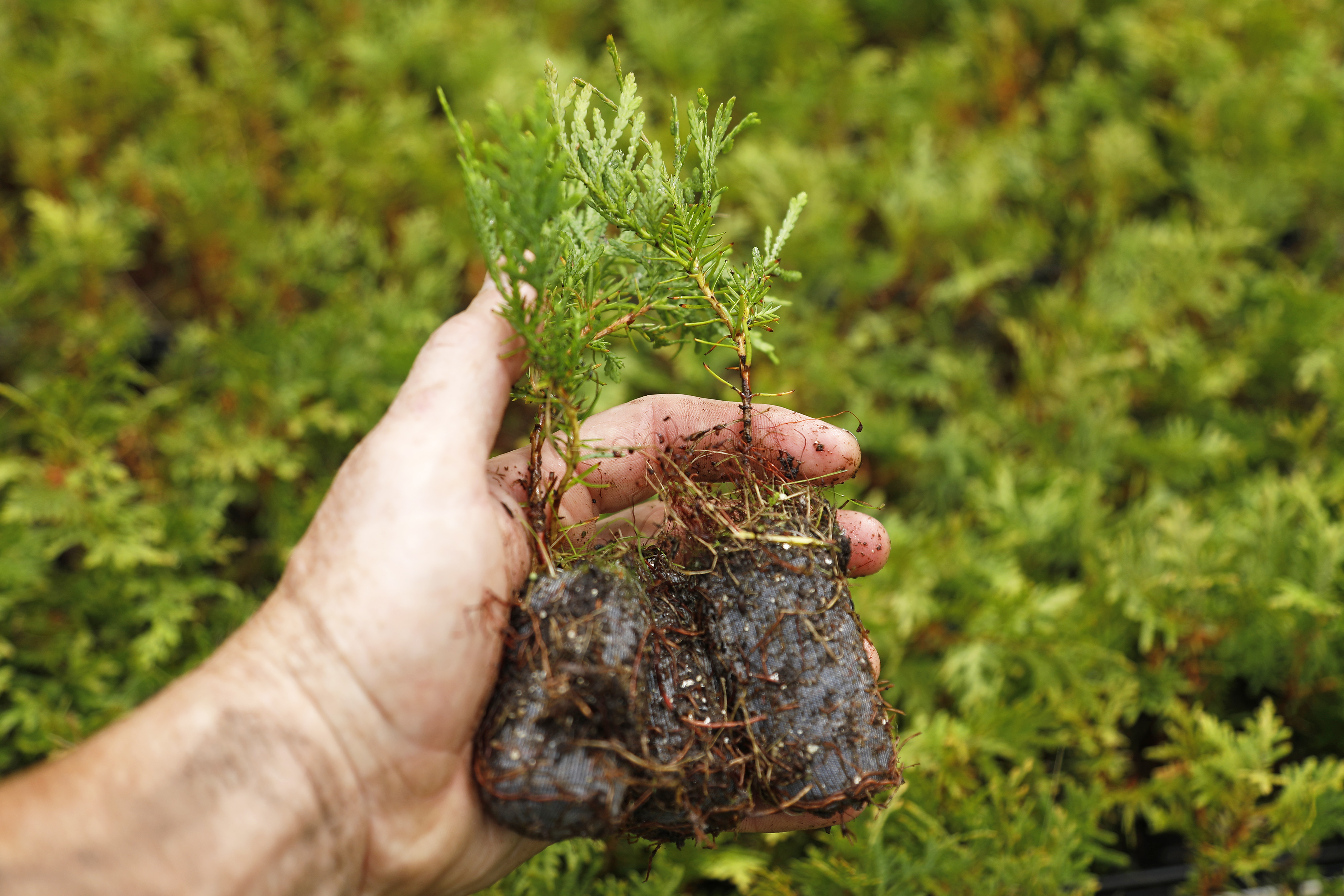
For the 2020 planting season, we included several thousand eastern white cedars in our species mixes at Replant.ca Environmental.  We planted these trees in areas with more moisture or shade, including understory areas, near streams, and in swampy areas.  Even though they are one of the less voluminous conifers in our mixes, and there is a higher risk of some mortality due to deer browsing, we feel that these are a very beneficial species to add to our mixes.  Here's a photo of some of our eastern white cedar seedlings:


Thanks for reading ...

- Jonathan Clark
www.replant-environmental.ca


Replant.ca Environmental is a Canadian company that plants trees for carbon capture and builds community forests.  We also plant trees in national, provincial, and municipal public parks to mitigate damage from wildfires, storms, insects, and forest diseases.  We operate thanks to numerous small contributions from the general public, in addition to larger project sponsorships from businesses and corporations around the world.  If you'd like to learn how to show your support, visit our donations page.  Even if you aren't able to make a contribution, we very much appreciate when people are able to share our posts or our website link on social media, to help spread the word about the work that we're doing!

Teachers are welcome to use content from this post for their classes.  If you know a teacher who might like to use this information, please share it with them!  The more that people learn about trees, the better our world will be.

To learn more about the various species that we plant, visit the conifers page or the deciduous (hardwoods) page on our website.  Thanks so much for your interest!


Incidentally, our organization is often seeking additional land for our carbon capture projects.  Please visit this link if you might know of a recently-harvested property that we could rebuild into a permanent legacy forest.