Showing posts with label tree planting. Show all posts

Saturday, November 23, 2024

Tree Planting Project, Skyline Trail (Cape Breton, Nova Scotia)

This past Fall (2024), one of the Replant.ca Environmental teams finished up a small environmental reforestation project in Cape Breton, near Cheticamp.

This project took place on the north side of Cape Breton Island.  The goal for this project was to add some new native tree species to the area just east of the fenced area that surrounds the observation platform.  This area is subject to strong winds, and trees tend to grow very slowly here.  Adding seedlings of native species will help to kick-start the regeneration of the former forest.  Our role in this project was to be a service provider.  Parks Canada was the organization that planned and sponsored the project.


Here's a graphic (courtesy of Google Earth) showing the location of the Skyline Trail, which is a very well-known tourist attraction within Cape Breton Highlands National Park:


We also did a separate larger project within the Park this year (on North Mountain), and another small project on near Ingonish (the Mary Ann Falls bike trail).

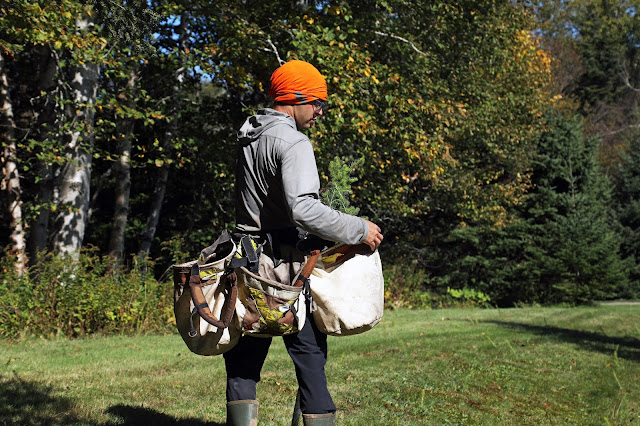
Here are a few photos of the team in action at Skyline:


We planted a variety of native species in this patch of future forest:  Sugar maple, eastern white pine, eastern larch, white birch, green alder, and balsam fir.


You can see more photos of our tree planting work at this site by visiting our Planting Photos folder on Dropbox, then going into the "2024 Planting Photos" folder, then into the "Skyline Trail" sub-folder.  Start here:

    www.replant-environmental.ca/photos


We'd like to thank Anne-Claude and her staff for their hospitality and support while we were on site, and to Parks Canada for putting together this proactive project.  It's a really enjoyable area to hike!


Jonathan "Scooter" Clark


Replant.ca Environmental is a Canadian company that plants trees for carbon capture and builds community forests.  We also plant trees in national, provincial, and municipal public parks to mitigate damage from wildfires, storms, insects, and forest diseases.  We operate thanks to numerous small contributions from the general public, in addition to larger project sponsorships from businesses, corporations, and NGO's around the world.  If you'd like to learn how to show your support, visit our donations page.  Even if you aren't able to make a contribution, we very much appreciate when people are able to share our posts or our website link on social media, to help spread the word about the work that we're doing!

To learn more about the various species that we plant, visit the conifers page or the deciduous (hardwoods) page on our website.  Thanks so much for your interest! 


Tree Planting Project, Mary Ann Fall Road (Cape Breton, Nova Scotia)

This past month (November 2024), Replant.ca Environmental finished up a small environmental restoration project in Cape Breton, near Ingonish.

This project took place on the east side of Cape Breton Island, just around the corner to the north of the Broad Cove Campground.  There used to be a rough gravel truck road that led up to the bridge by the Falls, but the Park has been using contractors to turn the area into a recreational trail for bikers and hikers.  The goal was to restore the old road to a more natural state, for the purpose of environmental restoration, and at the same time to provide additional public opportunities for outdoor recreation.  Our role in this project was to be a service provider, planting trees off to either side of the special compacted bike trail going up to the Fall.  Parks Canada was the organization that planned and sponsored this project.


Here's a graphic (courtesy of Google Earth) showing the location of the new bike trail, which is almost seven kilometers in length:


This trail falls within the confines of Cape Breton Highlands National Park.  We also did a separate larger project within the Park this year (on North Mountain), and another small project on the Skyline Trail.

Here are a few photos of the seedlings and of the team in action at Mary Ann Falls Road:


We planted a variety of species in the reclaimed sections beside the new bike trail:  Sugar maple, eastern white pine, eastern larch, white birch, black spruce, green alder, and balsam fir.


You can see more photos of our tree planting work at this site by visiting our Planting Photos folder on Dropbox, then going into the "2024 Planting Photos" folder, then into the "Mary Ann Falls" sub-folder.  Start here:

    www.replant-environmental.ca/photos


We'd like to thank Anne-Claude and her staff for their hospitality and support while we were on site, and to Parks Canada for putting together this proactive project.  It's a really enjoyable area to hike or bike!


Jonathan "Scooter" Clark


Replant.ca Environmental is a Canadian company that plants trees for carbon capture and builds community forests.  We also plant trees in national, provincial, and municipal public parks to mitigate damage from wildfires, storms, insects, and forest diseases.  We operate thanks to numerous small contributions from the general public, in addition to larger project sponsorships from businesses, corporations, and NGO's around the world.  If you'd like to learn how to show your support, visit our donations page.  Even if you aren't able to make a contribution, we very much appreciate when people are able to share our posts or our website link on social media, to help spread the word about the work that we're doing!

To learn more about the various species that we plant, visit the conifers page or the deciduous (hardwoods) page on our website.  Thanks so much for your interest! 


Monday, December 18, 2023

Tree Planting Project at Fishing Cove, Cape Breton Highlands (2023)

This past Fall (2023), Replant.ca Environmental tackled a small environmental restoration project in Cape Breton, near Fishing Cove.

This project took place close to the Cabot Trail, on the northwest side of Cape Breton (just slightly south of Pleasant Bay).  There are a couple of gravel pits in this area which have been used as a source for aggregates for road construction and repair.  One of these pits has been completely decommissioned, and the other has been partly decommissioned.  Our goal was to plant trees in the parts of the pits which are no longer being used to supply construction material.


Here's a graphic (courtesy of Google Earth) showing the location of the borrow pits:


These two borrow pits fall within the confines of Cape Breton Highlands National Park.  We also did a separate project within the Park (on North Mountain) which was a much larger project.

The weather was very cold and rainy when we were completing this project, but that didn't dampen the spirits of the planting team.

Here are a few photos of the seedlings and of the team in action at Fishing Cove:


You can see many more photos of our tree planting work on this site by visiting our public Planting Photos folder on Dropbox.  Go into the 2023 sub-folder, then go into the "Fishing Cove" sub-folder.

We'd like to thank Anne-Claude and her staff for their hospitality and support while we were on site, and to the project sponsor One Tree Planted for providing the financial resources that helped make this project happen.


Jonathan "Scooter" Clark


Replant.ca Environmental is a Canadian company that plants trees for carbon capture and builds community forests.  We also plant trees in national, provincial, and municipal public parks to mitigate damage from wildfires, storms, insects, and forest diseases.  We operate thanks to numerous small contributions from the general public, in addition to larger project sponsorships from businesses, corporations, and NGO's around the world.  If you'd like to learn how to show your support, visit our donations page.  Even if you aren't able to make a contribution, we very much appreciate when people are able to share our posts or our website link on social media, to help spread the word about the work that we're doing!

To learn more about the various species that we plant, visit the conifers page or the deciduous (hardwoods) page on our website.  Thanks so much for your interest! 


Sunday, October 17, 2021

Tree Planting Project at Hopewell Rocks Provincial Park (2021)

This fall, Replant.ca Environmental started a long-term planting project at Hopewell Rocks Provincial Park.  This park is located in southeastern New Brunswick.  This work was made possible thanks to a sponsorship from the Trees For Life organization.  Learn more about Trees For Life at www.treesforlife.ca

Hopewell Rocks Provincial Park is only a 35 minute drive from Moncton, down to the south through Riverview.  The park is situated on the world-famous Bay of Fundy.  The park itself doesn't have camping sites, although there are private campgrounds open to the public only a few minutes away, such as Ponderosa Pines.  Incidentally, ponderosa pine is not a native species to New Brunswick.  Now I'm curious to know whether there are any imported ponderosa pines growing at the campground.  But let's get back to the topic of the day.  Here's a photo of Mattea, planting a sugar maple seedling:


Here's a graphic (courtesy of Google Earth) showing the location of the park:


Hopewell Rocks is famous due to its iconic beach rocks, which tell a story interwoven by time, tides, and the intricacies of nature.  Located on what is officially known as the Hopewell Rocks Ocean Tidal Exploration Site, these rocks (also known as the Flowerpot Rocks) are composed of sandstone and sedimentary conglomerate rock.  The rock formations were originally part of the shoreline, but over time, water eroded cracks in the cliffs and eventually caused some parts to appear to have become "separated" from the main cliffs.  As tides come in and out, the water gradually erodes the base of the rocks underneath the high tide line, causing the unique shape.  In 2016, part of the Elephant Rock sheared off, as was noted in this CBC article:

https://www.cbc.ca/news/canada/new-brunswick/hopewell-rocks-new-brunswick-collapse-1.3491431

That article has some good photos, including a photo at the bottom that illustrates the enormous difference in water level between low tide and high tide.  The Bay of Fundy has some of the world's largest tides.

If you'd like to learn more about the park, their website is a great resource:

www.parcsnbparks.info/en/parks/33/hopewell-rocks-provincial-park

The Replant.ca Environmental team planted 10,960 young seedlings within the park in 2021.  A total of four species were planted:  Red spruce, eastern white pine, northern (red) oak, and sugar maple.  This was the first phase of a multi-year program, and both the species diversity and the number of hardwoods will be increased significantly in the future.  We plan to eventually provide more than sixteen different species (six conifers and ten deciduous) to the park.

The team covered a number of different planting areas within the park.  Here are a few photos of the team in action at Hopewell Rocks:


You can see more photos of our 2021 tree planting work in our public 2021 Planting Photos folder on Dropbox.

We'd like to thank Erika (the Park Manager) and her staff for their hospitality and support while we were on site.  We definitely look forward to returning in 2022 to continue the work that Trees For Life is making possible.


Update:  Here's the post describing the work that we did at Hopewell Rocks in 2022!

replant-environmental.blogspot.com/2023/02/tree-planting-project-at-hopewell-rocks.html


Jonathan "Scooter" Clark


Replant.ca Environmental is a Canadian company that plants trees for carbon capture and builds community forests.  We also plant trees in national, provincial, and municipal public parks to mitigate damage from wildfires, storms, insects, and forest diseases.  We operate thanks to numerous small contributions from the general public, in addition to larger project sponsorships from businesses and corporations around the world.  If you'd like to learn how to show your support, visit our donations page.  Even if you aren't able to make a contribution, we very much appreciate when people are able to share our posts or our website link on social media, to help spread the word about the work that we're doing!

To learn more about the various species that we plant, visit the conifers page or the deciduous (hardwoods) page on our website.  Thanks so much for your interest!

Incidentally, our organization is often seeking additional land for our carbon capture projects.  Please visit this link if you might know of a recently-harvested property that we could rebuild into a permanent legacy forest.


Friday, January 8, 2021

The Red Maple tree (Acer rubrum)

Today we'll talk about the red maple tree, which many people think of as "Canada's tree."  After all, a red-coloured generic maple leaf is featured on Canada's national flag.  The Latin name for the red maple is the Acer rubrum.  Some people also refer to this species as the water maple, the swamp maple, or the soft maple.

Red maple gets its name due to the brilliant red colour of the leaves before they drop in the fall.  Here's a photo of a red maple, which stands out brilliantly in the early fall when surrounded by other species with leaves that stay green.

Even though many Canadians think of the red maple as "our" tree, it only grows throughout parts of Canada.  Its range in the US is much larger!  In Canada, red maple can be found very commonly throughout southern Ontario, southern Quebec, and the Maritime provinces.  However, in the US, the range extends through all of the northeastern and southeastern parts of the country, right down to the southern tip of Florida and west into Texas.  That's great, because if global warming raises our average temperatures in Canada in the next few decades, the red maple (and many other hardwoods) will thrive.  Here's a range map, courtesy of Wikipedia:

This species can grow to be a fairly large tree.  It is common for mature trees to be as much as thirty meters in height (100 feet) and to have a diameter at breast height that is a full meter thick (three feet).  Of course, a tree grown in the open can have an even thicker trunk than one grown in a forest, which is the case with most species.

Red maple has a fairly thin bark.  It is easy for this bark to become damaged by animals or other reasons, in which case fungi may be able to get into the tree, eventually leading to heart rot of the core of the tree.  Although this maple can grow to be fairly large, it is not an extremely long lasting tree like many conifers.  A mature red maple will often live for more than a century when left alone, but this is still not as long as species such as red spruce or eastern white pine.

Red maple has an ability to thrive in many types of ecosystems.  It's a pioneer species, coming in rapidly after a forest has been disturbed.  Thanks to its versatility, it can grow in direct sunlight or shade, in elevations from sea level to almost a thousand meters (3000 feet), in a wide pH range for soil acidity, and in everything from dry ground to poorly drained swamps.  In fact, its ability to thrive in swampy areas is why it is often referred to as water maple or swamp maple.

As a forest matures, it is common for the red maples to eventually die out and be replaced by shade-tolerant succession species.  However, due to widespread die-off of American elms and American chestnuts during the last couple of centuries, red maple is slowly becoming a more important component of mature forests throughout the eastern United States.

The leaves of the red maple are a very distinct feature of the species, as we've already mentioned.  Here's a photo of some leaves before they start to turn colour in the fall:

And of course, you can compare their shape as being somewhat similar to that of the Canadian flag:


I should note that the maple leaf on the Canadian flag is NOT actually the red maple.  It's a generic or stylized maple design, sort of a blend between red and sugar and a few other maples.  There are about ten types of maple trees in Canada.

Red maple leaves have a very distinct shape.  They also have slightly serrated edges, which helps distinguish them from the leaves of other maples.  In the fall, as they are getting ready to die and fall from the tree, they lose their green colour and turn yellow/orange and sometimes to a bright red.  Trees with male flowers are more likely to turn a brilliant red than trees with female flowers.  Also, trees in colder areas (further north, higher elevation) are also more likely to be be a bright red instead of a more subdued orange.

One drawback with red maples:  If you have horses, don't plant red maples in their paddocks or pastures.  The leaves are toxic to horses.

Here are a few fun facts about red maple trees:

1.  The red maple is the state tree of Rhode Island.  Rhode Islanders love their reds, it seems.  Their state bird is the red hen, and even the name Rhode Island comes from a Dutch reference to "reddish."  That could refer to the reddish clay, or it may refer to the reddish colour of the maples.

2.  Wood ducks often like to nest inside the cavities of swamp maples.

3.  Red maples grow quite quickly, and can start producing seed when they are just four or five years old.

4.  Red maple seeds are called samara, which is a seed type that means "dried fruit with wing."  The seeds grow on the tree in pairs.  As they fall, they separate and rotate slowly to the ground.  This means that the wind is able to carry the seeds a fair distance away from the tree, to help propagate the species more widely.  These seeds are fairly large (about an inch long) and are quite easy to spot.  Here's a photo of a connected pair:


At Replant.ca Environmental, we sometimes plant red maple seedlings.  There's no need to plant them in harvested or damaged areas that held red maple previously, because they regenerate quite well naturally.  However, it can be helpful to plant this type of tree as part of a broader species mix in some afforestation projects where natural regen is unlikely, such as when turning unused pastureland back to forest.  Here's a photo of some of the red maple seedlings that we were planting on several of our projects this past fall:


Thanks for reading!

- Jonathan Clark


Replant.ca Environmental is a Canadian company that plants trees for carbon capture and builds community forests.  We also plant trees in national, provincial, and municipal public parks to mitigate damage from wildfires, storms, insects, and forest diseases.  We operate thanks to numerous small contributions from the general public, in addition to larger project sponsorships from businesses and corporations around the world.  If you'd like to learn how to show your support, visit our donations page.  Even if you aren't able to make a contribution, we very much appreciate when people are able to share our posts or our website link on social media, to help spread the word about the work that we're doing!

Teachers are welcome to use content from this post for their classes.  If you know a teacher who might like to use this information, please share it with them!  The more that people learn about trees, the better our world will be. 

To learn more about the various species that we plant, visit the conifers page or the deciduous (hardwoods) page on our website.  Thanks so much for your interest! 


Incidentally, our organization is often seeking additional land for our carbon capture projects.  Please visit this link if you might know of a recently-harvested property that we could rebuild into a permanent legacy forest.

Thursday, October 22, 2020

The Yellow Birch tree (Betula alleghaniensis)

The Yellow Birch tree is also known in many areas as Golden Birch.  Our Quebecois readers will certainly be quite familiar with this species, as it is the provincial tree of Quebec.  In that province, it is sometimes referred to as the merisier.

The yellow birch tree has long been sought as an important tree in North America's lumber industry.  Traditionally, its wood has been used for everything from flooring and furniture and veneer to doors, cabinets, and even toothpicks.  If you go to a lumber store and buy birch, chances are high that it is yellow birch that you're getting.  The wood of the yellow birch can be polished quite well, and also looks good when stain is applied.  The colour of the wood is not consistent though.  It can sometimes be quite white, but some trees tend to be very dark yellowish.  The name though comes from the golden yellowish colour of the bark as the tree starts to mature.  For the kings and queens of old, gold symbolized the crown.  That seems appropriate, since the yellow birch is the most regal of the birches.

Bark of the Yellow Birch

Within Canada, yellow birch is only found naturally in the eastern half of the country.  It's a very common hardwood in Quebec and the Maritime provinces, and down through the eastern seaboard of the US.  Here's a range map, courtesy of Wikipedia:

Range Map for Yellow Birch

Although yellow birch is not known for being a tree that likes to live in swamps, I've found in the past that I tend to discover more yellow birch in wetter areas and slopes than in flat open areas, whereas I see more paper birch in those drier areas.

Yellow birch will eventually grow to be the largest birch species in North America.  They can grow to be more than 25m tall (80 feet) and almost a meter (three feet) in diameter, although mature trees are more likely to be a bit narrower than that.  Yellow birch trees can live to be more than two hundred years old if left undisturbed.

The seeds of the yellow birch are interesting.  The tree produces significant amounts of seed some years, and minor amounts in other years.  The yellow birch has catkins which are the tree's flowers.  Each tree is "monoecious" which means that it produces both male and female flowers on the same tree.  The male catkins hang down from the ends of branches, and are usually a couple inches long.  The female catkins are only half this size, and grow upright beside the leaves.  When the tiny seeds are released in the autumn, they don't tend to establish when they sit on top of a layer of leaf litter.  However, if they land in an area with more moisture, they are more likely to germinate (especially in moss or in cracks of logs and rocks).  Yellow birch also grows from seed quite easily in nurseries.

Yellow birch can be distinguished from paper birch fairly easily by looking at the bark.  In addition to differences in the colour, the yellow birch peels off in very fine, small, curly strips compared to paper birch.  Many of these peelings are less than a centimeter wide.

Historically, the yellow birch had many uses beyond lumber.  In addition to being used to make tea, yellow birch can be used to make a syrup, much like maple syrup.  Although it is usually quite a bit more expensive than the more traditional maple syrup, you should be able to find it in a lot of Canadian grocery stores.  You can find books on Amazon that describe the science of tapping and distilling birch syrup, although this information is usually included as side notes in books about making maple syrup.  Birch syrup needs to be distilled more, thus a smaller volume of the end product is produced than from the same volume of maple sap.  

Birch syrup and maple syrup have very different tastes to them.  This isn't surprising when you dig deeper.  Maple syrup is mostly composed of sucrose, whereas the sugars in birch syrup are mostly fructose with a bit of glucose.  Birch syrup is much darker and stronger than maple syrup, and arguably quite a bit healthier for you.  Some people compare the taste of birch syrup with that of molasses, depending on how it is made.  Due to this, many people prefer the taste of maple syrup.  For some, birch syrup is an acquired taste.  There's a good article about birch syrup at this link:

https://smallfarms.cornell.edu/2015/04/weighing-the-pros/

Aside from its use as a hardwood for lumber, for firewood, or for the production of birch syrup, here are a few fun facts about the yellow birch:

1.  A decoction of birch (boiling out a liqueur from the plant) can be used as a sleep aid.

2.  When turned into an essential oil, yellow birch is often used as an anti-inflammatory to relieve joint or muscle pain (applied externally), and is also used as a massage oil.

3.  Yellow birch is used as a source of "Oil of Wintergreen" which is used as a flavoring and/or active ingredient in various medicines.

At Replant.ca Environmental, we include yellow birch trees in some of our species mixes in eastern Canada.  We typically source them from the Scott & Stewart forest nursery in Nova Scotia.  The yellow birch is a fast growing hardwood, and as you'll have learned by now, it's a great species to include in our Canadian forests.  Here is a photo of some of our yellow birch seedlings:


Thanks for reading ...

- Jonathan Clark
www.replant-environmental.ca


Replant.ca Environmental is a Canadian company that plants trees for carbon capture and builds community forests.  We also plant trees in national, provincial, and municipal public parks to mitigate damage from wildfires, storms, insects, and forest diseases.  We operate thanks to numerous small contributions from the general public, in addition to larger project sponsorships from businesses and corporations around the world.  If you'd like to learn how to show your support, visit our donations page.  Even if you aren't able to make a contribution, we very much appreciate when people are able to share our posts or our website link on social media, to help spread the word about the work that we're doing!

Teachers are welcome to use content from this post for their classes.  If you know a teacher who might like to use this information, please share it with them!  The more that people learn about trees, the better our world will be.

To learn more about the various species that we plant, visit the conifers page or the deciduous (hardwoods) page on our website.  Thanks so much for your interest!


Incidentally, our organization is often seeking additional land for our carbon capture projects.  Please visit this link if you might know of a recently-harvested property that we could rebuild into a permanent legacy forest.