Showing posts with label red oak. Show all posts

Sunday, October 17, 2021

Tree Planting Project in PEI National Park at Greenwich

This fall, Replant.ca Environmental was part of a tree planting project in PEI National Park.  This park is spread across multiple locations in northern Prince Edward Island.  This work was made possible thanks to a sponsorship from the One Tree Planted organization.  Learn more about One Tree Planted at www.onetreeplanted.org

PEI National Park is absolutely beautiful.  And it's broken up into a series of different locations, as already noted.  There are three main regions:  Cavendish / North Rustico, Brackley / Dalvay, and Greenwich.  We were working in the Greenwich part of the Park.


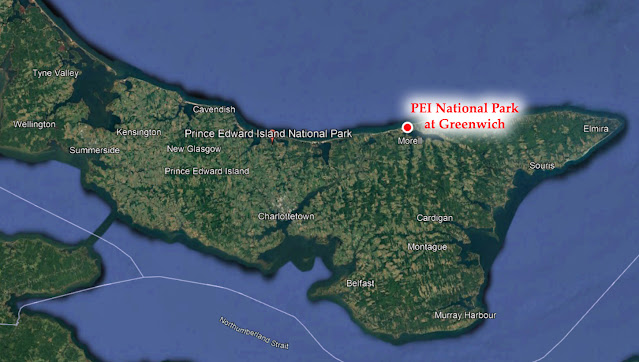
Here's a graphic (courtesy of Google Earth) showing the location of the park.  The busier parts of the park are in the central area of PEI's north coast, while Greenwich is further to the east (but still on the north coast).
 

A lot of people visit PEI due to the beaches.  The province certainly has no shortage of beaches!  However, there are three specifically notable beaches that can be found within PEI National Park system:  Cavendish Beach, Brackley Beach, and Stanhope Beach (located within the Brackley region, just east of Brackley Beach).  These three beaches are special due to their Accessibility, with amenities designed for persons with limited mobility.  Learn more about them from the Visitor Guide that you'll find on this page:

www.pc.gc.ca/en/pn-np/pe/pei-ipe/visit/guides

However, there's a lot more to the PEI National Park system than just beaches.  There are two main campgrounds (Cavendish Campground and Stanhope Campground, which have several hundred camping sites between them), and there are dozens of trails throughout the park system.  In addition, there are attractions such as Green Gables Heritage Place, Province House in Charlottetown, and the Skmaqn/Port-la-Joye/Fort Amherst National Historic Site.  Again, if you're looking for a travel destination, I highly recommend that you check out the Visitor Guide in the link above.

In 2019, Hurricane Dorian struck Atlantic Canada, and caused tens of millions of dollars in damages.  Countless numbers of mature trees were also blown down throughout the region.  Greenwich was hit hard, and a number of mature trees were destroyed. 

This planting work was not to be the first work in the PEI National Park system.  Some work was done in Cavendish in 2020.  Here are a couple of news articles about that earlier planting work, which was done by Park staff:

 
https://www.cbc.ca/news/canada/prince-edward-island/pei-cavendish-campground-tree-planting-parks-canada-1.5762300

https://www.saltwire.com/prince-edward-island/news/post-dorian-restoration-in-cavendish-sees-1000-plus-trees-shrubs-planted-in-pei-national-park-509418/


Our goal for September of 2021 was to work through several of the areas that suffered hurricane damage, in order to scatter newly planted seedlings throughout the damaged stands.  This will enhance the long-term resilience of those stands.

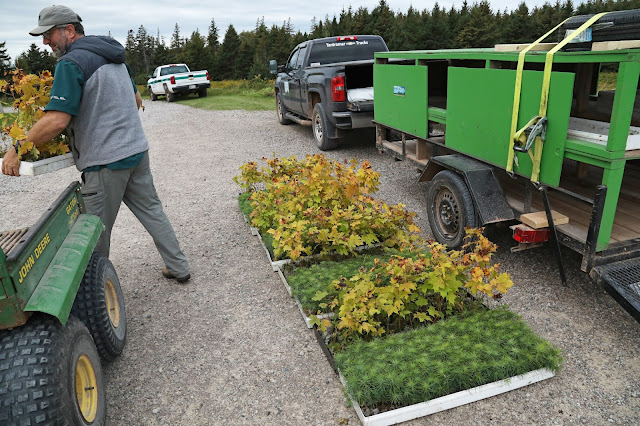
The Replant.ca Environmental team planted several thousand young seedlings within the park.  A total of five species were planted:  Northern (red) oak, sugar maple, yellow birch, red maple, and eastern white pine.

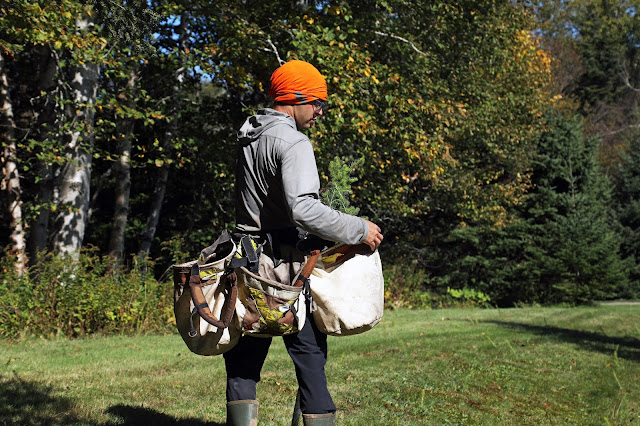
Here are a few photos of the team in action in Greenwich:


As you can see in that third photo, some of the areas that we were planting were pretty challenging!  PEI National Park has a policy not to cut out or remove any trees, including blowdown, which we think is great.  Although it was a real challenge to work our way through some of those areas to add seedlings, the broken trees provide a tremendous amount of beneficial habitat to the wildlife in the area.


You can see more photos of our 2021 tree planting work in our public 2021 Planting Photos folder on Dropbox.

We'd like to thank Philip and Hailey and their staff for their hospitality and support with setting up this project, and while we were on site.  Prince Edward Islanders are incredibly welcoming, and we look forward to completing additional projects on PEI in 2022 and beyond!


Jonathan "Scooter" Clark


Replant.ca Environmental is a Canadian company that plants trees for carbon capture and builds community forests.  We also plant trees in national, provincial, and municipal public parks to mitigate damage from wildfires, storms, insects, and forest diseases.  We operate thanks to numerous small contributions from the general public, in addition to larger project sponsorships from businesses and corporations around the world.  If you'd like to learn how to show your support, visit our donations page.  Even if you aren't able to make a contribution, we very much appreciate when people are able to share our posts or our website link on social media, to help spread the word about the work that we're doing!

To learn more about the various species that we plant, visit the conifers page or the deciduous (hardwoods) page on our website.  Thanks so much for your interest! 

Incidentally, our organization is often seeking additional land for our carbon capture projects.  Please visit this link if you might know of a recently-harvested property that we could rebuild into a permanent legacy forest.


Tree Planting Project at Mactaquac Provincial Park (2021)

This fall, Replant.ca Environmental started a long-term planting project at Mactaquac Provincial Park.  This work was made possible thanks to a sponsorship from the Trees For Life organization.  Learn more about Trees For Life at www.treesforlife.ca

Mactaquac Provincial Park is only a 30 minute drive from Fredericton, over to the west through either Keswick or French Village.  The park is situated on the St. John River, across from the Mactaquac Dam and power generating station.  This station generates one eighth of the electricity for the entire province of New Brunswick.


Here's a graphic (courtesy of Google Earth) showing the location of the park:


Mactaquac has a golf course, campground, two beaches, hiking trails, and [in the winter] it also has cross-country skiing trails.  The camping options are excellent, with around four hundred camping sites and several rustic cabins.  The washrooms and showers were extremely clean, and the entire project was a wonderful experience.  Here's a link for anyone who wants to make reservations:

https://www.parcsnbparks.info/en/parks/10/mactaquac-provincial-park


In 2014, the first named hurricane of the season was Hurricane Arthur.  It was a very early hurricane, hitting North America in early July.  It swept up the east coast and over the Maritime provinces.  The winds did a tremendous amount of damage to trees and infrastructure, especially in the Fredericton area.  Mactaquac was hit quite hard, and lost a lot of trees.  Our goal was to start the slow process of replanting some of the areas that had blown down during that storm several years earlier, and also to begin creating new wooded areas in other sections of the park.

The Replant.ca Environmental team planted 48,564 young seedlings within the park in 2021.  A total of seven species were planted:  Red spruce, white spruce, eastern white pine, eastern larch, eastern white cedar, northern (red) oak, and sugar maple.  This was the first phase of a multi-year program, and both the species diversity and the number of hardwoods will be increased significantly in 2022 and 2023.  We plan to eventually provide more than sixteen different species (six conifers and ten deciduous) to the park.

The team covered a number of different planting areas within the park.  The next three images show the approximate locations of newly planted seedlings (shaded in cyan).  Please note that these two photos are not perfectly oriented with north to the top, as is common in cartography.  However, they fit better in the blog post this way:


Here are a few photos of the team in action at Mactaquac:


You can see more photos of our 2021 tree planting work in our public 2021 Planting Photos folder on Dropbox.

We'd like to thank Kevin (the Park Manager) and his staff for their hospitality and support while we were on site.  We definitely look forward to returning in 2022 to continue the work that Trees For Life is making possible.


Edit:  If you'd like to read about the continuation of our work on this site in 2022, visit this link:

https://replant-environmental.blogspot.com/2023/02/tree-planting-project-at-mactaquac.html


Jonathan "Scooter" Clark


Replant.ca Environmental is a Canadian company that plants trees for carbon capture and builds community forests.  We also plant trees in national, provincial, and municipal public parks to mitigate damage from wildfires, storms, insects, and forest diseases.  We operate thanks to numerous small contributions from the general public, in addition to larger project sponsorships from businesses and corporations around the world.  If you'd like to learn how to show your support, visit our donations page.  Even if you aren't able to make a contribution, we very much appreciate when people are able to share our posts or our website link on social media, to help spread the word about the work that we're doing!

To learn more about the various species that we plant, visit the conifers page or the deciduous (hardwoods) page on our website.  Thanks so much for your interest! 

Incidentally, our organization is often seeking additional land for our carbon capture projects.  Please visit this link if you might know of a recently-harvested property that we could rebuild into a permanent legacy forest.


Tree Planting Project at Hopewell Rocks Provincial Park (2021)

This fall, Replant.ca Environmental started a long-term planting project at Hopewell Rocks Provincial Park.  This park is located in southeastern New Brunswick.  This work was made possible thanks to a sponsorship from the Trees For Life organization.  Learn more about Trees For Life at www.treesforlife.ca

Hopewell Rocks Provincial Park is only a 35 minute drive from Moncton, down to the south through Riverview.  The park is situated on the world-famous Bay of Fundy.  The park itself doesn't have camping sites, although there are private campgrounds open to the public only a few minutes away, such as Ponderosa Pines.  Incidentally, ponderosa pine is not a native species to New Brunswick.  Now I'm curious to know whether there are any imported ponderosa pines growing at the campground.  But let's get back to the topic of the day.  Here's a photo of Mattea, planting a sugar maple seedling:


Here's a graphic (courtesy of Google Earth) showing the location of the park:


Hopewell Rocks is famous due to its iconic beach rocks, which tell a story interwoven by time, tides, and the intricacies of nature.  Located on what is officially known as the Hopewell Rocks Ocean Tidal Exploration Site, these rocks (also known as the Flowerpot Rocks) are composed of sandstone and sedimentary conglomerate rock.  The rock formations were originally part of the shoreline, but over time, water eroded cracks in the cliffs and eventually caused some parts to appear to have become "separated" from the main cliffs.  As tides come in and out, the water gradually erodes the base of the rocks underneath the high tide line, causing the unique shape.  In 2016, part of the Elephant Rock sheared off, as was noted in this CBC article:

https://www.cbc.ca/news/canada/new-brunswick/hopewell-rocks-new-brunswick-collapse-1.3491431

That article has some good photos, including a photo at the bottom that illustrates the enormous difference in water level between low tide and high tide.  The Bay of Fundy has some of the world's largest tides.

If you'd like to learn more about the park, their website is a great resource:

www.parcsnbparks.info/en/parks/33/hopewell-rocks-provincial-park

The Replant.ca Environmental team planted 10,960 young seedlings within the park in 2021.  A total of four species were planted:  Red spruce, eastern white pine, northern (red) oak, and sugar maple.  This was the first phase of a multi-year program, and both the species diversity and the number of hardwoods will be increased significantly in the future.  We plan to eventually provide more than sixteen different species (six conifers and ten deciduous) to the park.

The team covered a number of different planting areas within the park.  Here are a few photos of the team in action at Hopewell Rocks:


You can see more photos of our 2021 tree planting work in our public 2021 Planting Photos folder on Dropbox.

We'd like to thank Erika (the Park Manager) and her staff for their hospitality and support while we were on site.  We definitely look forward to returning in 2022 to continue the work that Trees For Life is making possible.


Update:  Here's the post describing the work that we did at Hopewell Rocks in 2022!

replant-environmental.blogspot.com/2023/02/tree-planting-project-at-hopewell-rocks.html


Jonathan "Scooter" Clark


Replant.ca Environmental is a Canadian company that plants trees for carbon capture and builds community forests.  We also plant trees in national, provincial, and municipal public parks to mitigate damage from wildfires, storms, insects, and forest diseases.  We operate thanks to numerous small contributions from the general public, in addition to larger project sponsorships from businesses and corporations around the world.  If you'd like to learn how to show your support, visit our donations page.  Even if you aren't able to make a contribution, we very much appreciate when people are able to share our posts or our website link on social media, to help spread the word about the work that we're doing!

To learn more about the various species that we plant, visit the conifers page or the deciduous (hardwoods) page on our website.  Thanks so much for your interest!

Incidentally, our organization is often seeking additional land for our carbon capture projects.  Please visit this link if you might know of a recently-harvested property that we could rebuild into a permanent legacy forest.