Showing posts with label sponsor. Show all posts

Tuesday, October 26, 2021

Tree Planting Project at Five Islands Provincial Park, Nova Scotia

Our organization did some more tree planting work at the Five Islands Provincial Park this past September (of 2021).  This work was funded by the Trees For Life organization.  You can learn more about them from their website:  www.treeforlife.ca


This provincial park is located in north central Nova Scotia, on the north side of the Minas Basin.  This is on the south side of the arm that connects most of mainland Nova Scotia with New Brunswick.  The town of Truro is about an hour to the east.  Here's an overview graphic of eastern Canada, courtesy of Google Earth, which shows the location of this park:


This project was put together to initiate afforestation on some open areas, and to repair some of the extensive damage done by Hurricane Dorian in 2019.  This storm battered central Nova Scotia quite strongly, and was the costliest storm in history when it came to damages to the provincial power grid.

Damages within the park were not as bad as in some of Nova Scotia's other provincial parks.  However, since there were open areas in the park from previous insect damage, this park was a prime candidate for the planting of some new seedlings.  When we offered to assist with this work, the park staff were very happy to accommodate.

The park foresters estimated that a series of openings along the sides of Camping Area B would be amenable to the addition of seedlings.  We decided that this project would be approached in multiple phases.  We would start by planting several thousand trees in the fall of 2020, and follow that up with a larger phase of planting in the fall of 2021.


Our first phase of work in 2020 got off to a great start, and was initially funded by public donations.  However, the project really began to have a major impact in 2021 with the support of the Trees For Life organization.  The support that we received from them funded the planting of 12,490 more trees in 2021!

The following graphic shows approximately where new seedlings have been added so far.  Some of the seedlings were planted in open areas where trees were lost to the hurricane, and others were scattered as an underplant under various sections of existing partial canopy:


To date, our species mix for this project has included a total of seven species.  We had five types of conifers (mostly red spruce, eastern white pine, and eastern hemlock, plus a handful of eastern larch and black spruce).  We also had four species of deciduous hardwoods (sugar maple, red oak, mountain ash, and yellow birch).

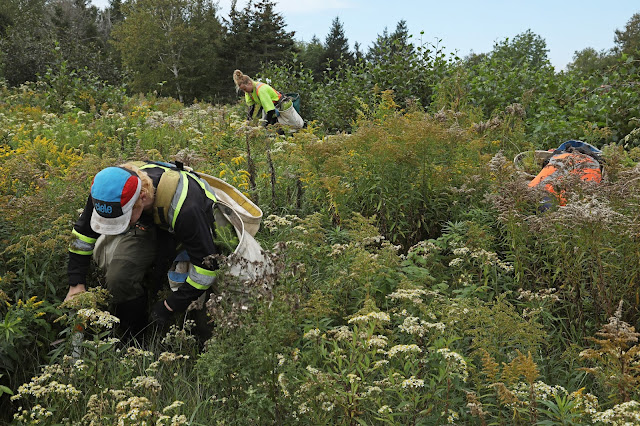
Here are a few photos of our team in action in 2021:


The second phase of planting on this project went very smoothly.  We're looking forward to returning next year to wrap up the final phase of the restoration work.  This project is getting very close to completion now, and the addition of a few more hardwood seedlings will finish this project in 2022.

We'd like to thank the staff at the Nova Scotia Department of Lands and Forestry for helping organize this project, and again to the Trees For Life organization for making this work possible.

You can see more photos of our 2021 tree planting work in our public 2021 Planting Photos folder on Dropbox.


If you'd like to learn more about the Five Island Provincial Park, visit their web page:

parks.novascotia.ca/park/five-islands


Thanks for reading!

- Jonathan Clark


Replant.ca Environmental is a Canadian company that plants trees for carbon capture and builds community forests.  We also plant trees in national, provincial, and municipal public parks to mitigate damage from wildfires, storms, insects, and forest diseases.  We operate thanks to numerous small contributions from the general public, in addition to larger project sponsorships from businesses and corporations around the world.  If you'd like to learn how to show your support, visit our donations page.  Even if you aren't able to make a contribution, we very much appreciate when people are able to share our posts or our website link on social media, to help spread the word about the work that we're doing!

To learn more about the various species that we plant, visit the conifers page or the deciduous (hardwoods) page on our website.  Thanks so much for your interest!

Incidentally, our organization is often seeking additional land for our carbon capture projects.  Please visit this link if you might know of a recently-harvested property that we could rebuild into a permanent legacy forest.


Sunday, October 17, 2021

Tree Planting Project at Mactaquac Provincial Park (2021)

This fall, Replant.ca Environmental started a long-term planting project at Mactaquac Provincial Park.  This work was made possible thanks to a sponsorship from the Trees For Life organization.  Learn more about Trees For Life at www.treesforlife.ca

Mactaquac Provincial Park is only a 30 minute drive from Fredericton, over to the west through either Keswick or French Village.  The park is situated on the St. John River, across from the Mactaquac Dam and power generating station.  This station generates one eighth of the electricity for the entire province of New Brunswick.


Here's a graphic (courtesy of Google Earth) showing the location of the park:


Mactaquac has a golf course, campground, two beaches, hiking trails, and [in the winter] it also has cross-country skiing trails.  The camping options are excellent, with around four hundred camping sites and several rustic cabins.  The washrooms and showers were extremely clean, and the entire project was a wonderful experience.  Here's a link for anyone who wants to make reservations:

https://www.parcsnbparks.info/en/parks/10/mactaquac-provincial-park


In 2014, the first named hurricane of the season was Hurricane Arthur.  It was a very early hurricane, hitting North America in early July.  It swept up the east coast and over the Maritime provinces.  The winds did a tremendous amount of damage to trees and infrastructure, especially in the Fredericton area.  Mactaquac was hit quite hard, and lost a lot of trees.  Our goal was to start the slow process of replanting some of the areas that had blown down during that storm several years earlier, and also to begin creating new wooded areas in other sections of the park.

The Replant.ca Environmental team planted 48,564 young seedlings within the park in 2021.  A total of seven species were planted:  Red spruce, white spruce, eastern white pine, eastern larch, eastern white cedar, northern (red) oak, and sugar maple.  This was the first phase of a multi-year program, and both the species diversity and the number of hardwoods will be increased significantly in 2022 and 2023.  We plan to eventually provide more than sixteen different species (six conifers and ten deciduous) to the park.

The team covered a number of different planting areas within the park.  The next three images show the approximate locations of newly planted seedlings (shaded in cyan).  Please note that these two photos are not perfectly oriented with north to the top, as is common in cartography.  However, they fit better in the blog post this way:


Here are a few photos of the team in action at Mactaquac:


You can see more photos of our 2021 tree planting work in our public 2021 Planting Photos folder on Dropbox.

We'd like to thank Kevin (the Park Manager) and his staff for their hospitality and support while we were on site.  We definitely look forward to returning in 2022 to continue the work that Trees For Life is making possible.


Edit:  If you'd like to read about the continuation of our work on this site in 2022, visit this link:

https://replant-environmental.blogspot.com/2023/02/tree-planting-project-at-mactaquac.html


Jonathan "Scooter" Clark


Replant.ca Environmental is a Canadian company that plants trees for carbon capture and builds community forests.  We also plant trees in national, provincial, and municipal public parks to mitigate damage from wildfires, storms, insects, and forest diseases.  We operate thanks to numerous small contributions from the general public, in addition to larger project sponsorships from businesses and corporations around the world.  If you'd like to learn how to show your support, visit our donations page.  Even if you aren't able to make a contribution, we very much appreciate when people are able to share our posts or our website link on social media, to help spread the word about the work that we're doing!

To learn more about the various species that we plant, visit the conifers page or the deciduous (hardwoods) page on our website.  Thanks so much for your interest! 

Incidentally, our organization is often seeking additional land for our carbon capture projects.  Please visit this link if you might know of a recently-harvested property that we could rebuild into a permanent legacy forest.


Friday, February 28, 2020

The Norway Spruce tree (Picea abies)

The Norway spruce is also known as the European spruce.  The Latin name for this tree is Picea abies.  You may wonder why I'm talking about this species despite the fact that it is not originally native to North America.  I'll explain that shortly.

First, let's cover a few basics.  Norway spruce is typically native to northern, central, and eastern Europe.  It doesn't like warm temperatures, so it's not common in southern Europe (although pockets do exist).  It is very closely related to the Siberian spruce, which is found commonly east of the Urals.

Norway spruce has become a relatively common tree in North America, despite not being a native species.  Globally, this species is one of the most widely planted of all trees, both inside and outside its native range.  Norway spruce is planted frequently within the cooler northern parts of the United States, and through eastern Canada.  It is so prevalent that there are now naturalized populations from the Great Lakes to parts of the northeastern seaboard.  It fits quite well into parts of Canada's temperate forest, and even grows well in parts of the southeastern boreal forest (at least where the climate is suitable).

Norway spruce is a very large conifer, often growing to heights of more than 40 meters, and diameters of more than a meter.  More importantly, it is very fast-growing compared to most other spruce species, especially for the first twenty-five years.  Typically, when you see mixed species plantations, you'll notice that pine trees grow very quickly (because they love sunlight) and spruce trees lag behind quite significantly, but the spruce trees slowly start to catch up after a few decades.  Norway spruce narrows that gap significantly.  Here's a photo of a semi-mature tree:


You'll notice that this particular urban tree looks quite symmetrical and full.  It has a nice shape to it.  Norway spruce has high commercial value, and not just for pulp and lumber.  It's also a very popular tree for the cultivation of Christmas trees, and used for this purpose all over the world.  Oslo (the capital of Norway) donates a large Norway spruce Christmas tree to the cities of London, Edinborough, and Washington DC each year, as thanks for the aid that the US and UK gave to Norway during World War II.  Norway spruce are also commonly used as ornamental trees in parks and gardens in many parts of the world (as long as the climate is suitable).

The needles of the Norway spruce are four-sided (quadrangular).  This means that if you take a needle and try to "roll" it between your thumb and finger, it rolls quite easily.  In contract, the needles for some species don't do this.  Balsam fir, as an example, is a three-sided needle but it's a very shallow profile (almost two-sided), so balsam fir needles won't roll easily between your fingers.  The needles of the Norway spruce have quite blunt tips.  Here's a photo of some lush foilage.


The seed cones of the Norway spruce are record-setting among the various spruce species for having the longest length.  Some full-sized cones can be almost twenty centimeters (eight inches) long.  These cones start out being either reddish or greenish in colour, but about half a year after they are pollinated, they mature to a rich brown colour.


Here are a few fun facts about the Norway spruce:

1.  This species is so fast-growing that in some areas, it grows to reach the appropriate size for Christmas trees in as little as four years.

2.  This is another species which is especially suitable for making beer (the brew is made from young branches with the richest needles).

3.  There is a Norway spruce tree in Sweden which has been nicknamed Old Tjikko.  This tree, which grew as a clone from a root system, has been dated as being 9,550 years old.  It is the oldest known individual living tree of any species (some trembling aspen clusters are much older).


Thanks for reading ...

- Jonathan Clark
www.replant-environmental.ca


Replant.ca Environmental is a Canadian company that plants trees for carbon capture and builds community forests.  We also plant trees in national, provincial, and municipal public parks to mitigate damage from wildfires, storms, insects, and forest diseases.  We operate thanks to numerous small contributions from the general public, in addition to larger project sponsorships from businesses and corporations around the world.  If you'd like to learn how to show your support, visit our donations page.  Even if you aren't able to make a contribution, we very much appreciate when people are able to share our posts or our website link on social media, to help spread the word about the work that we're doing!

Teachers are welcome to use content from this post for their classes.  If you know a teacher who might like to use this information, please share it with them!  The more that people learn about trees, the better our world will be.

To learn more about the various species that we plant, visit the conifers page or the deciduous (hardwoods) page on our website.  Thanks so much for your interest!


Incidentally, our organization is often seeking additional land for our carbon capture projects.  Please visit this link if you might know of a recently-harvested property that we could rebuild into a permanent legacy forest.

Wednesday, February 26, 2020

The Tamarack tree (Larix laricina)

In this post, I'm going to take a close look at a tree with many names, but which most Canadians refer to as the Tamarack.  The Latin name for this species is Larix laricina, but in addition to being called the tamarack in common usage, it's also referred to as eastern larch, black larch, red larch, hackmatack, or American larch.  In this case, "American" is a reference to North American, not to the United States.  In the northern dialect of the Eastern James Bay Cree, it is called the waachinaakin.

Here's a photo of a young tamarack tree:


The tamarack is a fairly unique tree among the conifers.  I'm excited to explain that in a minute, but first we should quickly look at the range.  If you look at our recent post about black spruce trees, you'll see that the range maps of these two species overlap almost perfectly.  The black spruce has a slightly larger range, but they are very similar overall.  And that means that it's pretty easy to find tamarack through most parts of Canada.  Here's a range map, courtesy of Wikipedia:


I already referred to the tamarack as being fairly unique among conifers.  To explain why, I have to review some definitions.  A conifer is a tree that is cone-bearing.  Most people equate conifers with evergreens.  Evergreen is a slang term for a tree that stays green throughout the entire year.  Most conifers do retain their leaves (needles) through the winter, so yes, most conifers are also evergreens.

Do you know what a deciduous tree is?  Most people assume that any broad-leaf tree is a deciduous tree.  However, that's not quite correct.  Broad-leaf is a slang term for any type of leaf that is broad.  No surprises there.  Most people say that all trees have either [broad] leaves or needles.  Is there any advantage for a tree in having needles?  Well, needles are more waterproof and more wind-proof than broad leaves.

Anyway, let's get back to the point.  The true definition of a deciduous tree is one that sheds its needles annually.  In cold regions such as Canada, most broad-leafed trees shed their needles every year, so the terms are somewhat synonymous.  But here's where the tamarack bends the rules.  The tamarack is a needle-bearing tree, but it drops its needles every year, then grows a new set in the spring.  Therefore, the tamarack is both coniferous (cone-bearing) and deciduous (shedding leaves annually).  It is therefore known as a deciduous conifer.  The tamarack and the western larch are the only two common deciduous conifers found in Canada.

When the tamarack is about to lose its needles in the fall, they turn a beautiful golden-yellow colour, making these trees very easy to spot in some areas.  Here's are two photos that I took in October, where you can very easily identify the brightly coloured tamarack:


If you'd like to learn more about deciduous conifers, check out this article:
https://www.thespruce.com/what-are-deciduous-conifers-3269799

Now that we've covered the most exciting thing about the tamarack, let's get back to basics with a list of common characteristics:
- Extremely tolerant of cold.  Temperatures of -70oC don't bother this species.
- Maximum height usually not much more than 15 meters (50 feet).
- Maximum diameter usually not much more than half a meter (a foot and a half).
- The average lifespan of a mature tree is around 150 years.
- Needles occur in large groups of up to 20 needles per cluster.
- Often found in wet swampy or boggy conditions, growing alongside black spruce.
- Strangely enough, tamarack is also a good pioneer species in fresh burns, at least until it gets overtaken by other species.

Here's a close-up of the needles and cones:

Even when green, tamarack has a very sparse look to it.  It provides very little shade compared to most trees, which allows a thick undergrowth of mosses and shrubs to thrive underneath the tree.  Speaking of shade, tamarack itself is a very shade intolerant tree.  If you plant it underneath other trees, or even under competing shrubs or vegetation, the mortality rate is quite high.  This is a pioneer species, and in the long term, is usually succeeded first by black spruce, and then by other species.

Tamarack wood is quite flexible.  Native Americans often used this species for making snowshoes.  It isn't a major commercial species, although it's very resistant to rot from moisture (just like cedar), so it is a good option for fence poles and similar applications.  My dad was a land surveyor, and he mentioned that tamarack is a good choice if you need to leave a pole in the ground for some time.


Fun facts:

1.  This is quite unrelated to the tamarack, but you'll notice that I've been throwing around the words "swamp" and "bog" fairly interchangeably.  Actually, there is a difference.  There are four distinct types of wetlands:  swamps, marshes, bogs, and fens.  But I'll save that for another blog post.  I only bring that up because tamaracks thrive near or even in various types of wetlands.

2.  The tamarack is Canada's most northerly tree, found as far north as the 72nd degree of latitude.  That's quite far north of the Arctic Circle (which is at approximately 66.5 degrees north latitude).  Therefore, tamarack trees can grow in the land of White Nights.

 3.  The Ojibwa used tamarack roots as a "thread" to sew together pieces of birch bark when making canoes, due to rot resistance and flexibility.


Here's a photo of a tamarack with its needles dropped during the winter.  Despite appearances, this is a healthy tree!  It's not a great photo, with the grey sky in the background, but if we get a day with deep blue sky I'll try to upgrade the photo:


And here is a photo of some of our tamarack seedlings:


Thanks for reading ...

- Jonathan Clark
www.replant-environmental.ca


Replant.ca Environmental is a Canadian company that plants trees for carbon capture and builds community forests.  We also plant trees in national, provincial, and municipal public parks to mitigate damage from wildfires, storms, insects, and forest diseases.  We operate thanks to numerous small contributions from the general public, in addition to larger project sponsorships from businesses and corporations around the world.  If you'd like to learn how to show your support, visit our donations page.  Even if you aren't able to make a contribution, we very much appreciate when people are able to share our posts or our website link on social media, to help spread the word about the work that we're doing!

Teachers are welcome to use content from this post for their classes.  If you know a teacher who might like to use this information, please share it with them!  The more that people learn about trees, the better our world will be.

To learn more about the various species that we plant, visit the conifers page or the deciduous (hardwoods) page on our website.  Thanks so much for your interest!


Incidentally, our organization is often seeking additional land for our carbon capture projects.  Please visit this link if you might know of a recently-harvested property that we could rebuild into a permanent legacy forest.


The Norway Pine tree (Pinus resinosa)

I'd like to share some information about the Norway Pine tree.  The Latin name for this tree is Pinus resinosa, and it is also very commonly known throughout northeastern North America as the Red pine.  Red pine is probably a better name for common use.  The inner bark of the red pine is very reddish in colour, so it's an appropriate name.  In the field, I usually refer to this tree as the red pine rather than Norway pine.  Most people do.

Speaking of the bark of the tree, here's a photo.  It's quite scaly.  The bark often has more of a grey appearance in weathered trees, but if you peel away the surface bark you'll quickly see the reddish tint underneath.  The reddish bark is also easier to discern in juvenile trees.  Here's a photo showing the bark and trunk of a red pine up close:


The Norway pine is a very majestic tree at maturity.  It can often grow to be more than 30 meters (100 feet) in height and more than a meter in diameter.  Even more impressive, this is a fairly long-lived species, sometimes living for up to five hundred years.

Norway pine has a range which is limited to northeastern North America.  It is commonly found in southern Ontario, Quebec, and through the Maritime provinces.  It is also found in pockets in Newfoundland, and as far west within Canada as southern Manitoba.  It is also common around the Great Lakes and in northeastern parts of the US.  Here's a range map, courtesy of Wikipedia:


Let's go back to the proper name of this tree.  Nobody really seems to be sure why the pine was named after Norway.  It doesn't seem to have any relation to that country.  There's a small town in Maine called Norway, and that town has a lot of red pine around it.  But Norway (Maine) didn't get its name until it was incorporated in 1797, and the original intention was to call it Norage, which was a Native American name for waterfalls.  There doesn't seem to be any information online to hint at when Norway pine started to be called as such, but if it pre-dates the founding of the town of Norway, then it certainly can't be named after the town.  Incidentally, Norway (Maine) was once very famous as the alleged "snowshoe capital of the world."  Red pine was used in the manufacture of snowshoes.  That still doesn't explain the name properly.  I like to pretend that there was once a famous giant lumberjack from Norway with a bushy red beard, and the tree was named after this lumberjack.  But that's unlikely.  It would be a good story though, if it was true.

The Norway pine is a conifer.  Conifers are cone-bearing trees.  The cones of the Norway pine are ovoid in shape, which means that they're egg-shaped.  They're also fairly close in size to regular [chicken] eggs that you'd find at a grocery store, ie. about 5-6cm long when they're still closed.

The needles of the Norway pine are a dark yellow-green, and always come in pairs.  Needles on pine trees always come in pairs, triplets, or groups of five, but the number depends upon the species.  These needles can be fairly long, usually about 15cm or so, and like many other long-needled pines, the needles can be fairly brittle.  Here's a close-up photo of the needles and some opened cones on a Norway pine:


This species is not shade-tolerant.  It wants open ground and a lot of sunlight to grow successfully.  Despite wanting sunshine, it also likes cool summers and cold winters, which is why it thrives in Canada but not in the southern States.  If climate change causes temperatures to rise in the future, we may see that Norway pine becomes almost entirely a Canadian tree.  Like most other pines, this species prefers well-drained sandy or loamy soils, rather than clay.

Unfortunately, the Norway pine is susceptible to a fairly large range of insect pests, including pine beetles, pine gall weevil, pine needle miner, tussock moth, and sawflies.  However, these problems are much worse in warm climates, and don't have as significant an impact on the population in Canada.

Here are three fun facts about the Norway pine:
1.  This species was planted in large quantities during very early tree planting programs in the United States.  During the Great Depression, the Civilian Conservation Corp planted millions of these trees.
2.  The Norway pine is the State Tree of Minnesota.  In fact, Minnesota is probably the only area where people usually refer to this species as Norway pine instead of red pine.
3.  This species was historically a favoured tree for the construction of log cabins, due to its very straight and clean trunks.

At Replant.ca Environmental, Norway pine is just one of a large number of species that we use on some of our projects!


Thanks for reading ...

- Jonathan Clark
www.replant-environmental.ca


Replant.ca Environmental is a Canadian company that plants trees for carbon capture and builds community forests.  We also plant trees in national, provincial, and municipal public parks to mitigate damage from wildfires, storms, insects, and forest diseases.  We operate thanks to numerous small contributions from the general public, in addition to larger project sponsorships from businesses and corporations around the world.  If you'd like to learn how to show your support, visit our donations page.  Even if you aren't able to make a contribution, we very much appreciate when people are able to share our posts or our website link on social media, to help spread the word about the work that we're doing!

Teachers are welcome to use content from this post for their classes.  If you know a teacher who might like to use this information, please share it with them!  The more that people learn about trees, the better our world will be.

To learn more about the various species that we plant, visit the conifers page or the deciduous (hardwoods) page on our website.  Thanks so much for your interest!


Incidentally, our organization is often seeking additional land for our carbon capture projects.  Please visit this link if you might know of a recently-harvested property that we could rebuild into a permanent legacy forest.

Saturday, November 2, 2019

The White Spruce tree (Picea glauca)

For this week's featured species, we're going to look at the White Spruce.  The proper Latin name for this species is Picea glauca.  White spruce is sometimes referred to as "Canadian spruce," although that's not an official name of any sort.


Some people refer to Engelmann spruce as white spruce, but that's a different species.  Engelmann spruce is found at elevation in southern BC at the western US.  Engelmann spruce is often crossed with true white spruce to create a hardy hybrid that is planted all over western Canada.

Here's a photo that I took of a white spruce, which I believe was probably about 30-40 years old:


The white spruce is a very plentiful tree.  It's very healthy, and has a broad range.  You can find this species all across Canada, except for the very southern reaches of BC and Alberta, and the west coast of BC (where Sitka spruce takes over).  Here's a range map from Wikipedia:


Spruce trees, in general, love water.  They typically prefer flowing (aerated) water, although black spruce can thrive in some pretty fetid swampy areas.  White spruce is certainly quite happy to grow in moisture-laden soils.  White spruce, like all other spruce trees, is also a very shade-tolerant tree.  However, it is slightly less shade tolerant than red spruce (red spruce is a common tree in New Brunswick and Nova Scotia).  Regardless, white spruce will do adequately when planted under a canopy, or in areas with high brush and vegetation competition.  However, white spruce seedlings can be susceptible to spring frosts.  Having brush or a mature canopy over young seedlings acts to protect them until they're older.

When I was very young, I thought that all cones, regardless of what species of conifer the cone came from, were called pine cones.  Of course, that was that naivete of a young child.  The cones on spruce trees are called spruce cones.  White spruce has two types of cones, male and female.  Each tree contains both types.  The male cones produce pollen, which floats to the female cones to fertilize the seed.  After the cones are fertilized, it takes about three months for them to mature and open.  When the cones open, the seed is dispersed fairly far from the tree, due to small wings on each seed.  It is common for seed to spread more than 100m from the parent tree, thanks to winds.  Although the number of seeds per cone varies, there are usually at least a few dozen seeds in a cone, and sometimes more than a hundred.
 

A mature white spruce will often live to be more than 200 years old.  Some trees live to be many times older than that.  After the first century, as long as the site and growing conditions are adequate, a white spruce will often reach 30m (100 feet) in height, and can have a diameter of more than a meter (3 feet) at the base.  This species can capture very large amounts of carbon.  Our Walker Road property has some beautiful mature white spruce that are starting to approach this size.

Although we don't harvest any of our trees at Replant.ca Environmental, white spruce is often used in the manufacture of acoustic guitars.

One way to distinguish white spruce from red spruce is by the colour of the needles.  The white spruce needles are a bluish-green shade, in contrast to the more yellow-green shade of red spruce needles.

This year, we've planted many thousands of white spruce seedlings at Replant.ca Environmental.  Here's a photo of some of them:


Thanks for reading!


- Jonathan Clark
www.replant-environmental.ca


Replant.ca Environmental is a Canadian company that plants trees for carbon capture and builds community forests.  We also plant trees in national, provincial, and municipal public parks to mitigate damage from wildfires, storms, insects, and forest diseases.  We operate thanks to numerous small contributions from the general public, in addition to larger project sponsorships from businesses and corporations around the world.  If you'd like to learn how to show your support, visit our donations page.  Even if you aren't able to make a contribution, we very much appreciate when people are able to share our posts or our website link on social media, to help spread the word about the work that we're doing!

Teachers are welcome to use content from this post for their classes.  If you know a teacher who might like to use this information, please share it with them!  The more that people learn about trees, the better our world will be.

To learn more about the various species that we plant, visit the conifers page or the deciduous (hardwoods) page on our website.  Thanks so much for your interest!

Incidentally, our organization is often seeking additional land for our carbon capture projects.  Please visit this link if you might know of a recently-harvested property that we could rebuild into a permanent legacy forest.