Showing posts with label pine. Show all posts

Saturday, November 23, 2024

Tree Planting Project at Herring Cove Provincial Park, New Brunswick (2024)

Our organization did some tree planting work at Herring Cove Provincial Park this past September.  This work was funded entirely by the Forests Canada organization through their Forest Recovery Canada initiative as the Project Sponsor.


This provincial park is located in the very southwest corner of New Brunswick, on Campobello Island (which is northeast of Grand Manan Island).  From the United States, Herring Cove is only a six minute drive from the border bridge at Lubec Narrows.  From our home base in Canada, the route is slightly more complicated, involving two ferry crossings in each direction, first to Deer Island and then on to Campobello Island.  Here's an overview graphic, courtesy of Google Earth:


The approximate GPS coordinates at the park visitor centre are:  44.87716, -66.93423


Most of the planting for this particular project involved planting tree seedlings where the Park staff wanted to improve visual buffers between camping sites (with existing sporadic mature trees).  We also planted a few trees in some open areas that should be returned to forest land, and in parts of the understory where the canopy could use eventual thickening and diversity.  The afforestation and the underplanting with both be important for carbon sequestration and climate change mitigation, and will provide additional habitat for birds and wildlife.  Basically, several goals aligned with the work that we carried out.  The following graphic shows the approximate locations for the new seedlings:


In total, our planting team added 13,443 trees to the Park this year!

Here are a few photos of the planting team in action:


This project went very smoothly.  We were able to complete the planned planting on all of the current-year targeted areas within this park.  We expect to return at some point in the near future to add more seedlings to additional areas.  Naturally, we will also be making regular visits back to monitor the long-term growth and health of the planted trees.

We'd like to thank the staff at NB Parks for helping with the logistical planning that ensured this project came together, and we again want to thank the Forests Canada organization for being the sponsor that made this work possible.

You can see more photos of our tree planting work at this site by visiting our Planting Photos folder on Dropbox, then going into the "2024 Planting Photos" folder, then into the "Herring Cove Provincial Park" sub-folder.  Start here:

    www.replant-environmental.ca/photos


If you'd like to learn more about Herring Cove Provincial Park, visit their web page:

www.parcsnbparks.info/en/parks/6/herring-cove-provincial-park


Thanks for reading!

- Jonathan Clark


Replant.ca Environmental is a Canadian company that plants trees for carbon capture and builds community forests.  We also plant trees in national, provincial, and municipal public parks to mitigate damage from wildfires, storms, insects, and forest diseases.  We operate thanks to numerous small contributions from the general public, in addition to larger project sponsorships from businesses and corporations around the world.  If you'd like to learn how to show your support, visit our donations page.  Even if you aren't able to make a contribution, we very much appreciate when people are able to share our posts or our website link on social media, to help spread the word about the work that we're doing!


To learn more about the various species that we plant, visit the conifers page or the deciduous (hardwoods) page on our website.  Thanks so much for your interest!

Incidentally, our organization is often seeking additional land for our carbon capture projects.  Please visit this link if you might know of a recently-harvested property that we could rebuild into a permanent legacy forest.


Tree Planting Project in Tantramar, New Brunswick (2024)

Here's a post about another carbon sequestration project that we recently completed on behalf of one of our Sponsor Partners.  The tree planting work on this site in southeastern New Brunswick was done in the Spring of 2024.  The work was done at a large site on the side of the TransCanada Highway, just west of Sackville.  The planting on this site was entirely sponsored by One Tree Planted.


This site was harvested about a decade and a half ago, by a third party, and our goal was to help rebuild a new forest there.  The site is large and easily accessible, and might be a great site for a public park in the future.  It is fairly close to Sackville's Beech Hill Park, which has some nice recreation trails, and trails on this site could complement those that are already built in the area.

As noted, although we hope to provide future opportunities for public recreation on this site, the primary initial purpose of this project was to support climate stability through carbon sequestration.  As a side benefit, this site will support biodiversity and wildlife habitat.  There were already some healthy trees growing on this site (mostly balsam fir, white spruce, American beech, trembling aspen, red maple, and white birch) so we were able to plant at fairly low density, adding only 33,750 more trees (mostly eastern white pine seedlings) into open areas on this 121.8 acre site.  Diverse forests are healthy forests, and eastern white pine is an especially appealing native tree when considering possible negative future climate change scenarios.

Here are a few more photos taken during the planting of this project, which took place in late April of 2024:


You can see more photos of our tree planting work at this site by visiting our Planting Photos folder on Dropbox, then going into the "2024 Planting Photos" folder, then into the "Tantramar Rec Trails" sub-folder.  Start here:

    www.replant-environmental.ca/photos


We look forward to studying this site in the coming years.  We will be doing periodic surveys to assess the carbon capture progress of the new forest, and hope to start exploring the possibility of building recreational trails in 2027.

Again, a huge thanks to One Tree Planted, the sponsors and lead on this major project.


Thanks for reading!

- Jonathan Clark


Replant.ca Environmental is a Canadian company that plants trees for carbon capture and builds community forests.  We also plant trees in national, provincial, and municipal public parks to mitigate damage from wildfires, storms, insects, and forest diseases.  We operate thanks to numerous small contributions from the general public, in addition to larger project sponsorships from businesses and corporations around the world.  If you'd like to learn how to show your support, visit our donations page.  Even if you aren't able to make a contribution, we very much appreciate when people are able to share our posts or our website link on social media, to help spread the word about the work that we're doing!

To learn more about the various species that we plant, visit the conifers page or the deciduous (hardwoods) page on our website.  Thanks so much for your interest!

Incidentally, our organization is often seeking additional land for our carbon capture projects.  Please visit this link if you might know of a recently-harvested property that we could rebuild into a permanent legacy forest.


Sunday, February 19, 2023

Tree Planting Project at the Luciphy West Carbon Plantation (2022)

Here's a post to share some info about another of our carbon sequestration projects.  The tree planting work on this site in southeastern New Brunswick was done in the spring and fall of 2022.  The work was done at a site near the northwest end of Luciphy Road, close to the northeast end of the Brooklyn Road.  From this site, the town of Sackville (our home base of operations) is about fifteen minutes away.


This site was formerly owned privately by a third party, and that landowner harvested the wood recently.  We were able to acquire the property after it was harvested, then designed a plan to turn it into an environmental project to help mitigate climate change (we will never allow it to be harvested again).  Based on the site characteristics, we decided that this particular property should be part of our group of carbon capture plantations.


The GPS coordinates at the center of this site are:  45.98869, -64.23508


The primary purpose of this project was to support climate stability through carbon sequestration.  As a side benefit, this site will support biodiversity and wildlife habitat.

In total, the planting team added 31,900 coniferous seedlings on this site (which covers 43.3 acres, with three distinct open areas).  Although the site already shows some evidence of natural regeneration of white birch, red maple, yellow birch, and other hardwoods, we plan to enhance the mix of deciduous species on this site in the near future, as availability permits.  Diverse forests are healthy forests.

Here are a few more photos taken during the planting of this project, which took place in April, May, and September of 2022 (multiple visits with different species):


We look forward to studying this site in the coming years.  We will be doing periodic surveys to assess the carbon capture progress of the new forest.

You can see several dozen additional photos of the work on this planting site by visiting our public 2022 Planting Photos folder on Dropbox (go into the "Luciphy West Carbon Plantation" sub-folder).


Thanks for reading!

- Jonathan Clark


Replant.ca Environmental is a Canadian company that plants trees for carbon capture and builds community forests.  We also plant trees in national, provincial, and municipal public parks to mitigate damage from wildfires, storms, insects, and forest diseases.  We operate thanks to numerous small contributions from the general public, in addition to larger project sponsorships from businesses and corporations around the world.  If you'd like to learn how to show your support, visit our donations page.  Even if you aren't able to make a contribution, we very much appreciate when people are able to share our posts or our website link on social media, to help spread the word about the work that we're doing!

To learn more about the various species that we plant, visit the conifers page or the deciduous (hardwoods) page on our website.  Thanks so much for your interest!

Incidentally, our organization is often seeking additional land for our carbon capture projects.  Please visit this link if you might know of a recently-harvested property that we could rebuild into a permanent legacy forest.


Wednesday, February 26, 2020

The Norway Pine tree (Pinus resinosa)

I'd like to share some information about the Norway Pine tree.  The Latin name for this tree is Pinus resinosa, and it is also very commonly known throughout northeastern North America as the Red pine.  Red pine is probably a better name for common use.  The inner bark of the red pine is very reddish in colour, so it's an appropriate name.  In the field, I usually refer to this tree as the red pine rather than Norway pine.  Most people do.

Speaking of the bark of the tree, here's a photo.  It's quite scaly.  The bark often has more of a grey appearance in weathered trees, but if you peel away the surface bark you'll quickly see the reddish tint underneath.  The reddish bark is also easier to discern in juvenile trees.  Here's a photo showing the bark and trunk of a red pine up close:


The Norway pine is a very majestic tree at maturity.  It can often grow to be more than 30 meters (100 feet) in height and more than a meter in diameter.  Even more impressive, this is a fairly long-lived species, sometimes living for up to five hundred years.

Norway pine has a range which is limited to northeastern North America.  It is commonly found in southern Ontario, Quebec, and through the Maritime provinces.  It is also found in pockets in Newfoundland, and as far west within Canada as southern Manitoba.  It is also common around the Great Lakes and in northeastern parts of the US.  Here's a range map, courtesy of Wikipedia:


Let's go back to the proper name of this tree.  Nobody really seems to be sure why the pine was named after Norway.  It doesn't seem to have any relation to that country.  There's a small town in Maine called Norway, and that town has a lot of red pine around it.  But Norway (Maine) didn't get its name until it was incorporated in 1797, and the original intention was to call it Norage, which was a Native American name for waterfalls.  There doesn't seem to be any information online to hint at when Norway pine started to be called as such, but if it pre-dates the founding of the town of Norway, then it certainly can't be named after the town.  Incidentally, Norway (Maine) was once very famous as the alleged "snowshoe capital of the world."  Red pine was used in the manufacture of snowshoes.  That still doesn't explain the name properly.  I like to pretend that there was once a famous giant lumberjack from Norway with a bushy red beard, and the tree was named after this lumberjack.  But that's unlikely.  It would be a good story though, if it was true.

The Norway pine is a conifer.  Conifers are cone-bearing trees.  The cones of the Norway pine are ovoid in shape, which means that they're egg-shaped.  They're also fairly close in size to regular [chicken] eggs that you'd find at a grocery store, ie. about 5-6cm long when they're still closed.

The needles of the Norway pine are a dark yellow-green, and always come in pairs.  Needles on pine trees always come in pairs, triplets, or groups of five, but the number depends upon the species.  These needles can be fairly long, usually about 15cm or so, and like many other long-needled pines, the needles can be fairly brittle.  Here's a close-up photo of the needles and some opened cones on a Norway pine:


This species is not shade-tolerant.  It wants open ground and a lot of sunlight to grow successfully.  Despite wanting sunshine, it also likes cool summers and cold winters, which is why it thrives in Canada but not in the southern States.  If climate change causes temperatures to rise in the future, we may see that Norway pine becomes almost entirely a Canadian tree.  Like most other pines, this species prefers well-drained sandy or loamy soils, rather than clay.

Unfortunately, the Norway pine is susceptible to a fairly large range of insect pests, including pine beetles, pine gall weevil, pine needle miner, tussock moth, and sawflies.  However, these problems are much worse in warm climates, and don't have as significant an impact on the population in Canada.

Here are three fun facts about the Norway pine:
1.  This species was planted in large quantities during very early tree planting programs in the United States.  During the Great Depression, the Civilian Conservation Corp planted millions of these trees.
2.  The Norway pine is the State Tree of Minnesota.  In fact, Minnesota is probably the only area where people usually refer to this species as Norway pine instead of red pine.
3.  This species was historically a favoured tree for the construction of log cabins, due to its very straight and clean trunks.

At Replant.ca Environmental, Norway pine is just one of a large number of species that we use on some of our projects!


Thanks for reading ...

- Jonathan Clark
www.replant-environmental.ca


Replant.ca Environmental is a Canadian company that plants trees for carbon capture and builds community forests.  We also plant trees in national, provincial, and municipal public parks to mitigate damage from wildfires, storms, insects, and forest diseases.  We operate thanks to numerous small contributions from the general public, in addition to larger project sponsorships from businesses and corporations around the world.  If you'd like to learn how to show your support, visit our donations page.  Even if you aren't able to make a contribution, we very much appreciate when people are able to share our posts or our website link on social media, to help spread the word about the work that we're doing!

Teachers are welcome to use content from this post for their classes.  If you know a teacher who might like to use this information, please share it with them!  The more that people learn about trees, the better our world will be.

To learn more about the various species that we plant, visit the conifers page or the deciduous (hardwoods) page on our website.  Thanks so much for your interest!


Incidentally, our organization is often seeking additional land for our carbon capture projects.  Please visit this link if you might know of a recently-harvested property that we could rebuild into a permanent legacy forest.

Wednesday, November 27, 2019

The Jack Pine tree (Pinus banksiana)

Let's take a look at another pine tree that we plant, the Jack Pine.  This tree is also referred to as the scrub pine, the grey pine, the Hudson Bay pine, or the Banksian pine.  The latter name is due to its Latin name, Pinus banksiana.  The term "scrub pine" seems somewhat dismissive.  Where is the love?

To be fair, the Jack pine is not the most impressive species out there.  We mix some Jack pine into our species mixes sometimes, but that's more for diversity than because it's a major contributor to carbon capture.  We also plant two other types of pine (Norway and Eastern White) in larger quantities.  Still, diversity is important.  What happens if global warming raises average temperatures by several degrees over the next few decades?  This could have a seriously negative effect upon many of the species currently growing in Canada, and we think that Jack pine is the conifer that is least likely to be affected if temperatures do get that high (eastern white pine being the second least vulnerable).

Here's a photo of some Jack pine trees, courtesy of Wikipedia.  I'll try to replace this photo with one of my own at some point:


The range of the Jack pine is quite broad.  There are a lot of different species of pine trees in the world (about 120, depending on whom you ask).  In western Canada, you can find about twenty different pine species, four of which I've planted while working in commercial operations.  In eastern Canada, you can find about thirteen species, three of which we plant at Replant.ca Environmental.  As far as I'm aware, Jack pine has the largest geographic distribution range within Canada (of the pines).  Here's a graphic from Wikipedia to illustrate that:


Despite its broad range and hardiness, the reason that Jack pine is often omitted from "favorite tree" lists is because it doesn't grow as large as some other types (such as Eastern white pine), and the trunk doesn't often grow as straight or majestically.  Due to this, many foresters and carpenters don't get as excited by Jack pine as they do by other types of pine, although to be honest, this probably has saved more than a few individual trees from the axe.  Under good growing conditions, Jack pine usually only reaches a height of 15-20 meters at maturity (50-65 feet), and the trunk doesn't often exceed a diameter of about 50 centimeters (one and a half feet).  As mentioned, the trunks can often be twisted or knotty, so when it is used commercially, it is often more likely to be used for pulpwood than for lumber.

Jack pines can be affected by quite a few diseases.  There are weevils and sawflies and budworms that attack the trees.  Jack pine can also be affected by a disease called sweet fern blister rust.  When this happens, Jack pine is an inadvertent victim.  Normally, sweet fern blister rust affects sweet ferns, but the spores can drift onto Jack pine and attack the trees too.

Jack pine is somewhat similar to lodgepole pine, which we plant very frequently on commercial projects all over the west coast.  Like lodgepole pine, the cones of Jack pine tend to open during periods of extreme heat (including wildfires).  Remember that occasional mild wildfires can be beneficial to the overall forest ecosystem.  However, Jack pine don't regrow in densities as thick as lodgepole does after a fire.  Also, on a mature tree, the Jack pine cones look quite different because they usually point forward along the branches.

When trying to identify a pine tree, it's always important to see how many needles come in each cluster.  Each pine species is quite distinct, usually having either two, three, or five needles per cluster.  Jack pine is a two-needle pine.

When I talked about eastern white pine, I mentioned one of Tom Thomson's famous paintings, "Byng Inlet, Georgian Bay."  The Jack pine is featured in an even more well-known painting by Tom Thomson, entitled "The Jack Pine."  That painting is currently held by the National Galley of Canada.  Here's an image of that very recognizable painting, courtesy of the NGC:


Although the Jack pine will probably never feature heavily in our mixes, we have to give it credit for being sturdy and hardy, which is why this species is the most common tree found throughout Canada!  I'll leave you with a photo of some of our Jack pine seedlings:


Thanks for reading ...

- Jonathan Clark
www.replant-environmental.ca


Replant.ca Environmental is a Canadian company that plants trees for carbon capture and builds community forests.  We also plant trees in national, provincial, and municipal public parks to mitigate damage from wildfires, storms, insects, and forest diseases.  We operate thanks to numerous small contributions from the general public, in addition to larger project sponsorships from businesses and corporations around the world.  If you'd like to learn how to show your support, visit our donations page.  Even if you aren't able to make a contribution, we very much appreciate when people are able to share our posts or our website link on social media, to help spread the word about the work that we're doing!

Teachers are welcome to use content from this post for their classes.  If you know a teacher who might like to use this information, please share it with them!  The more that people learn about trees, the better our world will be.

To learn more about the various species that we plant, visit the conifers page or the deciduous (hardwoods) page on our website.  Thanks so much for your interest!


Incidentally, our organization is often seeking additional land for our carbon capture projects.  Please visit this link if you might know of a recently-harvested property that we could rebuild into a permanent legacy forest.

Monday, October 14, 2019

The Eastern White Pine tree (Pinus strobus)

This post will talk about one of our favorite tree species of the east coast, the Eastern white pine.  The Latin name for this species is Pinus strobus.  Here's a famous photo of a giant Eastern white pine tree in Virginia:


Eastern white pine (which is also referred to by some people in the Unites States as the northern white pine), is a beautiful species.  It grows all over eastern Canada and around the Great Lakes, and also throughout the northeastern seaboard of the United States.  Ironically, even though it is sometimes called the northern white, it doesn't really grow well north of New Brunswick, central Newfoundland, or southern Ontario.  Here's a map showing the typical range, thanks to Wikipedia:


Eastern white pine is a powerful species.  In mature forests, it is typically the largest tree that might be found, and often towers well above other species around it.  This tree can very easily grow to be more than forty meters tall (130 feet), and some historical specimens were reported to exceed sixty meters.  Even forty meters is very tall for the east coast!  There are a number of old eastern whites on our Charles Clark Forest Reserve property in Nova Scotia, and I'm going to try to get an accurate measurement of their height soon.  Thanks to the use of drone technology, it will be very quick and easy to get a measurement that should be accurate to within one meter.  A few of these old giants were blown down several years ago by Hurricane Juan, but a number of them survived and still thrive today.  Thankfully, they recently survived the impact of Hurricane Dorian too.

Although height is everyone's favorite metric when it comes to talking about big trees, let's not forget about DBH, which stands for "diameter at breast height."  A mature eastern white can measure between 1.0 and 1.5 meters across (that's about three to five feet, for our American followers).  Stand beside one, or try to wrap your arms around it, and you'll be humbled. What's even more impressive about this species is its lifespan.  Mature trees often live 200-250 years, and can sometimes live for more than four centuries.  Some native Americans referred to this type of tree as the "Tree of Peace," and Henry David Thoreau remarked, "There is no finer tree."

There's a great historical story about eastern white pines.  In the 1700's, these trees were often used as masts for ships.  Government representatives (early day timber cruisers) would search for the best specimens in the forests and etch a special mark (a broad arrow) into the bark of the tree.  These trees were then designated as property of the crown, and anyone who cut one down (and got caught doing so) was ostensibly given a fine for "stealing" the tree.  This lead to a backlash in the American colonies that was arguably even more significant than the tea tax or the Stamp Act, and eventually led to the Pine Tree Riot of 1772.  This incident was significant in the lead-up to the American Revolution.  You can learn more about the Pine Tree Riot at this wiki link:
  https://en.wikipedia.org/wiki/Pine_Tree_Riot

The eastern white pine is the provincial tree of Ontario.  Despite its majesty, it doesn't always grow symmetrically.  If growing in an area exposed to heavy winds, the tree will often have very short branches on the side exposed most chronically to the wind, and large drooping branches on the leeward side of the trunk.  This happens to other species too, but eastern white is probably more noted for it because these trees tower above other species, so this characteristic is more common in eastern whites.  Many of you probably know of Tom Thomson's famous painting, called "The Jack Pine."  You may not know that his first famous Canadian outdoor painting, entitled, "Byng Inlet, Georgian Bay," features three eastern white pine trees.  I won't post the image here due to potential copyright issues, but you can find it easily with a google search.

When young eastern white pines are growing, they can survive in any kind of soil, although they generally prefer sandy soils.  However, they're versatile, and can still survive in moist receiving zones.  They grow best when exposed to significant amounts of sunlight, but they're also very shade tolerant when young.  This lets seedlings become established as juvenile trees in understory plantations.  For this reason, eastern white pine seedlings do best when planted in open ground or in mature canopies with some open space (two extremes), but generally don't do well when planted in dense young stands with thick juvenile brush.

Different pine species tend to have different numbers of needles in their clusters, consistent to each species.  Some pines are two-needle, some are three-needle, and some are five-needle.  The eastern white, like most other white pines around the world, is a five-needle pine.  These needles grow to be as long as fifteen centimeters on mature trees, and stay on the tree for between one and four years before they fall off and are replaced with new growth.

For those of you who are more intimately familiar with forestry and arboriculture, two of the main diseases that hit eastern whites are Amillaria root rot and white pine blister rust.  The biggest insect pest that causes problems for this species is the white pine weevil.  The white pine weevil attacks eastern white pine in eastern North America, but tends to target spruce trees in western North America.

Here's a photo of one of the large eastern white pines on our Charles Clark Forest Reserve project in Nova Scotia.  It towers above the surrounding canopy!  Thankfully, Hurricane Dorian didn't blow it over.


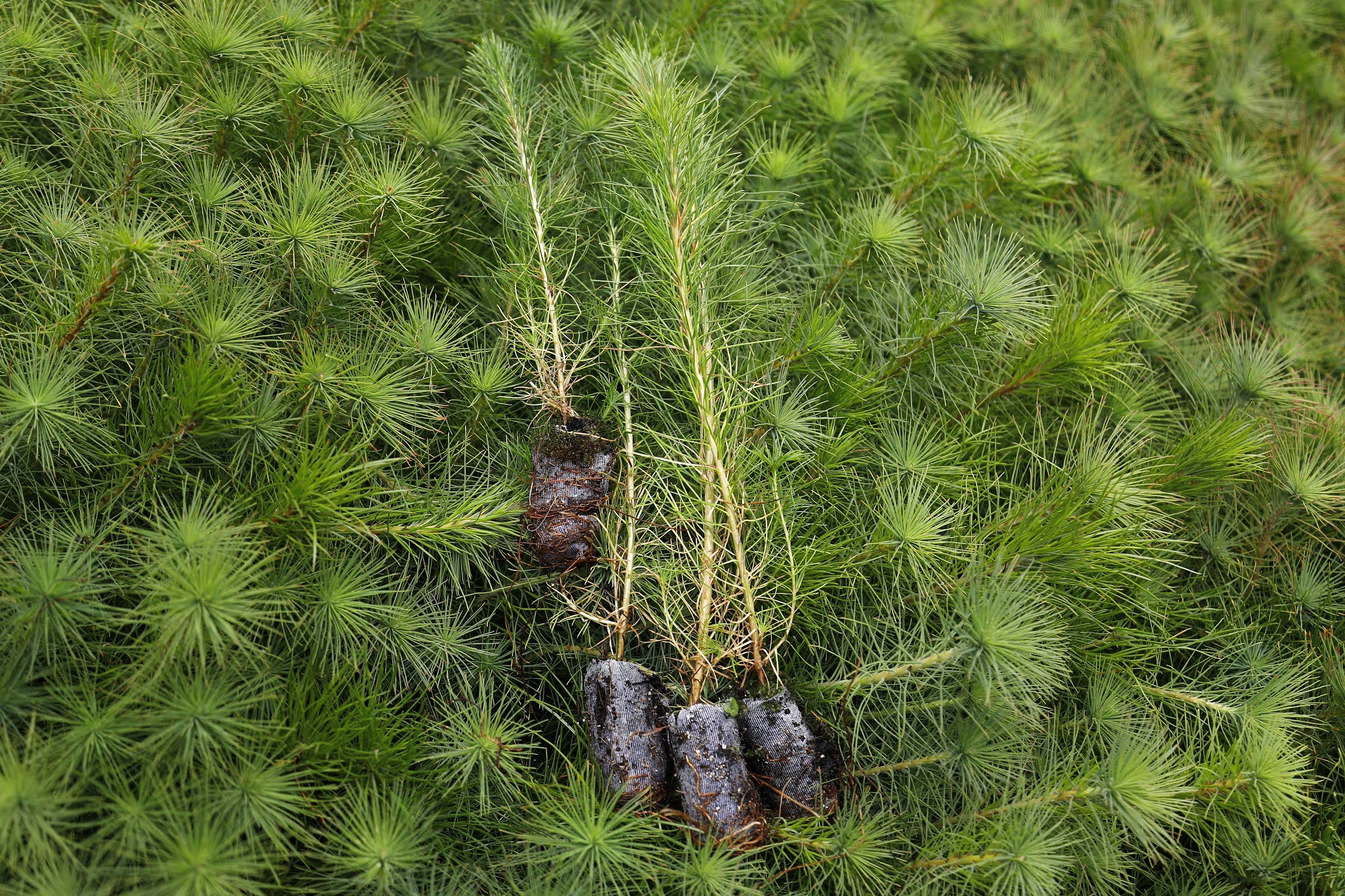
Now you know a lot about one of our favorite tree species.  We'll leave you with this photo of some of the thousands of eastern white pine seedlings that we planted in 2019!  They're a very important part of our species mix when we're building our community forests and creating forest reserves for carbon capture.  You can learn more by going to our website and looking at our progress report page.


Thanks for reading!

- Jonathan Clark
www.replant-environmental.ca


Replant.ca Environmental is a Canadian company that plants trees for carbon capture and builds community forests.  We also plant trees in national, provincial, and municipal public parks to mitigate damage from wildfires, storms, insects, and forest diseases.  We operate thanks to numerous small contributions from the general public, in addition to larger project sponsorships from businesses and corporations around the world.  If you'd like to learn how to show your support, visit our donations page.  Even if you aren't able to make a contribution, we very much appreciate when people are able to share our posts or our website link on social media, to help spread the word about the work that we're doing!

Teachers are welcome to use content from this post for their classes.  If you know a teacher who might like to use this information, please share it with them!  The more that people learn about trees, the better our world will be.

To learn more about the various species that we plant, visit the conifers page or the deciduous (hardwoods) page on our website.  Thanks so much for your interest!

Incidentally, our organization is often seeking additional land for our carbon capture projects.  Please visit this link if you might know of a recently-harvested property that we could rebuild into a permanent legacy forest.