Showing posts with label change. Show all posts

Sunday, February 19, 2023

Tree Planting Project at the Hardy Veritree Carbon Plantation (2022)

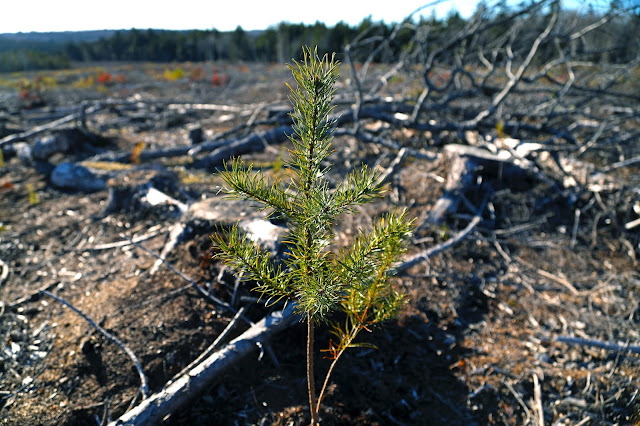
Here's a post to share some info about another carbon sequestration project that we completed on behalf of one of our Sponsor Partners.  The tree planting work on this site in southeastern New Brunswick was done in the Fall of 2022.  The work was done at a large site just west of Hardy, which is on Route 16.  The planting on this site was entirely sponsored by Veritree.


This site was harvested relatively recently, by a third party, and our goal was to rebuild a new forest there.  The site is large, and this might be a great site for a public park in the future.  Here's a link showing the approximate location of this project:


Note that this site is NOT the same Timber River Demonstration Forest site that we have already been managing for approximately fifteen years, although it's very close to that site.  The GPS coordinates at the south end of this year's site are:  46.071211, -64.042194


The primary purpose of this project was to support climate stability through carbon sequestration.  As a side benefit, this site will support biodiversity and wildlife habitat.

In total, the planting team added 208,225 coniferous seedlings on this site (which covers 252.1 acres, with seven distinct open areas).  The site also shows significant evidence of natural regeneration of white birch, red maple, yellow birch, and other hardwoods and soft deciduous.  Diverse forests are healthy forests.

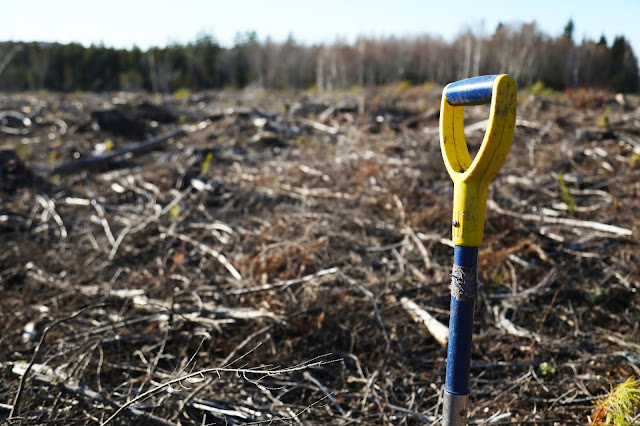
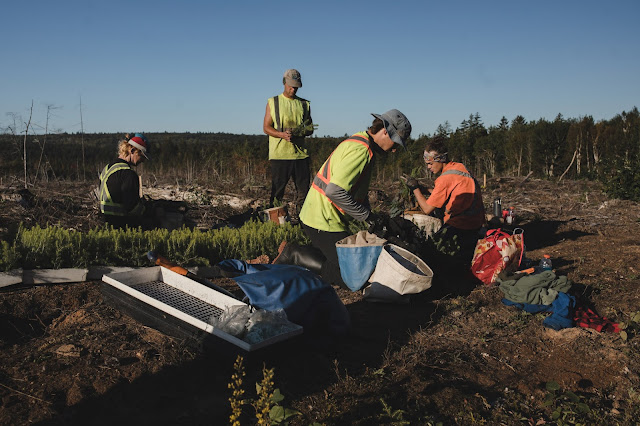
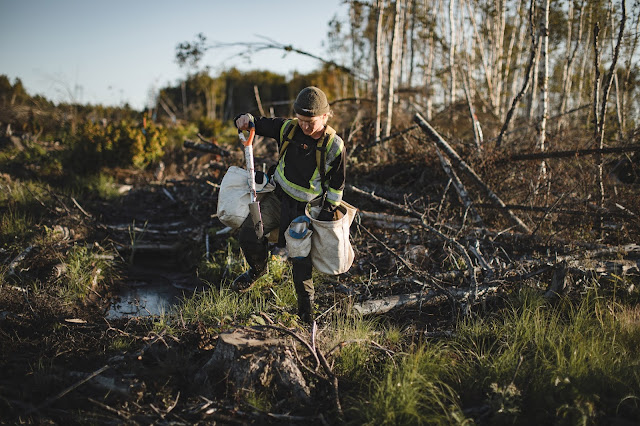
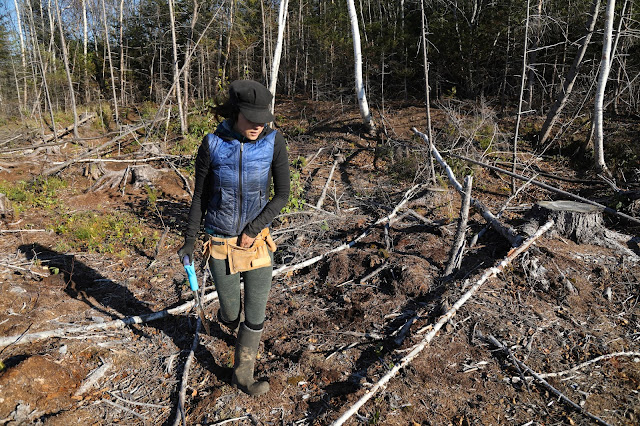
Here are a few more photos taken during the planting of this project, which took place in September and October of 2022:


We look forward to studying this site in the coming years.  We will be doing periodic surveys to assess the carbon capture progress of the new forest.

Again, a huge thanks to Veritree, the sponsors and lead on this major project.

You can see several dozen additional photos of the work on this planting site by visiting our public 2022 Planting Photos folder on Dropbox (go into the "Hardy Veritree Carbon Plantation" sub-folder).


Thanks for reading!

- Jonathan Clark


Replant.ca Environmental is a Canadian company that plants trees for carbon capture and builds community forests.  We also plant trees in national, provincial, and municipal public parks to mitigate damage from wildfires, storms, insects, and forest diseases.  We operate thanks to numerous small contributions from the general public, in addition to larger project sponsorships from businesses and corporations around the world.  If you'd like to learn how to show your support, visit our donations page.  Even if you aren't able to make a contribution, we very much appreciate when people are able to share our posts or our website link on social media, to help spread the word about the work that we're doing!

To learn more about the various species that we plant, visit the conifers page or the deciduous (hardwoods) page on our website.  Thanks so much for your interest!

Incidentally, our organization is often seeking additional land for our carbon capture projects.  Please visit this link if you might know of a recently-harvested property that we could rebuild into a permanent legacy forest.


Saturday, February 18, 2023

Tree Planting Project at the Cormier Road Carbon Plantation (2022)

Here's a post to share some info about another carbon sequestration project.  The tree planting work on this site in southeastern New Brunswick was done in the fall of 2022.  The work was done at a site in Botsford Portage, to the east of Cormier Village.  This site is also very close to Route 15.  This project was designed and implemented under the direction of the Sustainable Resource Corporation.


This site was formerly owned privately by a third party, and that landowner harvested the wood a few years ago.  We were able to acquire the property after it was harvested, on behalf of our Client (SRC), then we designed a plan to turn it into a carbon capture plantation to help mitigate climate change.  SRC will never allow it to be harvested again.  Here's a map showing where the property is located, adjacent to Chemin Cormier (Cormier Road):


The GPS coordinates at the entrance to this site are:  46.18821, -64.25338


The primary purpose of this project was to support climate stability through carbon sequestration.  As a side benefit, this site will support biodiversity and wildlife habitat.

In total, the planting team added 32,086 coniferous seedlings on this site (three species).  In addition to our planted trees, this site already shows evidence of some natural regeneration of white birch, red maple, yellow birch, sugar maple, and balsam fir.  Diverse forests are healthy forests.

Here are a few more photos taken during the planting of this project, which took place in September and October of 2022.  As the site had been harvested almost three years ago, quite a lot of low-value brush was present, so this was a particularly challenging site for the planting team:


We look forward to studying this site in the coming years.  We will be doing periodic surveys to assess the carbon capture progress of the new forest.

We were very pleased to act as a supply partner to SRC on this project, doing the boots-on-the-ground tree planting work while they approved the project design and provided the financial support.

You can see several dozen additional photos of the work on this planting site by visiting our public 2022 Planting Photos folder on Dropbox (go into the "Cormier Road Carbon Plantation" sub-folder).


Thanks for reading!

- Jonathan Clark


Replant.ca Environmental is a Canadian company that plants trees for carbon capture and builds community forests.  We also plant trees in national, provincial, and municipal public parks to mitigate damage from wildfires, storms, insects, and forest diseases.  We operate thanks to numerous small contributions from the general public, in addition to larger project sponsorships from businesses and corporations around the world.  If you'd like to learn how to show your support, visit our donations page.  Even if you aren't able to make a contribution, we very much appreciate when people are able to share our posts or our website link on social media, to help spread the word about the work that we're doing!

To learn more about the various species that we plant, visit the conifers page or the deciduous (hardwoods) page on our website.  Thanks so much for your interest!

Incidentally, our organization is often seeking additional land for our carbon capture projects.  Please visit this link if you might know of a recently-harvested property that we could rebuild into a permanent legacy forest.


Tree Planting Project at the Shemogue Carbon Plantation (2022)

Here's a post to share some info about another of our carbon sequestration projects.  The tree planting work on this site in southeastern New Brunswick was done in the spring of 2022.  The work was done at a site slightly to the south of Route 15, a few kilometers from the village of Shemogue.  From this site, the Shemogue wind turbine is quite visible just to the northwest.


This site was formerly owned privately by a third party, and that landowner harvested the wood recently.  We were able to acquire the property after it was harvested, then designed a plan to turn it into an environmental project to help mitigate climate change (we will never allow it to be harvested again).  Based on the site characteristics, we decided that this particular property should be part of our group of carbon capture plantations.


The GPS coordinates at the center of this site are:  46.16685, -64.22996


The primary purpose of this project was to support climate stability through carbon sequestration.  As a side benefit, this site will support biodiversity and wildlife habitat.

In total, the planting team added 74,800 coniferous seedlings on this site.  Although the site already shows some evidence of natural regeneration of white birch, red maple, yellow birch, and other hardwoods, we plan to enhance the mix of deciduous species on this site in the near future, as availability permits.  Diverse forests are healthy forests.

Here are a few more photos taken during the planting of this project, which took place in April and May 2022:


We look forward to studying this site in the coming years.  We will be doing periodic surveys to assess the carbon capture progress of the new forest.

You can see several dozen additional photos of the work on this planting site by visiting our public 2022 Planting Photos folder on Dropbox (go into the "Shemogue Carbon Plantation" sub-folder).


Thanks for reading!

- Jonathan Clark


Replant.ca Environmental is a Canadian company that plants trees for carbon capture and builds community forests.  We also plant trees in national, provincial, and municipal public parks to mitigate damage from wildfires, storms, insects, and forest diseases.  We operate thanks to numerous small contributions from the general public, in addition to larger project sponsorships from businesses and corporations around the world.  If you'd like to learn how to show your support, visit our donations page.  Even if you aren't able to make a contribution, we very much appreciate when people are able to share our posts or our website link on social media, to help spread the word about the work that we're doing!

To learn more about the various species that we plant, visit the conifers page or the deciduous (hardwoods) page on our website.  Thanks so much for your interest!

Incidentally, our organization is often seeking additional land for our carbon capture projects.  Please visit this link if you might know of a recently-harvested property that we could rebuild into a permanent legacy forest.


Monday, November 15, 2021

Carbon Capture Project for Tentree, 2021

Our organization did some tree planting work in southeastern New Brunswick this past September (2021).  This was one of the carbon capture plantation projects that we designed for Tentree International.


You've probably heard of Tentree Clothing.  If not, here's a link to their story:

www.businessinsider.com/tentree-sustainable-clothing-review


This particular site was a mid-sized project, where we planted slightly over 60,000 trees.  On this particular site, we planted sixteen distinct species.  That mix included conifers, oaks, birches, sugar maples, butter nut, and more.

One nice characteristic about this site is that it's really easy to find, if you'd like to explore one of Tentree's projects.  Tens of thousands of people drive within a hundred feet of this site every day, as they travel on the TransCanada highway through southeastern New Brunswick.  If you're on the TCH travelling from Moncton to Nova Scotia, you'll see this site on the right/south side of the highway, approximately four kilometers before the exit onto Walker Road (exit 500) close to Sackville.  The border between New Brunswick and Nova Scotia is just a ten minute drive down the highway.  Here's a more detailed map, courtesy of Google Earth:


The work that Tentree has been doing has been exhaustive.  To date, they've helped to fund the planting of more than sixty-six million trees in a number of countries around the world.  And they have a very inspiring goal ... to plant ONE BILLION trees by 2030.  That will be an tremendous achievement.  Replant.ca Environmental is incredibly excited to be a small part of that massive plan.

Tentree is very scientific about their approach to all of this planting.  They're diligent about ensuring that the planting projects are audited and verifiable.  Some of their technology is cutting edge, such as drone mapping software that provides photographic documentation of the sites.  They work with a block-chain based project called Veritree, which was designed to verify the legitimacy of global reforestation projects.  Anyone who is interested in blockchain or auditing or GIS work should check out the Veritree website:

www.veritree.com


Here are a few photos of our crew at work on this site in September.  Special thanks to Kalen Emsley and Tom Miller from Tentree for coming to visit this site to map out and verify the planting, and for doing the photography work that they shared with us.


As a side note, we returned to this site six weeks after this project was finished so we couldo plant a large number of acorns and chestnuts.  Seeds/nuts are not trees, and these were not counted in the tree totals!  This was just an experiment to see if we could have an additional impact upon a portion of the site by doing some late fall planting of some nuts that we had gathered, since we've been experimenting for the past couple years with growing various hardwood seedlings of our own.  Here's a photo of Dee, planting some of the acorns and chestnuts:


Our goal for this exercise was academic.  We do not want to stop planting young trees in the future.  Rather, we're interested in learning more about germination rates for these species in various types of soils in real-world conditions.

The impact that Tentree is having on our global community is profound.  We're very proud to be one of their many global reforestation partners.


You can see more photos of our 2021 tree planting work in our public 2021 Planting Photos folder on Dropbox.


Thanks for reading!

- Jonathan Clark


Replant.ca Environmental is a Canadian company that plants trees for carbon capture and builds community forests.  We also plant trees in national, provincial, and municipal public parks to mitigate damage from wildfires, storms, insects, and forest diseases.  We operate thanks to numerous small contributions from the general public, in addition to larger project sponsorships from businesses and corporations around the world.  If you'd like to learn how to show your support, visit our donations page.  Even if you aren't able to make a contribution, we very much appreciate when people are able to share our posts or our website link on social media, to help spread the word about the work that we're doing!

To learn more about the various species that we plant, visit the conifers page or the deciduous (hardwoods) page on our website.  Thanks so much for your interest!

Incidentally, our organization is often seeking additional land for our carbon capture projects.  Please visit this link if you might know of a recently-harvested property that we could rebuild into a permanent legacy forest.


Friday, February 28, 2020

The Norway Spruce tree (Picea abies)

The Norway spruce is also known as the European spruce.  The Latin name for this tree is Picea abies.  You may wonder why I'm talking about this species despite the fact that it is not originally native to North America.  I'll explain that shortly.

First, let's cover a few basics.  Norway spruce is typically native to northern, central, and eastern Europe.  It doesn't like warm temperatures, so it's not common in southern Europe (although pockets do exist).  It is very closely related to the Siberian spruce, which is found commonly east of the Urals.

Norway spruce has become a relatively common tree in North America, despite not being a native species.  Globally, this species is one of the most widely planted of all trees, both inside and outside its native range.  Norway spruce is planted frequently within the cooler northern parts of the United States, and through eastern Canada.  It is so prevalent that there are now naturalized populations from the Great Lakes to parts of the northeastern seaboard.  It fits quite well into parts of Canada's temperate forest, and even grows well in parts of the southeastern boreal forest (at least where the climate is suitable).

Norway spruce is a very large conifer, often growing to heights of more than 40 meters, and diameters of more than a meter.  More importantly, it is very fast-growing compared to most other spruce species, especially for the first twenty-five years.  Typically, when you see mixed species plantations, you'll notice that pine trees grow very quickly (because they love sunlight) and spruce trees lag behind quite significantly, but the spruce trees slowly start to catch up after a few decades.  Norway spruce narrows that gap significantly.  Here's a photo of a semi-mature tree:


You'll notice that this particular urban tree looks quite symmetrical and full.  It has a nice shape to it.  Norway spruce has high commercial value, and not just for pulp and lumber.  It's also a very popular tree for the cultivation of Christmas trees, and used for this purpose all over the world.  Oslo (the capital of Norway) donates a large Norway spruce Christmas tree to the cities of London, Edinborough, and Washington DC each year, as thanks for the aid that the US and UK gave to Norway during World War II.  Norway spruce are also commonly used as ornamental trees in parks and gardens in many parts of the world (as long as the climate is suitable).

The needles of the Norway spruce are four-sided (quadrangular).  This means that if you take a needle and try to "roll" it between your thumb and finger, it rolls quite easily.  In contract, the needles for some species don't do this.  Balsam fir, as an example, is a three-sided needle but it's a very shallow profile (almost two-sided), so balsam fir needles won't roll easily between your fingers.  The needles of the Norway spruce have quite blunt tips.  Here's a photo of some lush foilage.


The seed cones of the Norway spruce are record-setting among the various spruce species for having the longest length.  Some full-sized cones can be almost twenty centimeters (eight inches) long.  These cones start out being either reddish or greenish in colour, but about half a year after they are pollinated, they mature to a rich brown colour.


Here are a few fun facts about the Norway spruce:

1.  This species is so fast-growing that in some areas, it grows to reach the appropriate size for Christmas trees in as little as four years.

2.  This is another species which is especially suitable for making beer (the brew is made from young branches with the richest needles).

3.  There is a Norway spruce tree in Sweden which has been nicknamed Old Tjikko.  This tree, which grew as a clone from a root system, has been dated as being 9,550 years old.  It is the oldest known individual living tree of any species (some trembling aspen clusters are much older).


Thanks for reading ...

- Jonathan Clark
www.replant-environmental.ca


Replant.ca Environmental is a Canadian company that plants trees for carbon capture and builds community forests.  We also plant trees in national, provincial, and municipal public parks to mitigate damage from wildfires, storms, insects, and forest diseases.  We operate thanks to numerous small contributions from the general public, in addition to larger project sponsorships from businesses and corporations around the world.  If you'd like to learn how to show your support, visit our donations page.  Even if you aren't able to make a contribution, we very much appreciate when people are able to share our posts or our website link on social media, to help spread the word about the work that we're doing!

Teachers are welcome to use content from this post for their classes.  If you know a teacher who might like to use this information, please share it with them!  The more that people learn about trees, the better our world will be.

To learn more about the various species that we plant, visit the conifers page or the deciduous (hardwoods) page on our website.  Thanks so much for your interest!


Incidentally, our organization is often seeking additional land for our carbon capture projects.  Please visit this link if you might know of a recently-harvested property that we could rebuild into a permanent legacy forest.

Monday, February 24, 2020

The Black Spruce tree (Picea mariana)

Today's post is about a species which rarely gets any love.  It's the swamp-loving black spruce (Latin name Picea mariana).  Here's a typical photo, which I took from a helicopter in northern Alberta (the majority of these trees are black spruce):


Oddly enough, the black spruce doesn't have any other common names (except in French), regardless of where you find it across Canada.  And you WILL find black spruce all across Canada.  Its geographic range is much more diverse than even the Jack pine.  Black spruce can be found in all ten provinces and all three Arctic territories.  Here's a range map, courtesy of Wikipedia:


It's quite easy to find specimens of black spruce.  Just look for a swamp.  Black spruce thrives in wet areas, even when the water is quite stagnant.  Remember that all spruce trees love water, but most varieties prefer flowing, oxygenated water.

Black spruce has roots that are especially shallow and wide-spreading.  This allows it to thrive in areas which are too wet for competing species.  Trees, like many other creatures, can drown.  Shallow roots help ensure that the black spruce does well in swamps.  Trees need water, but they also need oxygen.  Flood their root systems, and they will eventually die.  Some trees can only tolerate root submersion for as little a week or so before they start to die.  The black spruce can survive for more than a month.  Regardless, their shallow roots make it less likely that they won't have any access to oxygen for extended periods.  Unfortunately, it also makes this species susceptible to blowdown in windstorms.

If you take a close look at black spruce trees near bogs and swamps, you'll see that the closer you get to water, the less vigorous the growth.


Spruce trees rarely grow to be large trees.  It is quite common for mature black spruce trees to be no more than 15m in height, although they can occasionally grow to 25m in really good conditions.  However, you're more likely to see them in the 10m to 15m range.  The trunk rarely grows to more than 50cm in diameter (a foot and a half) for a large tree.  On a positive note, black spruce usually have very straight trunks, without a significant taper until the very top of the tree.

The top of the black spruce is interesting.  The crown is narrow and pointed, and the small branches all droop, yet the tips are turned upward.  Unlike the tips, the cones hang downward.  Here's an excellent photo from Wikimedia Commons:


One of the more interesting things that many people learn about the black spruce is their long-term fire ecology behaviour.  Black spruce trees often live in peat bogs, as well as swamps.  Despite the moist ground, black spruce stands are especially susceptible to wildfires.  If you're puzzled about this, it's important to know that monocultures (especially conifers) are often especially susceptible to wildfires, while mixed-wood forests with lots of species such as aspen will be less susceptible.  Since black spruce is so much more tolerant of swampy/boggy conditions than most other trees (except for larch/tamarack), it tends to grow frequently in pure stands.  These pure stands are susceptible to fire, despite the wet ground.

Black spruce stands tend to burn frequently, but they also regenerate quickly immediately after a fire (just like lodgepole pine).  Therefore, a lot of black spruce stands tend to be very even-aged.  Over time (centuries), swampy areas with black spruce will often slowly become filled in by organics, and the surface of the ground will become elevated and drier.  As this happens, there will be ingress from moderately moisture-tolerant species such as tamarack, white cedar, white spruce, balsam fir, and eventually balsam poplar and trembling aspen.  Don't judge black spruce as an ugly swamp tree with no significant value.  In the long term, it's an important precursor to more diverse mature mixed-wood forests.


I'll leave you with three random facts about the black spruce:
- This is the provincial tree of Newfoundland and Labrador.
- Like red spruce, it is good for making spruce beer.
- Disposable chopsticks are often made of black spruce (or trembling aspen).

That's all for now.  I hope you enjoyed reading this, and it made you appreciate this species a bit more.  We don't plant very much black spruce at Replant.ca Environmental, simply because it's not great for long-term carbon capture, but it does occupy a small percentage of our annual seedling mixes due to its suitability (along with cedar and tamarack) in swampy ground.  Here's a photo of some of our black spruce seedlings:


Thanks for reading ...

- Jonathan Clark
www.replant-environmental.ca


Replant.ca Environmental is a Canadian company that plants trees for carbon capture and builds community forests.  We also plant trees in national, provincial, and municipal public parks to mitigate damage from wildfires, storms, insects, and forest diseases.  We operate thanks to numerous small contributions from the general public, in addition to larger project sponsorships from businesses and corporations around the world.  If you'd like to learn how to show your support, visit our donations page.  Even if you aren't able to make a contribution, we very much appreciate when people are able to share our posts or our website link on social media, to help spread the word about the work that we're doing!

Teachers are welcome to use content from this post for their classes.  If you know a teacher who might like to use this information, please share it with them!  The more that people learn about trees, the better our world will be.

To learn more about the various species that we plant, visit the conifers page or the deciduous (hardwoods) page on our website.  Thanks so much for your interest!


Incidentally, our organization is often seeking additional land for our carbon capture projects.  Please visit this link if you might know of a recently-harvested property that we could rebuild into a permanent legacy forest.


Saturday, October 12, 2019

The Beginnings of Replant.ca Environmental

(Updated in 2023)

My name is Jonathan Clark.

In late 2018, I "started" a new company.  The goal was to plant trees to help fight against climate change.  I had already been planting a small number of volunteer trees each year for the past several years, but I wanted to be able to increase my impact.  I also believed that I could plant trees for environmental reasons on a much larger scale if I formalized the organization.  After all, I had been receiving dozens of inquiries about this type of work every year.  I've been working as a professional tree planter for a couple decades, so I figured that my extensive field experience would be invaluable in building out a large planting organization.

I decided to call the company Replant.ca Environmental.


I knew that using this name had the potential to be slightly confusing.  The original Replant.ca website (which focuses on education for commercial reforestation) has been the most well-known tree planting site in Canada since I first put it online in 1998.  It hosts thousands of photos, music, videos, training materials, a message board, and much more.  During its tenure, the website has been visited a few million times, and it has been the reason, directly or indirectly, that tens of thousands of university/college students have found summer jobs as tree planters across the country.  The name has incredibly strong brand recognition, which I felt could be helpful in establishing a new company.

As Replant.ca grew, I kept planting trees.  Throughout my career, I gained a very wide diversity of experience.  I've been a camp supervisor at three companies, a foreman at six companies, and I've planted for more than fifteen companies.  I've planted well over a million trees, although to be honest, that's not really an impressive number for anyone who has worked in the commercial industry for several years.  However, more importantly, I've directly overseen the planting of well over a hundred million trees during my tenure as a camp supervisor (that was up to 2018, but the number is still increasing).  I estimate that approximately two thousand tree planters have worked for me in my camps so far.  I've also been involved in lots of related jobs, including forest nursery work, lifting seedlings, brushing, spacing, girdling, and many varieties of reclamation and environmental restoration work.

The only major drawback to my previous work experience is that my regular job as a professional planter has been an industry job, much like farming.  The tree planting that I normally perform is intended to fill empty cut-blocks after logging companies cut down part of a forest.  To be clear, I don't work for the logging companies directly.  I work (on a seasonal basis) for a few different companies that specialize in tree planting.  These planting companies are hired on a contractual basis by the logging companies or by the government.  I refer to this work as commercial or industrial "post-harvest" reforestation, because we rebuild forests after commercial harvesting.  This is the kind of work that is done seasonally by tens of thousands of Canadians, and this is what the traditional Replant.ca website focuses upon.

It's easy for professional tree planters to be cynical and complain about our work.  We protest that we're just perpetuating the entire cycle of logging, and to some extent, that's true.  In many cases, we're planting trees so that future loggers can harvest them and turn them into toilet paper for our grandchildren.  But there's more to it than that!  Think about the alternatives.  Wood IS a renewable resource, so if we're assisting the logging industry, at least it's better than working in an industry that consumes non-renewables.  If we harvest trees in a sustainable manner, that's some consolation.  And things could be much worse.  Historically I've usually worked in British Columbia and Alberta, where the law says that any harvested areas have to be turned back into forests.  I take solace in the fact that the logging companies that hire me don't just mow down the forests and walk away without replanting the land.

Even though I had tried in the past to be optimistic, and think positively about the sustainable approach that Canada's (west coast) logging industry was usually trying to take, I had always wanted to do more.  I always wanted to plant trees that would be protected from future logging.  I wanted to build forests that would be permanent, where people could walk underneath trees that had been living for hundreds of years.

For years, I didn't act upon those goals.  But in 2018, I knew that I could make a positive change, and that it was time to act.  I had planted a number of small volunteer projects over the past two decades.  However, awareness of the value of reforestation was growing in the cultural zeitgeist.  I'd been contacted many times by people who asked if I could plant large numbers of trees that they would sponsor, so I finally decided in 2018 that it was time to start accepting those requests more frequently.  I knew that I had the background and knowledge to be able to successfully plant environmentally-based trees on a larger scale, and after a few months of research and deciding upon a sustainable business model, I started to accept sponsorships.

In 2019, quite a few individuals and organizations pledged sponsorships for trees.  I brought in extra help.  In the summer of 2019, not only did we plant tens of thousands of sponsored trees, but we also built a proper website, and started spreading the story about our organization and goals through word-of-mouth.  We wanted to be able to capitalize on the very well-known brand name of Replant.ca, but we also wanted to distinguish the new company from the industrial/commercial reputation of the original website.  We decided that Replant.ca Environmental satisfied both needs.

Over the next couple of years, we quickly grew the organization to planting well over half a million trees per year.  Some of these have been our own self-led projects supported by public funders.  On other projects, we've worked as a supply partner to provide the boots-on-the-ground expertise to plant seedlings for other well-respected organizations such as One Tree Planted, Veritree, and Trees For Life.

Replant.ca Environmental plants trees that will not be cut down in the future by logging companies.  Our long-term plan is to acquire land, plant trees, and build community forests that the public is allowed to visit and enjoy!

Thankfully, we've had some help from several of our professional tree planting friends.  They also work for part of each year in traditional post-harvest reforestation, they share the same goal of building some permanent forests that won't be cut down in the future.

Replant.ca Environmental is based in Central Nova (I'm a born & raised Nova Scotian), and we also have an office in southeastern New Brunswick.

You can visit our new website to learn more about our company.  Here's the link:


Here are three things that you may find interesting:

1.  The Replant.ca Environmental organization is not involved with commercial post-harvest work for logging companies.

2.  We do not plant monocultures, and we aim for biodiversity.  We aim to maximize the number of species on each project site, whenever possible.  There are many good reasons to do this.  Carbon capture is maximized when there is a diversity of species.  If a particular species is attacked in the future by some sort of pest or disease, having many other species in the forest is a good form of insurance to make sure the forest survives as a whole.  A diverse forest is also more interesting to walk through, and is much more robust in ecological and biological terms.

3.  We want to make sure that our projects are transparent.  Some of the organizations that do charitable planting don't identify exactly where they do their work.  We want the public and our supporters to know exactly where we've been planting.  You can learn about many of the sites that we've worked on by visiting our projects page.


If you want to help us out, share this post!  Thanks for reading...
 - Jonathan Clark


A group photo showing part of our 2022 Planting Team.