Friday, February 28, 2020

The Norway Spruce tree (Picea abies)

The Norway spruce is also known as the European spruce.  The Latin name for this tree is Picea abies.  You may wonder why I'm talking about this species despite the fact that it is not originally native to North America.  I'll explain that shortly.

First, let's cover a few basics.  Norway spruce is typically native to northern, central, and eastern Europe.  It doesn't like warm temperatures, so it's not common in southern Europe (although pockets do exist).  It is very closely related to the Siberian spruce, which is found commonly east of the Urals.

Norway spruce has become a relatively common tree in North America, despite not being a native species.  Globally, this species is one of the most widely planted of all trees, both inside and outside its native range.  Norway spruce is planted frequently within the cooler northern parts of the United States, and through eastern Canada.  It is so prevalent that there are now naturalized populations from the Great Lakes to parts of the northeastern seaboard.  It fits quite well into parts of Canada's temperate forest, and even grows well in parts of the southeastern boreal forest (at least where the climate is suitable).

Norway spruce is a very large conifer, often growing to heights of more than 40 meters, and diameters of more than a meter.  More importantly, it is very fast-growing compared to most other spruce species, especially for the first twenty-five years.  Typically, when you see mixed species plantations, you'll notice that pine trees grow very quickly (because they love sunlight) and spruce trees lag behind quite significantly, but the spruce trees slowly start to catch up after a few decades.  Norway spruce narrows that gap significantly.  Here's a photo of a semi-mature tree:


You'll notice that this particular urban tree looks quite symmetrical and full.  It has a nice shape to it.  Norway spruce has high commercial value, and not just for pulp and lumber.  It's also a very popular tree for the cultivation of Christmas trees, and used for this purpose all over the world.  Oslo (the capital of Norway) donates a large Norway spruce Christmas tree to the cities of London, Edinborough, and Washington DC each year, as thanks for the aid that the US and UK gave to Norway during World War II.  Norway spruce are also commonly used as ornamental trees in parks and gardens in many parts of the world (as long as the climate is suitable).

The needles of the Norway spruce are four-sided (quadrangular).  This means that if you take a needle and try to "roll" it between your thumb and finger, it rolls quite easily.  In contract, the needles for some species don't do this.  Balsam fir, as an example, is a three-sided needle but it's a very shallow profile (almost two-sided), so balsam fir needles won't roll easily between your fingers.  The needles of the Norway spruce have quite blunt tips.  Here's a photo of some lush foilage.


The seed cones of the Norway spruce are record-setting among the various spruce species for having the longest length.  Some full-sized cones can be almost twenty centimeters (eight inches) long.  These cones start out being either reddish or greenish in colour, but about half a year after they are pollinated, they mature to a rich brown colour.


Here are a few fun facts about the Norway spruce:

1.  This species is so fast-growing that in some areas, it grows to reach the appropriate size for Christmas trees in as little as four years.

2.  This is another species which is especially suitable for making beer (the brew is made from young branches with the richest needles).

3.  There is a Norway spruce tree in Sweden which has been nicknamed Old Tjikko.  This tree, which grew as a clone from a root system, has been dated as being 9,550 years old.  It is the oldest known individual living tree of any species (some trembling aspen clusters are much older).


Thanks for reading ...

- Jonathan Clark
www.replant-environmental.ca


Replant.ca Environmental is a Canadian company that plants trees for carbon capture and builds community forests.  We also plant trees in national, provincial, and municipal public parks to mitigate damage from wildfires, storms, insects, and forest diseases.  We operate thanks to numerous small contributions from the general public, in addition to larger project sponsorships from businesses and corporations around the world.  If you'd like to learn how to show your support, visit our donations page.  Even if you aren't able to make a contribution, we very much appreciate when people are able to share our posts or our website link on social media, to help spread the word about the work that we're doing!

Teachers are welcome to use content from this post for their classes.  If you know a teacher who might like to use this information, please share it with them!  The more that people learn about trees, the better our world will be.

To learn more about the various species that we plant, visit the conifers page or the deciduous (hardwoods) page on our website.  Thanks so much for your interest!


Incidentally, our organization is often seeking additional land for our carbon capture projects.  Please visit this link if you might know of a recently-harvested property that we could rebuild into a permanent legacy forest.

Wednesday, February 26, 2020

The Tamarack tree (Larix laricina)

In this post, I'm going to take a close look at a tree with many names, but which most Canadians refer to as the Tamarack.  The Latin name for this species is Larix laricina, but in addition to being called the tamarack in common usage, it's also referred to as eastern larch, black larch, red larch, hackmatack, or American larch.  In this case, "American" is a reference to North American, not to the United States.  In the northern dialect of the Eastern James Bay Cree, it is called the waachinaakin.

Here's a photo of a young tamarack tree:


The tamarack is a fairly unique tree among the conifers.  I'm excited to explain that in a minute, but first we should quickly look at the range.  If you look at our recent post about black spruce trees, you'll see that the range maps of these two species overlap almost perfectly.  The black spruce has a slightly larger range, but they are very similar overall.  And that means that it's pretty easy to find tamarack through most parts of Canada.  Here's a range map, courtesy of Wikipedia:


I already referred to the tamarack as being fairly unique among conifers.  To explain why, I have to review some definitions.  A conifer is a tree that is cone-bearing.  Most people equate conifers with evergreens.  Evergreen is a slang term for a tree that stays green throughout the entire year.  Most conifers do retain their leaves (needles) through the winter, so yes, most conifers are also evergreens.

Do you know what a deciduous tree is?  Most people assume that any broad-leaf tree is a deciduous tree.  However, that's not quite correct.  Broad-leaf is a slang term for any type of leaf that is broad.  No surprises there.  Most people say that all trees have either [broad] leaves or needles.  Is there any advantage for a tree in having needles?  Well, needles are more waterproof and more wind-proof than broad leaves.

Anyway, let's get back to the point.  The true definition of a deciduous tree is one that sheds its needles annually.  In cold regions such as Canada, most broad-leafed trees shed their needles every year, so the terms are somewhat synonymous.  But here's where the tamarack bends the rules.  The tamarack is a needle-bearing tree, but it drops its needles every year, then grows a new set in the spring.  Therefore, the tamarack is both coniferous (cone-bearing) and deciduous (shedding leaves annually).  It is therefore known as a deciduous conifer.  The tamarack and the western larch are the only two common deciduous conifers found in Canada.

When the tamarack is about to lose its needles in the fall, they turn a beautiful golden-yellow colour, making these trees very easy to spot in some areas.  Here's are two photos that I took in October, where you can very easily identify the brightly coloured tamarack:


If you'd like to learn more about deciduous conifers, check out this article:
https://www.thespruce.com/what-are-deciduous-conifers-3269799

Now that we've covered the most exciting thing about the tamarack, let's get back to basics with a list of common characteristics:
- Extremely tolerant of cold.  Temperatures of -70oC don't bother this species.
- Maximum height usually not much more than 15 meters (50 feet).
- Maximum diameter usually not much more than half a meter (a foot and a half).
- The average lifespan of a mature tree is around 150 years.
- Needles occur in large groups of up to 20 needles per cluster.
- Often found in wet swampy or boggy conditions, growing alongside black spruce.
- Strangely enough, tamarack is also a good pioneer species in fresh burns, at least until it gets overtaken by other species.

Here's a close-up of the needles and cones:

Even when green, tamarack has a very sparse look to it.  It provides very little shade compared to most trees, which allows a thick undergrowth of mosses and shrubs to thrive underneath the tree.  Speaking of shade, tamarack itself is a very shade intolerant tree.  If you plant it underneath other trees, or even under competing shrubs or vegetation, the mortality rate is quite high.  This is a pioneer species, and in the long term, is usually succeeded first by black spruce, and then by other species.

Tamarack wood is quite flexible.  Native Americans often used this species for making snowshoes.  It isn't a major commercial species, although it's very resistant to rot from moisture (just like cedar), so it is a good option for fence poles and similar applications.  My dad was a land surveyor, and he mentioned that tamarack is a good choice if you need to leave a pole in the ground for some time.


Fun facts:

1.  This is quite unrelated to the tamarack, but you'll notice that I've been throwing around the words "swamp" and "bog" fairly interchangeably.  Actually, there is a difference.  There are four distinct types of wetlands:  swamps, marshes, bogs, and fens.  But I'll save that for another blog post.  I only bring that up because tamaracks thrive near or even in various types of wetlands.

2.  The tamarack is Canada's most northerly tree, found as far north as the 72nd degree of latitude.  That's quite far north of the Arctic Circle (which is at approximately 66.5 degrees north latitude).  Therefore, tamarack trees can grow in the land of White Nights.

 3.  The Ojibwa used tamarack roots as a "thread" to sew together pieces of birch bark when making canoes, due to rot resistance and flexibility.


Here's a photo of a tamarack with its needles dropped during the winter.  Despite appearances, this is a healthy tree!  It's not a great photo, with the grey sky in the background, but if we get a day with deep blue sky I'll try to upgrade the photo:


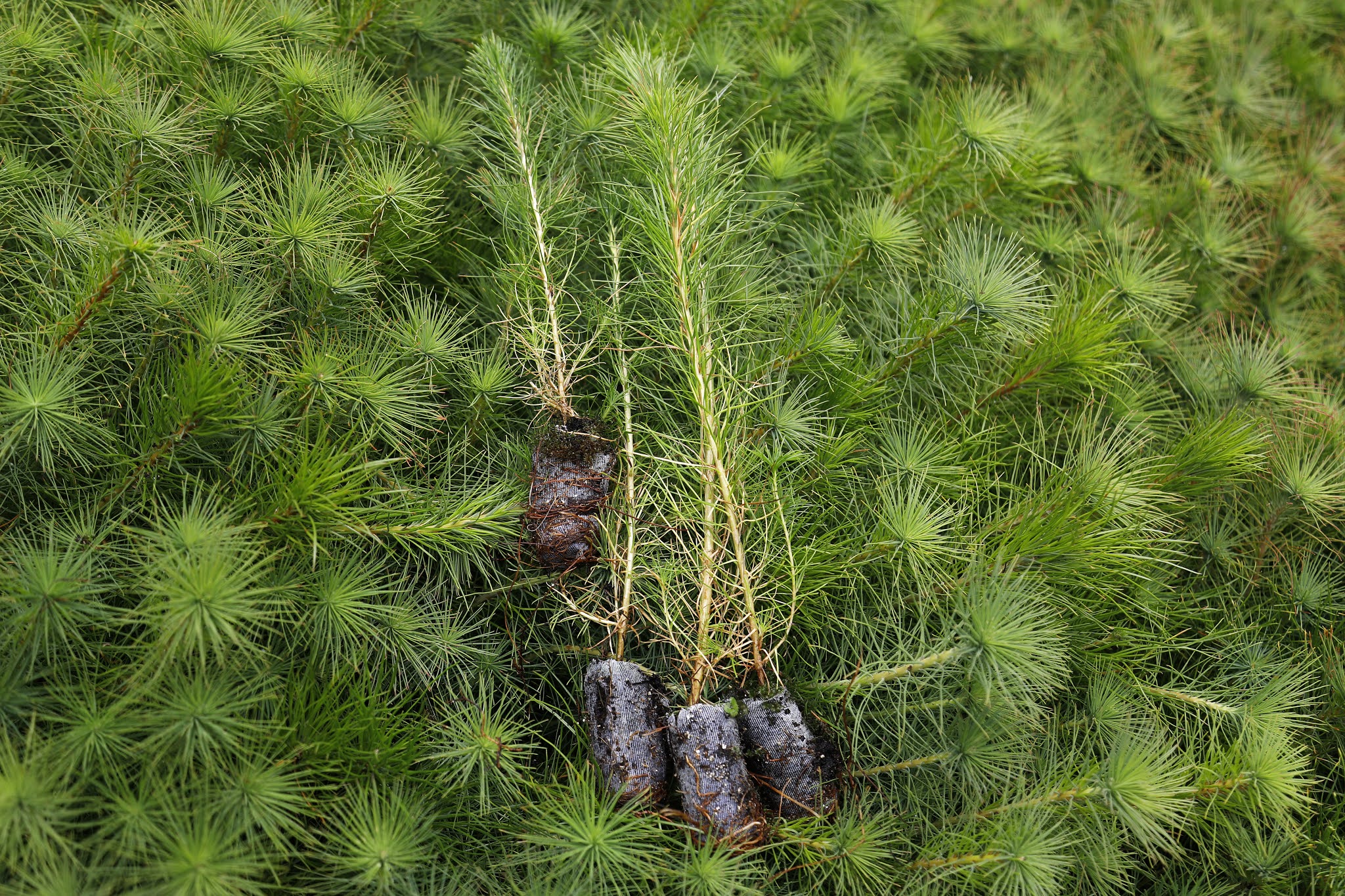
And here is a photo of some of our tamarack seedlings:


Thanks for reading ...

- Jonathan Clark
www.replant-environmental.ca


Replant.ca Environmental is a Canadian company that plants trees for carbon capture and builds community forests.  We also plant trees in national, provincial, and municipal public parks to mitigate damage from wildfires, storms, insects, and forest diseases.  We operate thanks to numerous small contributions from the general public, in addition to larger project sponsorships from businesses and corporations around the world.  If you'd like to learn how to show your support, visit our donations page.  Even if you aren't able to make a contribution, we very much appreciate when people are able to share our posts or our website link on social media, to help spread the word about the work that we're doing!

Teachers are welcome to use content from this post for their classes.  If you know a teacher who might like to use this information, please share it with them!  The more that people learn about trees, the better our world will be.

To learn more about the various species that we plant, visit the conifers page or the deciduous (hardwoods) page on our website.  Thanks so much for your interest!


Incidentally, our organization is often seeking additional land for our carbon capture projects.  Please visit this link if you might know of a recently-harvested property that we could rebuild into a permanent legacy forest.


The Norway Pine tree (Pinus resinosa)

I'd like to share some information about the Norway Pine tree.  The Latin name for this tree is Pinus resinosa, and it is also very commonly known throughout northeastern North America as the Red pine.  Red pine is probably a better name for common use.  The inner bark of the red pine is very reddish in colour, so it's an appropriate name.  In the field, I usually refer to this tree as the red pine rather than Norway pine.  Most people do.

Speaking of the bark of the tree, here's a photo.  It's quite scaly.  The bark often has more of a grey appearance in weathered trees, but if you peel away the surface bark you'll quickly see the reddish tint underneath.  The reddish bark is also easier to discern in juvenile trees.  Here's a photo showing the bark and trunk of a red pine up close:


The Norway pine is a very majestic tree at maturity.  It can often grow to be more than 30 meters (100 feet) in height and more than a meter in diameter.  Even more impressive, this is a fairly long-lived species, sometimes living for up to five hundred years.

Norway pine has a range which is limited to northeastern North America.  It is commonly found in southern Ontario, Quebec, and through the Maritime provinces.  It is also found in pockets in Newfoundland, and as far west within Canada as southern Manitoba.  It is also common around the Great Lakes and in northeastern parts of the US.  Here's a range map, courtesy of Wikipedia:


Let's go back to the proper name of this tree.  Nobody really seems to be sure why the pine was named after Norway.  It doesn't seem to have any relation to that country.  There's a small town in Maine called Norway, and that town has a lot of red pine around it.  But Norway (Maine) didn't get its name until it was incorporated in 1797, and the original intention was to call it Norage, which was a Native American name for waterfalls.  There doesn't seem to be any information online to hint at when Norway pine started to be called as such, but if it pre-dates the founding of the town of Norway, then it certainly can't be named after the town.  Incidentally, Norway (Maine) was once very famous as the alleged "snowshoe capital of the world."  Red pine was used in the manufacture of snowshoes.  That still doesn't explain the name properly.  I like to pretend that there was once a famous giant lumberjack from Norway with a bushy red beard, and the tree was named after this lumberjack.  But that's unlikely.  It would be a good story though, if it was true.

The Norway pine is a conifer.  Conifers are cone-bearing trees.  The cones of the Norway pine are ovoid in shape, which means that they're egg-shaped.  They're also fairly close in size to regular [chicken] eggs that you'd find at a grocery store, ie. about 5-6cm long when they're still closed.

The needles of the Norway pine are a dark yellow-green, and always come in pairs.  Needles on pine trees always come in pairs, triplets, or groups of five, but the number depends upon the species.  These needles can be fairly long, usually about 15cm or so, and like many other long-needled pines, the needles can be fairly brittle.  Here's a close-up photo of the needles and some opened cones on a Norway pine:


This species is not shade-tolerant.  It wants open ground and a lot of sunlight to grow successfully.  Despite wanting sunshine, it also likes cool summers and cold winters, which is why it thrives in Canada but not in the southern States.  If climate change causes temperatures to rise in the future, we may see that Norway pine becomes almost entirely a Canadian tree.  Like most other pines, this species prefers well-drained sandy or loamy soils, rather than clay.

Unfortunately, the Norway pine is susceptible to a fairly large range of insect pests, including pine beetles, pine gall weevil, pine needle miner, tussock moth, and sawflies.  However, these problems are much worse in warm climates, and don't have as significant an impact on the population in Canada.

Here are three fun facts about the Norway pine:
1.  This species was planted in large quantities during very early tree planting programs in the United States.  During the Great Depression, the Civilian Conservation Corp planted millions of these trees.
2.  The Norway pine is the State Tree of Minnesota.  In fact, Minnesota is probably the only area where people usually refer to this species as Norway pine instead of red pine.
3.  This species was historically a favoured tree for the construction of log cabins, due to its very straight and clean trunks.

At Replant.ca Environmental, Norway pine is just one of a large number of species that we use on some of our projects!


Thanks for reading ...

- Jonathan Clark
www.replant-environmental.ca


Replant.ca Environmental is a Canadian company that plants trees for carbon capture and builds community forests.  We also plant trees in national, provincial, and municipal public parks to mitigate damage from wildfires, storms, insects, and forest diseases.  We operate thanks to numerous small contributions from the general public, in addition to larger project sponsorships from businesses and corporations around the world.  If you'd like to learn how to show your support, visit our donations page.  Even if you aren't able to make a contribution, we very much appreciate when people are able to share our posts or our website link on social media, to help spread the word about the work that we're doing!

Teachers are welcome to use content from this post for their classes.  If you know a teacher who might like to use this information, please share it with them!  The more that people learn about trees, the better our world will be.

To learn more about the various species that we plant, visit the conifers page or the deciduous (hardwoods) page on our website.  Thanks so much for your interest!


Incidentally, our organization is often seeking additional land for our carbon capture projects.  Please visit this link if you might know of a recently-harvested property that we could rebuild into a permanent legacy forest.

Monday, February 24, 2020

The Black Spruce tree (Picea mariana)

Today's post is about a species which rarely gets any love.  It's the swamp-loving black spruce (Latin name Picea mariana).  Here's a typical photo, which I took from a helicopter in northern Alberta (the majority of these trees are black spruce):


Oddly enough, the black spruce doesn't have any other common names (except in French), regardless of where you find it across Canada.  And you WILL find black spruce all across Canada.  Its geographic range is much more diverse than even the Jack pine.  Black spruce can be found in all ten provinces and all three Arctic territories.  Here's a range map, courtesy of Wikipedia:


It's quite easy to find specimens of black spruce.  Just look for a swamp.  Black spruce thrives in wet areas, even when the water is quite stagnant.  Remember that all spruce trees love water, but most varieties prefer flowing, oxygenated water.

Black spruce has roots that are especially shallow and wide-spreading.  This allows it to thrive in areas which are too wet for competing species.  Trees, like many other creatures, can drown.  Shallow roots help ensure that the black spruce does well in swamps.  Trees need water, but they also need oxygen.  Flood their root systems, and they will eventually die.  Some trees can only tolerate root submersion for as little a week or so before they start to die.  The black spruce can survive for more than a month.  Regardless, their shallow roots make it less likely that they won't have any access to oxygen for extended periods.  Unfortunately, it also makes this species susceptible to blowdown in windstorms.

If you take a close look at black spruce trees near bogs and swamps, you'll see that the closer you get to water, the less vigorous the growth.


Spruce trees rarely grow to be large trees.  It is quite common for mature black spruce trees to be no more than 15m in height, although they can occasionally grow to 25m in really good conditions.  However, you're more likely to see them in the 10m to 15m range.  The trunk rarely grows to more than 50cm in diameter (a foot and a half) for a large tree.  On a positive note, black spruce usually have very straight trunks, without a significant taper until the very top of the tree.

The top of the black spruce is interesting.  The crown is narrow and pointed, and the small branches all droop, yet the tips are turned upward.  Unlike the tips, the cones hang downward.  Here's an excellent photo from Wikimedia Commons:


One of the more interesting things that many people learn about the black spruce is their long-term fire ecology behaviour.  Black spruce trees often live in peat bogs, as well as swamps.  Despite the moist ground, black spruce stands are especially susceptible to wildfires.  If you're puzzled about this, it's important to know that monocultures (especially conifers) are often especially susceptible to wildfires, while mixed-wood forests with lots of species such as aspen will be less susceptible.  Since black spruce is so much more tolerant of swampy/boggy conditions than most other trees (except for larch/tamarack), it tends to grow frequently in pure stands.  These pure stands are susceptible to fire, despite the wet ground.

Black spruce stands tend to burn frequently, but they also regenerate quickly immediately after a fire (just like lodgepole pine).  Therefore, a lot of black spruce stands tend to be very even-aged.  Over time (centuries), swampy areas with black spruce will often slowly become filled in by organics, and the surface of the ground will become elevated and drier.  As this happens, there will be ingress from moderately moisture-tolerant species such as tamarack, white cedar, white spruce, balsam fir, and eventually balsam poplar and trembling aspen.  Don't judge black spruce as an ugly swamp tree with no significant value.  In the long term, it's an important precursor to more diverse mature mixed-wood forests.


I'll leave you with three random facts about the black spruce:
- This is the provincial tree of Newfoundland and Labrador.
- Like red spruce, it is good for making spruce beer.
- Disposable chopsticks are often made of black spruce (or trembling aspen).

That's all for now.  I hope you enjoyed reading this, and it made you appreciate this species a bit more.  We don't plant very much black spruce at Replant.ca Environmental, simply because it's not great for long-term carbon capture, but it does occupy a small percentage of our annual seedling mixes due to its suitability (along with cedar and tamarack) in swampy ground.  Here's a photo of some of our black spruce seedlings:


Thanks for reading ...

- Jonathan Clark
www.replant-environmental.ca


Replant.ca Environmental is a Canadian company that plants trees for carbon capture and builds community forests.  We also plant trees in national, provincial, and municipal public parks to mitigate damage from wildfires, storms, insects, and forest diseases.  We operate thanks to numerous small contributions from the general public, in addition to larger project sponsorships from businesses and corporations around the world.  If you'd like to learn how to show your support, visit our donations page.  Even if you aren't able to make a contribution, we very much appreciate when people are able to share our posts or our website link on social media, to help spread the word about the work that we're doing!

Teachers are welcome to use content from this post for their classes.  If you know a teacher who might like to use this information, please share it with them!  The more that people learn about trees, the better our world will be.

To learn more about the various species that we plant, visit the conifers page or the deciduous (hardwoods) page on our website.  Thanks so much for your interest!


Incidentally, our organization is often seeking additional land for our carbon capture projects.  Please visit this link if you might know of a recently-harvested property that we could rebuild into a permanent legacy forest.


Saturday, January 11, 2020

The Red Spruce tree (Picea rubens)

For this week's look at various trees that we plant at Replant.ca Environmental, I'm going to focus on the red spruce.  As is common with many different tree species, this one is known by many names.  The other names that I'm most accustomed to hearing are eastern spruce, Maritime spruce, and yellow spruce.  The Latin name is Picea rubens.

Red spruce is an extremely common and valuable tree in eastern Canadian forestry.  Due to its versatility and economic value, it is the most commonly planted tree in the Maritime provinces.  Although it isn't the fastest-growing conifer, it is considered to be a late succession tree.  This means that it "catches up and wins," like the tortoise in the fable of "the tortoise and the hare."  The red spruce can often live to be 250-400 years old.


When the red spruce is young, it prefers to grow in moist soils.  It helps if the groundwater moisture is aerated.  Well-drained soils, or soils that are moistened by flowing water, are ideal.  However, red spruce is quite versatile, and will still thrive in many other types of ground conditions.  Red spruce is quite biologically similar to black spruce (a species which does really well in swampy areas with more stagnant water).  Red spruce is also extremely shade-tolerant when it is young.  This is important, because spruce trees generally grow more slowly than other conifers (such as pine) for the first decade or two.  Due to this slower start, spruce usually fail to get above competing grass and vegetation for several years.  However, they don't usually get choked out by plant competition due to their shade tolerance.

When a red spruce matures, it can be twenty to twenty-five meters in height (seventy to eighty feet).  A mature tree will often achieve a DBH (diameter at breast height) of 50cm to 60cm (up to two feet).  Red spruce often grows straighter than conifers such as red pine and white pine.  Although the red spruce doesn't grow as large as an eastern white pine, it's a beautiful and long-lived species in its own right.  Perhaps this is why the red spruce is the provincial tree of Nova Scotia.

Red spruce is mostly an eastern Canadian and northeast US seaboard species.  Here's a range map, courtesy of Wikipedia:


Spruce needles and balsam fir needles often look very similar to someone who doesn't spend a lot of time in the woods.  However, there's a neat trick that you can do to distinguish between them.  Spruce needles are four-sided.  When you put a needle between two fingers and try to "roll" it, it rolls easily.  Balsam fir needles are three-sided but their shape is like a very flattened triangle.  Due to this shape, balsam fir needles don't roll easily between your fingers.  This trick can still be a bit confusing.  If you use a lot of pressure, it's still possible to "roll" the needles of a balsam fir.  And if the spruce needles are sticky or if your fingers are rough, they don't necessarily roll perfectly.  However, if you are out in the woods and see two trees that look slightly different, and you think one is a spruce and one is a fir, try the needle-roll test.  Also, try grabbing a branch and squeezing.  Be careful though!  Spruce needles are much more pointy at the ends, so they'll feel a lot more prickly than fir needles.

If you're looking at the trunk of a juvenile tree, the appearance of spruce and fir are quite different.  Spruce trees will look scaly, and usually have a yellowish-brown or reddish-brown colour.  They will also have more needles on the trunk.  Conversely, a juvenile balsam fir tree will usually have grey bark, and it's usually quite smooth with almost no needles, except maybe some spare needles on the top foot or so of the tree.  The bark of each of these trees becomes much more rough as the trees passes the juvenile stage.  Both types of trees will develop vertical furrows on the bark, although the furrows will be more pronounced on spruce trees.

Take a close look at the underside of this red spruce branch.  What obvious colour patterns do you see?


When you look at a red spruce branch on a young tree, the new growth has a yellowish tinge, and the older growth has a brownish tinge.

Here are four interesting facts about the red spruce:

1.  This tree is monoecious.  This means that individual flowers (cones) are either male or female, but both sexes can be found on the same tree.  The cones are cross-pollinated by wind.

2.  Red spruce trees do not do well in areas with high atmospheric pollution, or "acid rain" (rain contaminated by industrial smoke and chemicals).  This is one more reason to keep our earth clean.  There's a slogan that says, "The solution to pollution is dilution."  I think a better solution is to avoid polluting in the first place.

3.  Red spruce is the most sought-after wood for making most musical instruments.

4.  Spruce twigs can be boiled with sugar, and the resulting liquid can be used to make spruce beer.  I think a lot of people would prefer spruce beer to hemlock tea.


As I mentioned, the red spruce is the most economically valuable species in the Maritime provinces, and is planted very frequently in post-logging operations.  Unfortunately, in that type of work, the logging companies generally plant it as a monoculture.  At Replant.ca Environmental, we endorse biodiversity.  Red spruce is definitely an important species within our planting mixes, but we never plant it by itself.  Here's a photo of some of our red spruce seedlings:


Thanks for reading ...

- Jonathan Clark
www.replant-environmental.ca


Replant.ca Environmental is a Canadian company that plants trees for carbon capture and builds community forests.  We also plant trees in national, provincial, and municipal public parks to mitigate damage from wildfires, storms, insects, and forest diseases.  We operate thanks to numerous small contributions from the general public, in addition to larger project sponsorships from businesses and corporations around the world.  If you'd like to learn how to show your support, visit our donations page.  Even if you aren't able to make a contribution, we very much appreciate when people are able to share our posts or our website link on social media, to help spread the word about the work that we're doing!

Teachers are welcome to use content from this post for their classes.  If you know a teacher who might like to use this information, please share it with them!  The more that people learn about trees, the better our world will be.

To learn more about the various species that we plant, visit the conifers page or the deciduous (hardwoods) page on our website.  Thanks so much for your interest!


Incidentally, our organization is often seeking additional land for our carbon capture projects.  Please visit this link if you might know of a recently-harvested property that we could rebuild into a permanent legacy forest.


Sunday, December 1, 2019

The Eastern White Cedar tree (Thuja occidentalis)

The Eastern white cedar is known by many names, but the most common alternatives are the northern white cedar, the swamp cedar, or the eastern arborvitae.  The Latin name for this tree is Thuja occidentalis.

You won't often hear rural dwellers referring to this tree as the arborvitae.  That term arborvitae is somewhat confusing.  Many horticulturalists use it.  However, arborvitae really refers to the entire Thuja s. genus, which includes five different species.  The only other arborvitae is the western red cedar, which we plant very frequently in BC's western coastal areas.  Incidentally, the word arborvitae comes from two separate words:  Arbor, meaning "tree," and vitae, meaning "life."  The implication is "tree of life."

When you look at the taxonomic classification of the Thuja genus, they belong to a family known as Cupressaceae, or more commonly known in English as cypress.  That's right, the north American cedars are not even true cedars!  Sigh.  Why is tree classification so confusing?  True cedars are only found natively in the Mediterranean and in the Himalayas.  Let's get back to our "fake" cedar, the eastern white cedar.

Perhaps the most unique thing about cedar trees is the appearance of the needles.  Cedar branches look very different than most other conifers, due to the flattened shape of the needles:


You can see that the needles almost look like scales.

When an eastern white cedar tree develops cones, they are quite small - only about one centimeter long.  Each cone contains approximately eight seeds, however, the cones grow in very dense clusters.  They start off as a yellowish colour, but then eventually turn to a fairly dark shade of brown.  Here's a photo showing some immature cones that are still developing:


This species is not a large one.  These trees rarely grow to be more than 15-25 meters in height (about 50-80 feet).  However, even though they're usually not nearly as tall as many of the other mature conifer species in eastern Canada, their trunks can still grow fairly thick, sometimes reaching almost a meter in diameter (3 feet) at maturity.  These measurements are typical for trees growing in the United States.  When they're found in Canada, they're usually slightly smaller.

Cedar trees taste great, at least to deer.  And that's a big problem.  Deer are especially attracted to these trees.  Exploding deer populations are causing all kinds of problems in many parts of Canada.  In the town that I grew up in, in central Nova Scotia, the deer can be found everywhere throughout town, and ravage people's gardens and shrubbery.  Cedar trees are one of the favorite species for deer to eat, and this is having a negative impact on cedar populations all over eastern North America.

On the west coast, when we plant cedar, we sometimes also install "browse protection devices" over the trees.  A browse protector usually looks like a tall thin plastic cone, about three feet tall.  We place a four-foot cedar stake beside a freshly planted cedar tree, and pound this stake into the ground with a mallet so it is firmly anchored, then place the cone over both the cedar seedling and the stake.  The cone is then tied to the stake so it will remain in place for several years.  The cones are translucent, which allows enough sunlight to reach the tree for photosynthesis.  The tree grows up inside the cone for approximately 3-5 years, then the crew goes back into the plantation to remove the cones, so they can be re-used on another project.  This system seems to work fairly well for letting the cedar seedlings become established until the trees are large enough that the deer start to ignore them (the deer prefer very young seedlings that are closer to the ground).  Here's a photo of a browse cone, protecting a freshly planted young cedar:


Cedar trees can live for a very, very long time.  Here's an interesting story:  There is an old eastern white cedar located on the shore of Lake Superior in Minnesota.  The Ojibwa refer to this tree as the Little Cedar Spirit Tree.  The first known written reference to this specific tree happened way back in 1731, by a French explorer named Sieur de la Verendrye.  The Ojibwa often leave tobacco around the tree as an offering to help protect them on voyages on Lake Superior.  Despite this tree being quite famous, that doesn't mean that it's one of the oldest.  It could be, but some eastern white cedars can live to be more than a thousand years old!  Why would anyone ever want to cut one of these trees down?

Although this species prefers very moist climates, it has managed to carve out a fairly large footprint in eastern Canada by taking advantage of conditions where other larger and faster-growing trees have problems thriving.  These cedar trees can survive on rocky cliffs, and in very moist swampy areas.  In that sense, this cedar is a good species to mix with black spruce when the ground conditions are appropriately moist.  Although eastern white cedar isn't found commonly throughout Nova Scotia or in the eastern half of Prince Edward Island, it has a wide range throughout the rest of eastern and central Canada and the northeastern United States.  Here's a range map, courtesy of Wikipedia:


I want to leave you with a few interesting facts about this species:

1.  When a branch falls from an eastern white cedar, it can sometimes lay out new roots into the ground and grow into a new tree, if the conditions are just right!

2.  The inner bark of this tree is tough enough to make into string or rope.

3.  Some people plant this species in their back yards specifically to attract wildlife.  Besides deer, rabbits and many types of birds are also attracted to this tree.


For the 2020 planting season, we included several thousand eastern white cedars in our species mixes at Replant.ca Environmental.  We planted these trees in areas with more moisture or shade, including understory areas, near streams, and in swampy areas.  Even though they are one of the less voluminous conifers in our mixes, and there is a higher risk of some mortality due to deer browsing, we feel that these are a very beneficial species to add to our mixes.  Here's a photo of some of our eastern white cedar seedlings:


Thanks for reading ...

- Jonathan Clark
www.replant-environmental.ca


Replant.ca Environmental is a Canadian company that plants trees for carbon capture and builds community forests.  We also plant trees in national, provincial, and municipal public parks to mitigate damage from wildfires, storms, insects, and forest diseases.  We operate thanks to numerous small contributions from the general public, in addition to larger project sponsorships from businesses and corporations around the world.  If you'd like to learn how to show your support, visit our donations page.  Even if you aren't able to make a contribution, we very much appreciate when people are able to share our posts or our website link on social media, to help spread the word about the work that we're doing!

Teachers are welcome to use content from this post for their classes.  If you know a teacher who might like to use this information, please share it with them!  The more that people learn about trees, the better our world will be.

To learn more about the various species that we plant, visit the conifers page or the deciduous (hardwoods) page on our website.  Thanks so much for your interest!


Incidentally, our organization is often seeking additional land for our carbon capture projects.  Please visit this link if you might know of a recently-harvested property that we could rebuild into a permanent legacy forest.

Wednesday, November 27, 2019

The Jack Pine tree (Pinus banksiana)

Let's take a look at another pine tree that we plant, the Jack Pine.  This tree is also referred to as the scrub pine, the grey pine, the Hudson Bay pine, or the Banksian pine.  The latter name is due to its Latin name, Pinus banksiana.  The term "scrub pine" seems somewhat dismissive.  Where is the love?

To be fair, the Jack pine is not the most impressive species out there.  We mix some Jack pine into our species mixes sometimes, but that's more for diversity than because it's a major contributor to carbon capture.  We also plant two other types of pine (Norway and Eastern White) in larger quantities.  Still, diversity is important.  What happens if global warming raises average temperatures by several degrees over the next few decades?  This could have a seriously negative effect upon many of the species currently growing in Canada, and we think that Jack pine is the conifer that is least likely to be affected if temperatures do get that high (eastern white pine being the second least vulnerable).

Here's a photo of some Jack pine trees, courtesy of Wikipedia.  I'll try to replace this photo with one of my own at some point:


The range of the Jack pine is quite broad.  There are a lot of different species of pine trees in the world (about 120, depending on whom you ask).  In western Canada, you can find about twenty different pine species, four of which I've planted while working in commercial operations.  In eastern Canada, you can find about thirteen species, three of which we plant at Replant.ca Environmental.  As far as I'm aware, Jack pine has the largest geographic distribution range within Canada (of the pines).  Here's a graphic from Wikipedia to illustrate that:


Despite its broad range and hardiness, the reason that Jack pine is often omitted from "favorite tree" lists is because it doesn't grow as large as some other types (such as Eastern white pine), and the trunk doesn't often grow as straight or majestically.  Due to this, many foresters and carpenters don't get as excited by Jack pine as they do by other types of pine, although to be honest, this probably has saved more than a few individual trees from the axe.  Under good growing conditions, Jack pine usually only reaches a height of 15-20 meters at maturity (50-65 feet), and the trunk doesn't often exceed a diameter of about 50 centimeters (one and a half feet).  As mentioned, the trunks can often be twisted or knotty, so when it is used commercially, it is often more likely to be used for pulpwood than for lumber.

Jack pines can be affected by quite a few diseases.  There are weevils and sawflies and budworms that attack the trees.  Jack pine can also be affected by a disease called sweet fern blister rust.  When this happens, Jack pine is an inadvertent victim.  Normally, sweet fern blister rust affects sweet ferns, but the spores can drift onto Jack pine and attack the trees too.

Jack pine is somewhat similar to lodgepole pine, which we plant very frequently on commercial projects all over the west coast.  Like lodgepole pine, the cones of Jack pine tend to open during periods of extreme heat (including wildfires).  Remember that occasional mild wildfires can be beneficial to the overall forest ecosystem.  However, Jack pine don't regrow in densities as thick as lodgepole does after a fire.  Also, on a mature tree, the Jack pine cones look quite different because they usually point forward along the branches.

When trying to identify a pine tree, it's always important to see how many needles come in each cluster.  Each pine species is quite distinct, usually having either two, three, or five needles per cluster.  Jack pine is a two-needle pine.

When I talked about eastern white pine, I mentioned one of Tom Thomson's famous paintings, "Byng Inlet, Georgian Bay."  The Jack pine is featured in an even more well-known painting by Tom Thomson, entitled "The Jack Pine."  That painting is currently held by the National Galley of Canada.  Here's an image of that very recognizable painting, courtesy of the NGC:


Although the Jack pine will probably never feature heavily in our mixes, we have to give it credit for being sturdy and hardy, which is why this species is the most common tree found throughout Canada!  I'll leave you with a photo of some of our Jack pine seedlings:


Thanks for reading ...

- Jonathan Clark
www.replant-environmental.ca


Replant.ca Environmental is a Canadian company that plants trees for carbon capture and builds community forests.  We also plant trees in national, provincial, and municipal public parks to mitigate damage from wildfires, storms, insects, and forest diseases.  We operate thanks to numerous small contributions from the general public, in addition to larger project sponsorships from businesses and corporations around the world.  If you'd like to learn how to show your support, visit our donations page.  Even if you aren't able to make a contribution, we very much appreciate when people are able to share our posts or our website link on social media, to help spread the word about the work that we're doing!

Teachers are welcome to use content from this post for their classes.  If you know a teacher who might like to use this information, please share it with them!  The more that people learn about trees, the better our world will be.

To learn more about the various species that we plant, visit the conifers page or the deciduous (hardwoods) page on our website.  Thanks so much for your interest!


Incidentally, our organization is often seeking additional land for our carbon capture projects.  Please visit this link if you might know of a recently-harvested property that we could rebuild into a permanent legacy forest.